
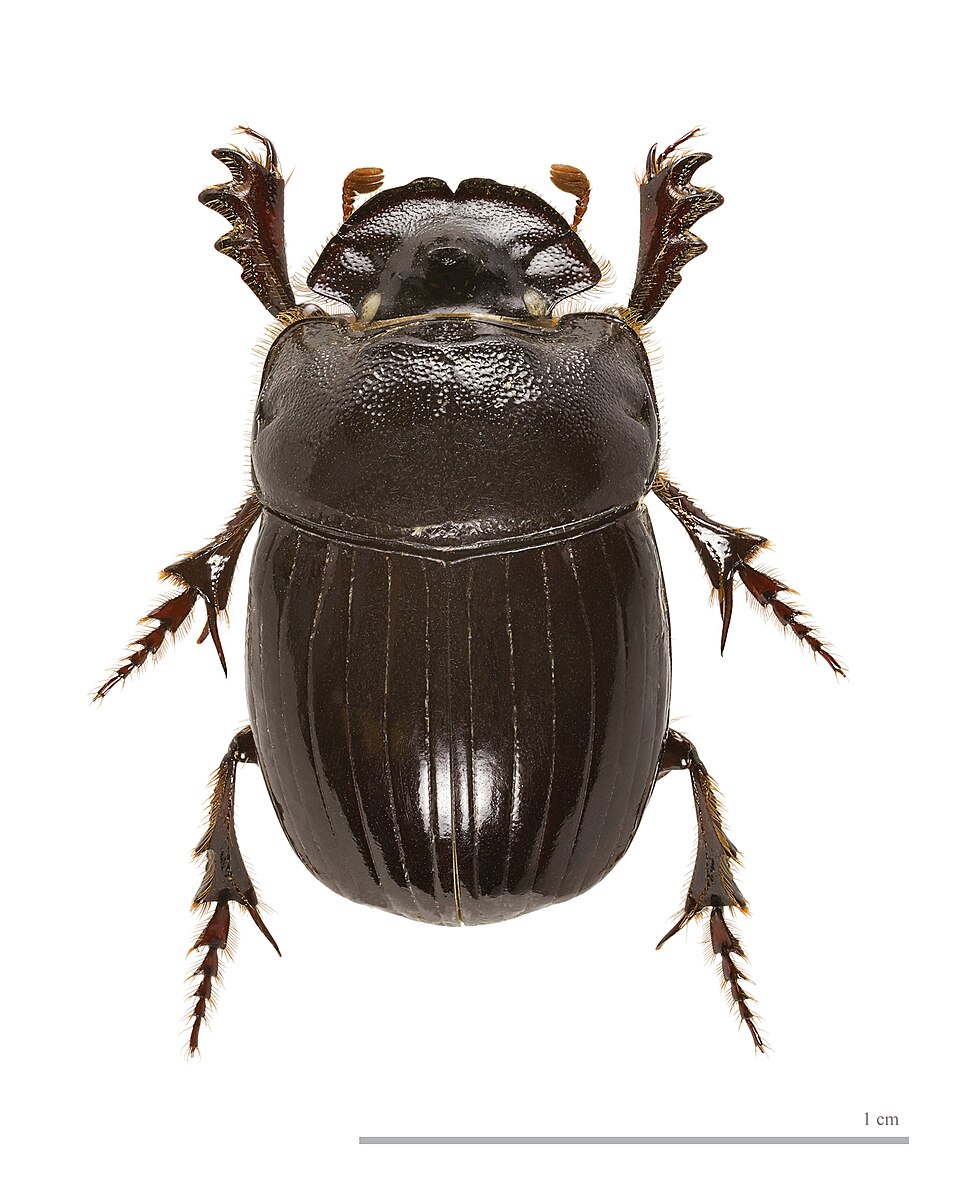
Presentation
The dung beetle is a coleopteran insect belonging to the subfamily Scarabaeinae, renowned for its distinctive behavior of collecting and rolling herbivore dung. Its sturdy body, often black or dark brown and sometimes tinged with metallic sheen, typically measures between 1 and 3 centimeters depending on the species. It plays a major ecological role by participating in organic matter recycling and soil aeration. Present on all continents except Antarctica, it inhabits primarily areas where livestock is abundant. In Tunisia, several dung beetle species, including the sacred scarab, are observed in rural and desert regions. This insect has captivated people since ancient Egypt, where it was revered as a solar symbol.
The dung beetle has a robust, convex body protected by hard elytra that cover its membranous wings. Its front legs are adapted for digging and manipulating dung pellets. The head often bears a horn or protuberance in males of certain species, used during territorial contests. Coloration ranges from matte black to metallic green or blue depending on the species.
Characteristics
Indicative values: they vary by subspecies, sex and region.
Habitat and distribution
The dung beetle is found in meadows, steppes, savannas and desert regions where livestock or wild herbivores are present. It also adapts to agricultural land and pastures. Its presence is closely linked to the availability of animal droppings.
CURRENT RANGE
The dung beetle is present on all continents except Antarctica, with a great diversity of species in Africa. In Tunisia, it is widespread in the rural, steppe and desert regions of the country.
Behaviour
The dung beetle is chiefly known for its behavior of shaping and rolling dung balls, sometimes moving them several meters before burying them. Some species burrow directly beneath the dung while others transport it to conceal it from competitors. Activity is generally diurnal or crepuscular depending on the species. The sacred scarab notably orients itself using the polarized light of the sun and moon to maintain a straight trajectory.
Reproduction
The female lays her eggs in buried balls of dung, which serve as both food source and shelter for the larva. Development passes through several larval stages before pupation, which takes place inside the ball. The adult emerges after several weeks to a few months depending on climatic conditions and the species.
Peculiarities
The sacred scarab was venerated by the ancient Egyptians, who associated the rolling of its dung ball with the sun's movement across the sky. Some dung beetle species are able to orient themselves using the Milky Way on moonless nights. The dung beetle provides an important ecological service by limiting the proliferation of parasites and promoting natural soil fertilization.
Threats and conservation
The intensive use of anthelmintics and pesticides in livestock farming reduces the availability and quality of droppings, affecting dung beetle populations. Degradation of natural pastures and agricultural intensification also pose threats to this insect. It generally does not benefit from specific protection status despite its ecological role.
Numbers and trends vary across sources and regions. See the IUCN assessment for the latest reference data.
Gallery
1 documented photographs.
References
Profile updated 26 August 2026 · Reviewed by the TunisieVet editorial team.
Comments (0)
No comments yet.
CONSERVATION STATUS
Least concern (LC)
IUCN source, latest published assessment.
Species health
Documented diseases for this species.
Find a veterinarianThis information is provided for educational purposes only and is not a substitute for a veterinary consultation. If you have any concerns about your animal's health, consult a veterinarian.
To discover around: Dung Beetle
Videos, facts, stories and records linked to this species.
RECORD
up to around 1,000 times its own body weight
One of the strongest animals relative to its size
Measurement taken in certain species of dung beetles capable of pulling loads during labor...
Similar animals
Other species documented in Animalpedia.
