Presentation
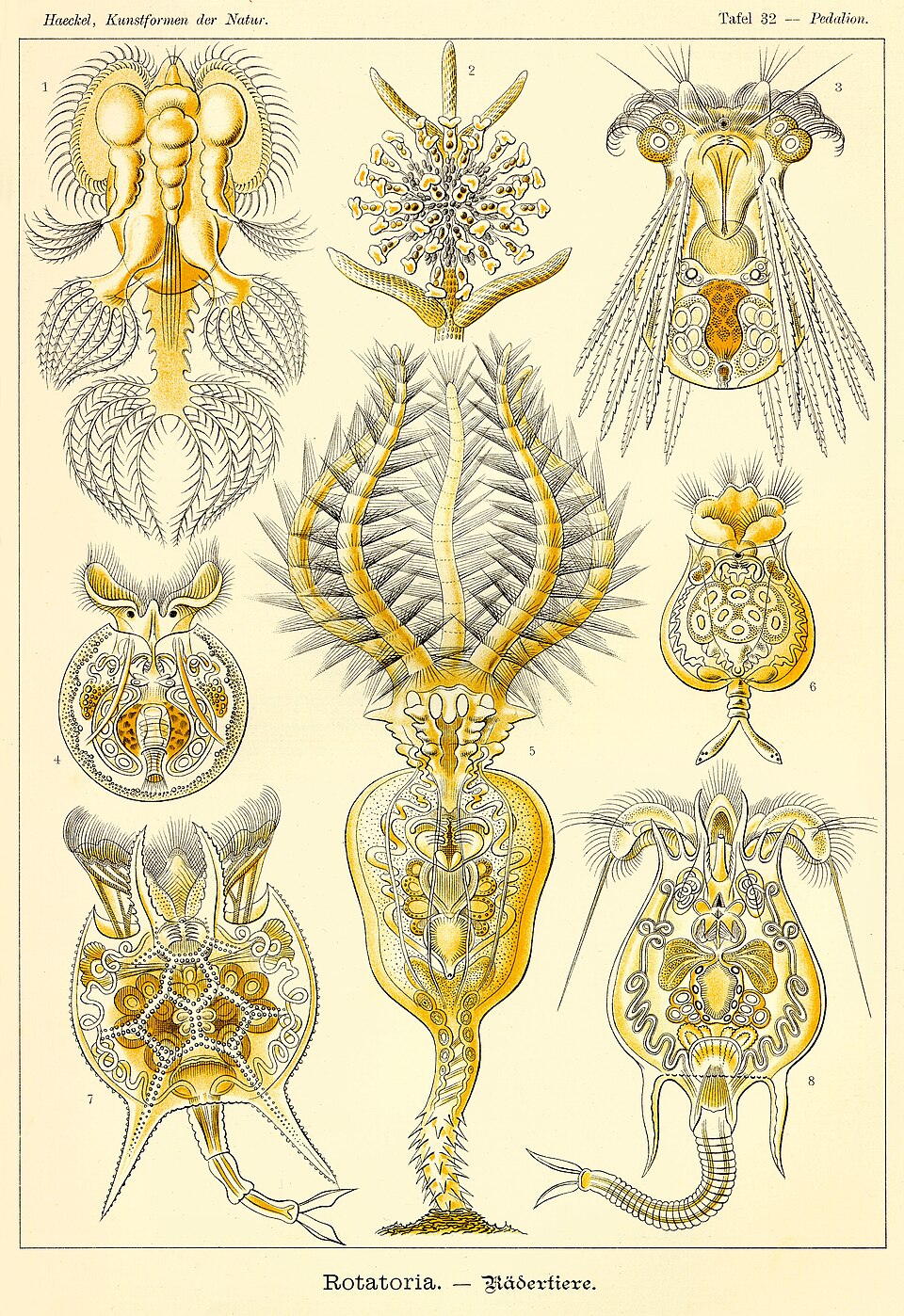
Rotifers form a phylum of microscopic aquatic microorganisms, typically measuring between 0.1 and 0.5 mm. Their name comes from the crown of beating cilia, called the corona, located at the front end of the body, whose movement resembles a rotating wheel. They are pseudocoelomate animals with a complete digestive system and an internal chewing apparatus called the mastax. They are found in a wide variety of freshwater environments, as well as in brackish, marine, or even terrestrial humid habitats such as moss. They play an important role in zooplankton and aquatic food chains. Several thousand species have been described worldwide.
The rotifer body is generally transparent, elongated or sac-shaped, and often covered by a more or less rigid cuticle called the lorica. The ciliated corona enables both locomotion and food capture by creating water currents. The mastax, a chewing organ unique to this group, grinds ingested food particles. Some species have a terminal foot equipped with adhesive glands that allow temporary attachment to a substrate.
Characteristics
Indicative values: they vary by subspecies, sex and region.
Habitat and distribution
Rotifers inhabit primarily still or slow-moving freshwaters, such as ponds, pools, lakes, and wetlands, where they live in the water column or are associated with sediments and aquatic vegetation. Some species tolerate brackish or coastal marine waters. Others colonize temporary moist terrestrial habitats, such as moss or waterlogged soil.
CURRENT RANGE
The rotifer phylum shows a cosmopolitan distribution, with representatives on all continents, including Antarctica in freshwater or moist habitats. Their small size and ability to produce resistant eggs facilitate their dispersal by wind, birds, or water. They occur in temperate, tropical, and polar regions alike.
Behaviour
Rotifers move by swimming through coordinated beating of their corona cilia, or by crawling on substrates for certain benthic species. Many alternate between periods of free swimming and temporary attachment to plants or sediment. Some species can enter dormancy as resistant eggs or in a slowed state of life (anhydrobiosis) when their environment dries out, allowing them to survive extreme conditions for long periods.
Reproduction
Rotifers combine reproduction through parthenogenesis, where females produce eggs without fertilization, with occasional sexual phases that generate resistance eggs. This mixed reproductive strategy allows them to rapidly colonize a favorable environment and survive difficult periods thanks to dormant eggs. In some species, males are rare, smaller in size, and appear only under particular environmental conditions. Development is direct, with no marked larval metamorphosis.
Peculiarities
Rotifers rank among the smallest known multicellular animals, with some species visible only under a microscope. Their capacity to survive complete desiccation for years, then rehydrate and resume normal activity, is particularly remarkable. The mastax, a unique internal chewing organ, is a distinctive feature of the group used for species identification.
Threats and conservation
Rotifers have no particular conservation status due to their abundance and wide distribution. Freshwater pollution and eutrophication can nonetheless locally alter rotifer community composition. They are sometimes used as bio-indicators of water quality.
Numbers and trends vary across sources and regions. See the IUCN assessment for the latest reference data.
Gallery
1 documented photographs.
References
Profile updated 15 September 2026 · Reviewed by the TunisieVet editorial team.
Comments (0)
No comments yet.
CONSERVATION STATUS
Data deficient (DD)
IUCN source, latest published assessment.
Species health
Documented diseases for this species.
Find a veterinarianThis information is provided for educational purposes only and is not a substitute for a veterinary consultation. If you have any concerns about your animal's health, consult a veterinarian.
Similar animals
Other species documented in Animalpedia.