
Presentation
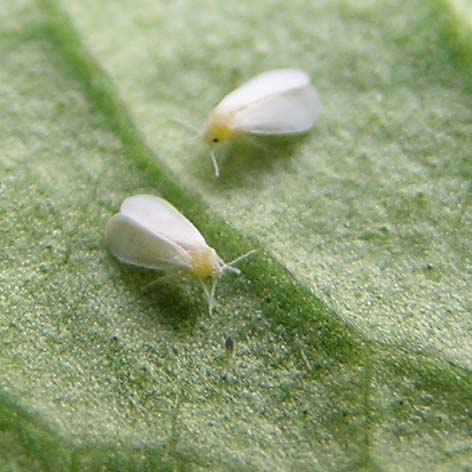
The whitefly is a small sap-sucking insect belonging to the family Aleyrodidae. Despite its common name, it is not a true fly but an insect related to aphids and scale insects. Its body and wings are covered with a fine white waxy powder that gives it its distinctive appearance. It lives in colonies, often very large, on the underside of leaves of many cultivated plants. It is a major agricultural pest, particularly feared in vegetable crops and ornamental plants grown under glass. It is also a vector of several plant viruses.
The adult measures between 1 and 3 mm long, with a pale yellowish body masked by a white waxy secretion. The four wings, also white and powdery, are folded in a roof-like shape at rest. The larvae, flattened and immobile after the first stage, resemble small translucent scales attached to the underside of leaves.
Characteristics
Indicative values: they vary by subspecies, sex and region.
Habitat and distribution
The whitefly colonizes vegetable crops, greenhouses, and gardens, where it finds an abundance of tender host plants. It occurs in both open agricultural settings and protected environments under cover. Warm and temperate climate zones promote its permanent establishment.
CURRENT RANGE
The Aleyrodidae form a cosmopolitan family present on all inhabited continents, with particularly high diversity in tropical and subtropical climates. Certain species such as Bemisia tabaci have spread widely through the trade in ornamental and vegetable plants. They are now established in nearly all agricultural regions of the world.
Behaviour
Adults fly up in a characteristic cloud when an infested plant is shaken, hence their nickname whitefly. They cluster in dense colonies on new shoots and the underside of leaves. The species has a rapid development cycle, favored by warm temperatures, allowing several generations per year.
Reproduction
Females lay eggs, often arranged in a circle, directly on the underside of leaves. Development passes through several immobile larval stages before the winged adult emerges. The complete cycle can be completed in two to four weeks depending on temperature, allowing populations to multiply very rapidly.
Peculiarities
The body and wings of the whitefly are covered in white wax secreted by specialized glands, giving it its distinctive powdery appearance. Some species, like Bemisia tabaci, are capable of transmitting more than a hundred different plant viruses. Its small size and ability to develop insecticide resistance complicate its management in agriculture.
Threats and conservation
The whitefly is not a threatened species; on the contrary, it is classified among globally significant agricultural pests. Farmers actively seek to limit its populations through integrated, biological, or chemical control methods. No conservation status therefore applies to this species.
Numbers and trends vary across sources and regions. See the IUCN assessment for the latest reference data.
Gallery
1 documented photographs.
References
Profile updated 26 August 2026 · Reviewed by the TunisieVet editorial team.
Comments (0)
No comments yet.
CONSERVATION STATUS
Least concern (LC)
IUCN source, latest published assessment.
Species health
Documented diseases for this species.
Find a veterinarianThis information is provided for educational purposes only and is not a substitute for a veterinary consultation. If you have any concerns about your animal's health, consult a veterinarian.
Similar animals
Other species documented in Animalpedia.
