Presentation
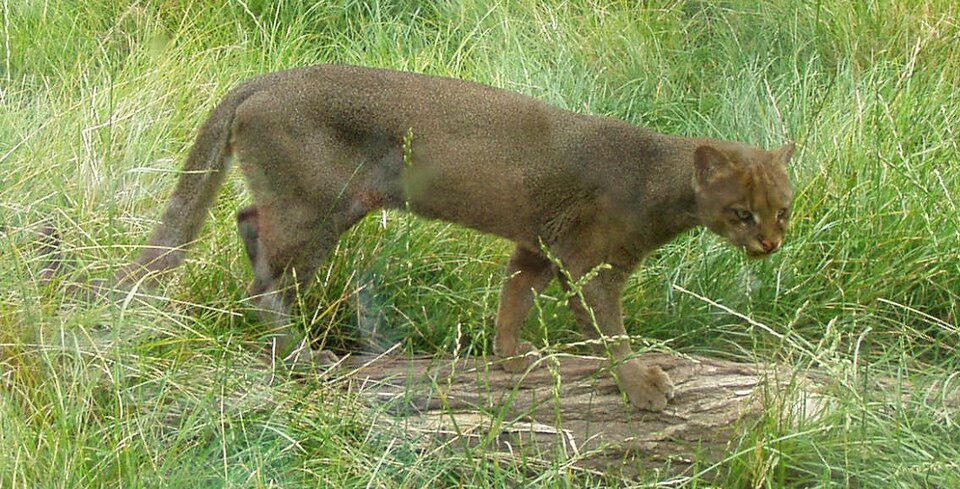
The jaguarondi is a small wild cat native to the Americas, recognizable by its elongated body, short legs, and small flattened head that give it a silhouette resembling an otter or weasel. Its coat is short and uniform, ranging from dark gray to reddish-brown depending on the individual, with no visible spotted pattern in adults. Unlike most felines, it is primarily active during the day, which sometimes makes it easier to observe. It inhabits a wide variety of environments, from dense forests to open scrubby areas. Discreet and solitary, it remains nonetheless less wary than other small wild cats of South America. Its population is stable across much of its range, though declining locally due to habitat loss.
Long muscular body, short legs, thick tail, small rounded head with short ears. Two color morphs exist, one grayish and one reddish, once considered as two distinct species. The coat is short, dense, and unmarked, which clearly distinguishes it from other spotted small felines of the Americas.
Characteristics
Indicative values: they vary by subspecies, sex and region.
Habitat and distribution
The jaguarondi occupies highly varied habitats, ranging from humid tropical forests to semi-arid scrubland and brushy savanna. It tolerates proximity to agricultural areas and habitats disturbed by human activity, provided there is sufficient plant cover. It generally avoids high-altitude zones and completely open environments.
CURRENT RANGE
The species ranges from the southern United States to central Argentina, with extensive distribution throughout Central and South America. It occupies many countries including Mexico, Brazil, Paraguay, and Argentina. Some historical North American populations have declined sharply or disappeared.
Behaviour
Solitary and territorial species, active mainly during the day unlike most wild felines. A good climber and occasional swimmer, it moves nimbly on the ground while searching for prey. Individuals communicate through scent marking and varied vocalizations, notably whistles and chirping sounds.
Reproduction
The female gives birth after a gestation of approximately two to three months, delivering one to four kittens in a shelter concealed under dense vegetation. Young are weaned at two to three months of age and reach sexual maturity at one to two years. Breeding can occur at different times of year depending on the region.
Peculiarities
Its atypical body shape, resembling that of a weasel or otter, clearly distinguishes it from other wild cats of the American continent. It is one of the few small felids regularly active during daylight hours. The two color morphs, gray and reddish, can sometimes occur together within the same litter.
Threats and conservation
Destruction and fragmentation of forest habitat constitute the primary threat, particularly due to agricultural expansion. It occasionally falls victim to road collisions and persecution by livestock farmers concerned about poultry predation. The North American population, notably in Texas, is classified as critically endangered locally.
Numbers and trends vary across sources and regions. See the IUCN assessment for the latest reference data.
Gallery
1 documented photographs.
References
Profile updated 02 September 2026 · Reviewed by the TunisieVet editorial team.
Comments (0)
No comments yet.
CONSERVATION STATUS
Least concern (LC)
IUCN source, latest published assessment.
Species health
Documented diseases for this species.
Find a veterinarianThis information is provided for educational purposes only and is not a substitute for a veterinary consultation. If you have any concerns about your animal's health, consult a veterinarian.
Related species
Similar animals
Other species documented in Animalpedia.

Be among the first to use our app. Sign up and get early Google Play access.
Discover