
Presentation
The Eurasian Hoopoe (Upupa epops) is a medium-sized bird easily recognised by its distinctive crest and orange plumage striped with black and white. Its long, fine, slightly curved bill allows it to probe the ground in search of insects. Found across Europe, Africa and Asia, it inhabits open and semi-open landscapes. In Tunisia, it is present year-round and is a familiar species of farmland and gardens. Its characteristic call, repeated 'hoop-hoop-hoop', is the origin of its name.
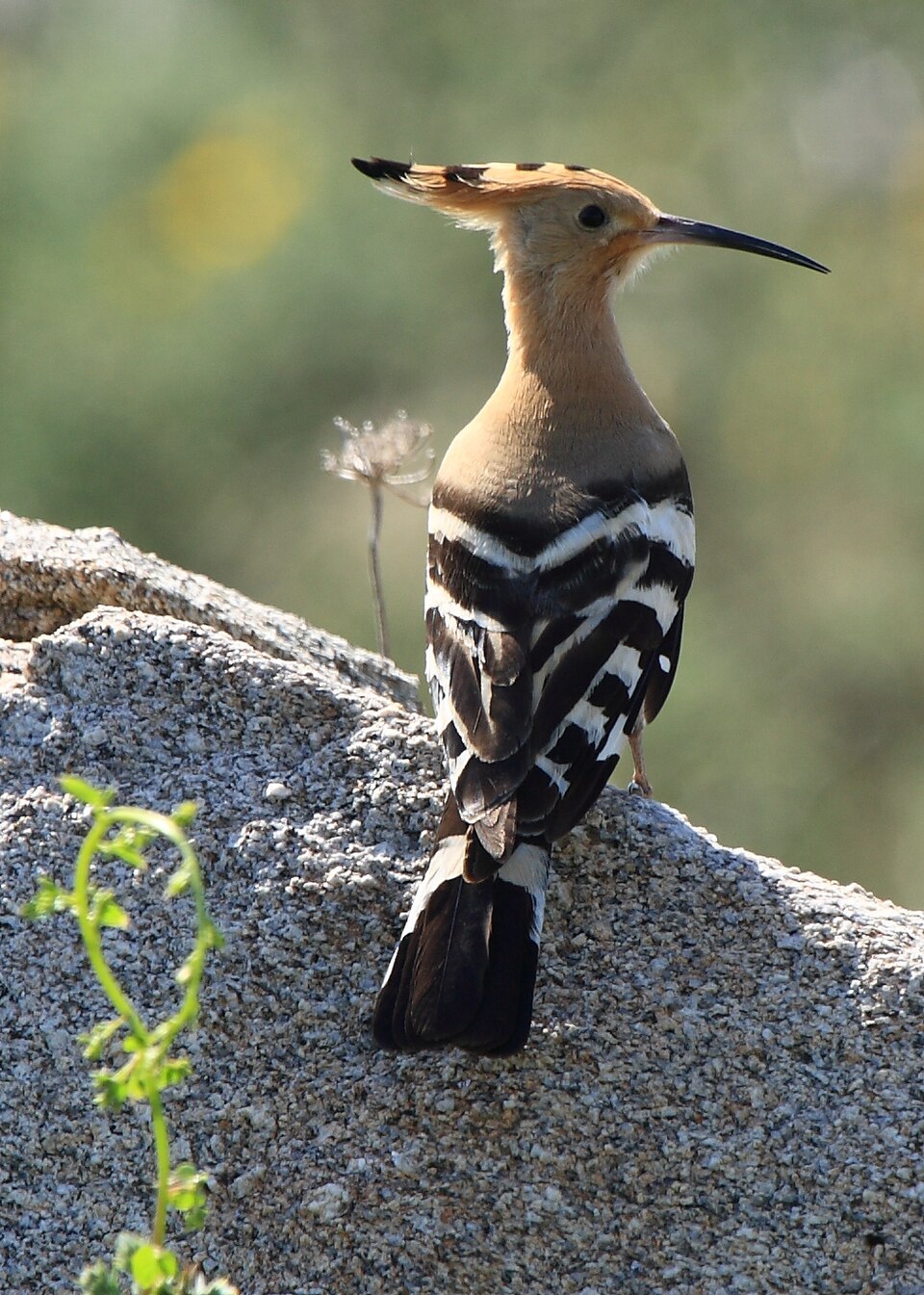
The Eurasian Hoopoe measures approximately 25 to 32 cm in length with a wingspan of 44 to 48 cm. It is distinguished by its crest of orange feathers tipped with black, which it can raise or lower depending on its level of excitement. Its body plumage is tawny-brown, while its wings and tail display striking black and white bands. Its flight is undulating, resembling that of a large butterfly.
Characteristics
Indicative values: they vary by subspecies, sex and region.
Habitat and distribution
It favours open and semi-open habitats such as grasslands, orchards, olive groves, and cultivated areas. It prefers open ground suitable for foraging, associated with trees or walls offering cavities for nesting. It is also found in rural gardens and farmland margins. It generally avoids dense forests and fully urbanised areas.
CURRENT RANGE
The Hoopoe is widely distributed across Europe, Africa, and Asia. European populations generally migrate to sub-Saharan Africa in winter, while some southern populations, particularly North African ones, are sedentary. In Tunisia, it is present year-round throughout the country, from coastal regions to Saharan oases. It is among the most common and most recognisable birds in the country.
Behaviour
The Eurasian Hoopoe is a rather solitary species or seen in pairs during the breeding season. It is diurnal and spends much of its time foraging on the ground. When threatened, it can secrete a foul-smelling substance from its uropygial gland to deter predators. It is territorial during the nesting season and actively defends the vicinity of its nest.
Reproduction
The Hoopoe nests in natural cavities, tree holes, or walls, often near human habitation. The female typically lays 4 to 8 eggs, which she incubates alone for about two to three weeks. The male feeds the female during incubation. Young birds remain in the nest for approximately three to four weeks before fledging.
Peculiarities
Its distinctive erectile crest, which it fans out during displays or alarm responses, is its most striking feature. It also has the ability to produce foul-smelling secretions to protect its nest from predators. This bird has been designated the national bird of Israel and appears in numerous cultural traditions of the Mediterranean basin.
Threats and conservation
The species is not globally threatened, but it suffers locally from intensified agriculture and pesticide use, which reduce insect resources. The loss of old trees and stone walls also limits nesting sites. In Tunisia, it remains common, though vulnerable to degradation of its rural habitat.
Numbers and trends vary across sources and regions. See the IUCN assessment for the latest reference data.
Gallery
1 documented photographs.
References
Profile updated 06 September 2026 · Reviewed by the TunisieVet editorial team.
Comments (0)
No comments yet.
CONSERVATION STATUS
Least concern (LC)
IUCN source, latest published assessment.
Species health
Documented diseases for this species.
Find a veterinarianThis information is provided for educational purposes only and is not a substitute for a veterinary consultation. If you have any concerns about your animal's health, consult a veterinarian.
Similar animals
Other species documented in Animalpedia.

TunisieVet in your pocket 📱🐾 Access your veterinary services wherever you are. [ Download the app ]
Learn more