
Presentation
The serin is a small seed-eating finch belonging to the finch family, known both in its wild form (European serin, Serinus serinus) and in its domesticated form, the canary (Serinus canaria domestica). It is characterized by a small size, a short conical beak suited to eating seeds, and plumage that is often yellow, green, or brown depending on the population and breeding variety. The wild European serin is found around the Mediterranean basin, while the domestic canary is raised worldwide as a pet bird for its song. This lively and social bird lives in small groups outside the breeding season. Its popularity stems largely from the melodious quality of its song, which is particularly well developed in males. In Tunisia, the European serin is present in the wild in certain areas, and the domestic canary is widely kept as a pet.
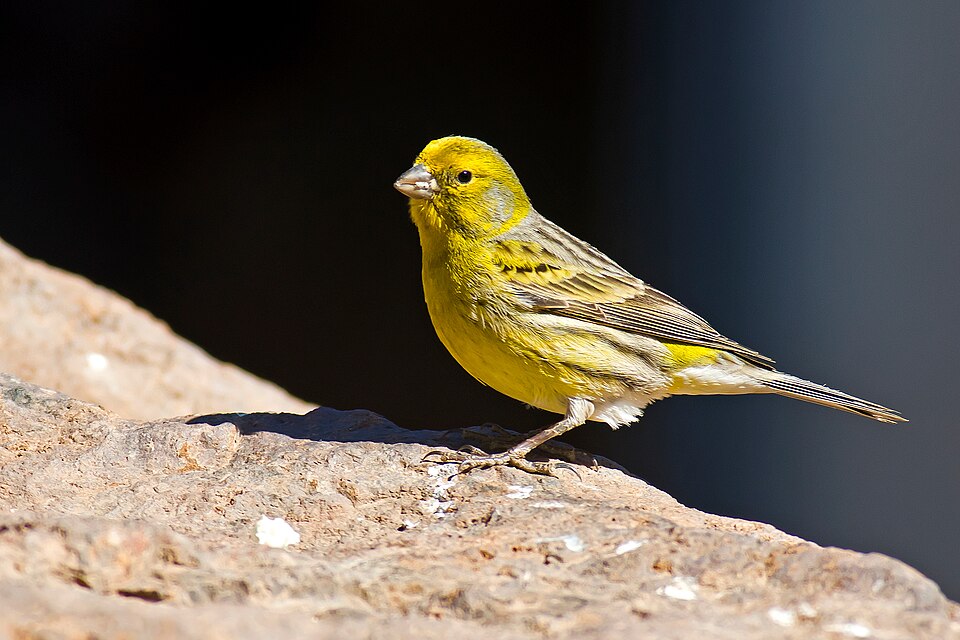
The serin has a stocky body, a small round head, and a short conical beak. Its plumage ranges from bright yellow in the domestic canary to olive-green streaked with brown in the wild European serin. Males often display more vivid colors than females and are renowned for their complex and melodious song.
Characteristics
Indicative values: they vary by subspecies, sex and region.
Habitat and distribution
The wild European serin inhabits open and semi-open environments such as gardens, orchards, scrubland, forest edges, and agricultural areas. It favours the presence of trees or hedgerows for nesting, near open areas rich in seeds. The domestic canary, by contrast, lives exclusively in a cage or aviary in a breeding or pet context.
CURRENT RANGE
The European serin originates from the Mediterranean region, present in southern Europe, North Africa, and certain islands. The domestic canary, derived from the canary finch (Serinus canaria), is now bred throughout the world as a companion bird. In Tunisia, the European serin is found in various regions, particularly in the northern part of the country.
Behaviour
The serin is a diurnal, active, and social bird that often moves about in small groups or loose flocks, especially outside the breeding season. The male's song, which is varied and flute-like, plays an important role in territory defense and courtship display. The species is not shy and adapts easily to human proximity, particularly in gardens and parks.
Reproduction
The wild European serin's breeding season typically extends from spring through summer. The female builds a discreet cup-shaped nest in a tree or shrub and lays 3 to 5 eggs. Incubation lasts about 13 days, and chicks leave the nest after two to three weeks. Domestic canaries breed readily in captivity, often several times a year under the breeder's management.
Peculiarities
The domestic canary is one of the longest-established and most widely bred companion bird species in the world, selected for centuries for its song and colours. Numerous breeds and colour varieties have been developed by breeders. The male canary's song is particularly prized and is the subject of specialized competitions.
Threats and conservation
The wild European serin does not face major threats and its populations remain globally stable in the Mediterranean region. Loss of natural habitats due to urbanization and agricultural intensification can locally affect its numbers. The domestic canary is not affected by these threats, being raised in captivity.
Numbers and trends vary across sources and regions. See the IUCN assessment for the latest reference data.
Gallery
1 documented photographs.
References
Profile updated 05 September 2026 · Reviewed by the TunisieVet editorial team.
Comments (0)
No comments yet.
CONSERVATION STATUS
Least concern (LC)
IUCN source, latest published assessment.
Species health
Documented diseases for this species.
This information is provided for educational purposes only and is not a substitute for a veterinary consultation. If you have any concerns about your animal's health, consult a veterinarian.
Similar animals
Other species documented in Animalpedia.

TunisieVet in your pocket 📱🐾 Access your veterinary services wherever you are. [ Download the app ]
Learn more