
Presentation
The cockatoo is a parrot recognized by its distinctive erectile crest and plumage that is typically white, black, or pink depending on the species. Native to Oceania and Southeast Asia, it inhabits tropical forests, wooded savannas, and urban tree-covered environments. With a powerful curved beak and zygodactyl feet, it manipulates food with great dexterity. Highly social, it lives in loud groups and communicates through piercing calls audible over great distances. Its exceptional lifespan and intelligence make it a popular captive bird, though this raises animal welfare concerns. Several species are threatened by illegal trade and deforestation.
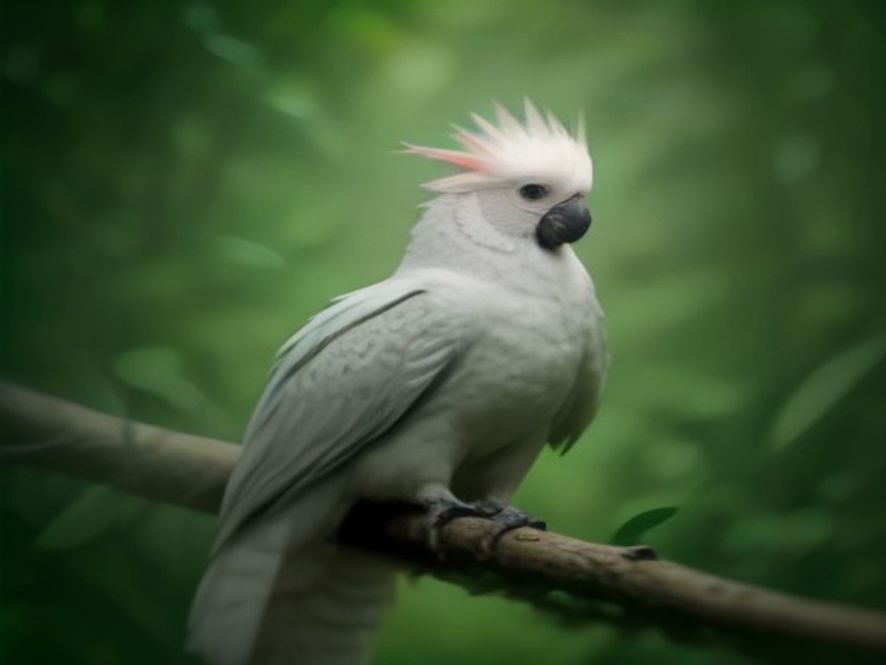
The cockatoo typically measures between 12 and 28 inches depending on species, with a distinctive crest that it raises when excited or alert. Its plumage is predominantly white, black, or grey, sometimes accented with yellow, pink, or red on the crown and cheeks. Its curved, sturdy beak allows it to crack hard nuts and seeds.
Characteristics
Indicative values: they vary by subspecies, sex and region.
Habitat and distribution
The cockatoo inhabits tropical forests, wooded savannas, and coastal woodlands throughout its natural range. Some species have adapted to parks and gardens in urban areas, particularly in Australia. The bird depends on mature trees with cavities suitable for nesting.
CURRENT RANGE
The cockatoo originates from Oceania, particularly Australia, New Guinea, and the Indonesian islands, as well as the Philippines for certain species. No wild populations exist naturally outside this region. In Tunisia, it is found only in captivity, as a pet or in animal facilities.
Behaviour
This bird is highly social and lives in flocks that can number dozens of individuals in the wild. It is diurnal, active in early morning and late afternoon, and is very vocal with powerful calls that maintain group cohesion. Highly intelligent, it readily learns to imitate sounds and solve simple problems. In solitary captivity, it can develop stress or self-destructive behaviors from lack of social stimulation.
Reproduction
Cockatoos typically nest in tree cavities where the female lays two to three eggs per clutch. Incubation lasts about 25 to 30 days and is shared by both parents. Young birds remain in the nest for several months before becoming independent, and some species maintain strong family bonds even after fledging.
Peculiarities
The cockatoo's mobile crest is a unique visual signal among parrots, expressing its emotions and intentions. Some species, such as the black cockatoo, are among the few birds capable of using tools to produce rhythmic sounds. Its lifespan can exceed 60 years in captivity, making ownership a very long-term commitment.
Threats and conservation
Habitat loss from deforestation and agricultural expansion threatens several cockatoo species. Illegal trade for the pet market remains a major pressure, particularly for rare species. Competition for nesting cavities with other species also aggravates decline in some regions.
Numbers and trends vary across sources and regions. See the IUCN assessment for the latest reference data.
Gallery
1 documented photographs.
References
Profile updated 04 September 2026 · Reviewed by the TunisieVet editorial team.
Comments (0)
No comments yet.
CONSERVATION STATUS
Least concern (LC)
IUCN source, latest published assessment.
Species health
Documented diseases for this species.
See the 4 diseases of this species Find a veterinarianThis information is provided for educational purposes only and is not a substitute for a veterinary consultation. If you have any concerns about your animal's health, consult a veterinarian.
To discover around: Cockatoo
Videos, facts, stories and records linked to this species.
Similar animals
Other species documented in Animalpedia.

TunisieVet in your pocket 📱🐾 Access your veterinary services wherever you are. [ Download the app ]
Learn more