
Presentation
The common Carp (Cyprinus carpio) is a freshwater fish native to Asia and Eastern Europe, widely introduced throughout the world for fishing and aquaculture. Its massive body, covered with large golden to brown scales, and its two pairs of barbels on the mouth make it easily recognizable. It likes calm waters, rich in vegetation, where it searches the bottom in search of food. A hardy and tolerant species, it adapts to varied conditions of temperature and water quality. Its longevity and size make it a popular species for sport fishermen. In Tunisia, it is present in several dams and freshwater reservoirs.
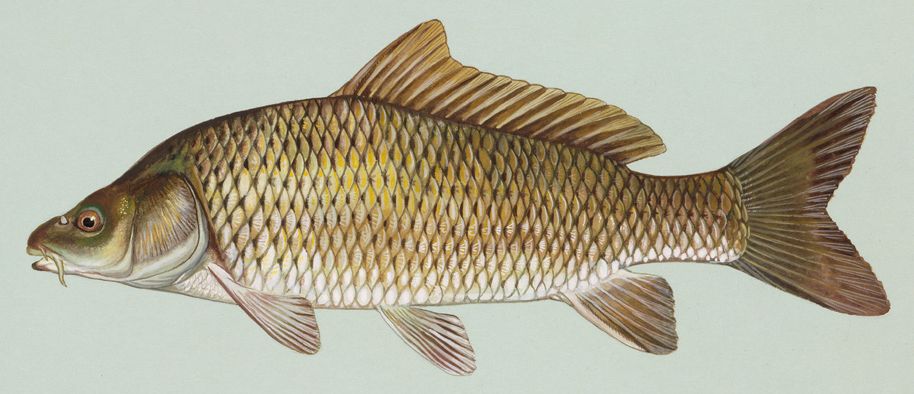
Stocky and elongated body, covered with large bronze to golden cycloid scales. The protractile mouth is lined with two pairs of sensory barbels used to search the slime. The dorsal fin is long with a characteristic hard, serrated first ray.
Characteristics
Indicative values: they vary by subspecies, sex and region.
Habitat and distribution
The Carp frequents calm, shallow fresh waters: lakes, ponds, dams and slow-moving rivers. It particularly likes muddy bottoms rich in aquatic vegetation. It tolerates warm, oxygen-poor waters better than most freshwater fish.
CURRENT RANGE
Native to the Danube basin and Central Asia, Carp has been introduced to almost every continent through aquaculture and sport fishing. It is now present in Europe, Asia, North and South America, Africa and Oceania. In Tunisia, it has been introduced into several dams for recreational fishing.
Behaviour
A gregarious fish, the Carp often lives in small groups near the bottom of calm waters. It is most active at dawn and dusk, during which it actively feeds. In winter, its metabolism slows down significantly and it remains not very mobile near the bottom.
Reproduction
Reproduction takes place in spring and summer, when water temperatures exceed 18°C. Females lay several hundred thousand adhesive eggs on aquatic vegetation. No parental care is given to the eggs or fry after laying.
Peculiarities
Its mouth barbels give it a highly developed sense of smell and touch to locate its food in the mud. It can live for several decades, making it one of the longest-lived freshwater fish. Some farmed varieties, such as the Carp koi, have been selected for their ornamental coloring.
Threats and conservation
The species is not threatened on a global scale and is even considered invasive in certain ecosystems where it has been introduced. However, it can suffer locally from water pollution and the degradation of spawning areas. In certain regions, its proliferation disrupts the balance of native aquatic ecosystems.
Numbers and trends vary across sources and regions. See the IUCN assessment for the latest reference data.
Gallery
1 documented photographs.
References
Profile updated 30 August 2026 · Reviewed by the TunisieVet editorial team.
Comments (0)
No comments yet.
CONSERVATION STATUS
Vulnerable (VU)
IUCN source, latest published assessment.
Species health
Documented diseases for this species.
This information is provided for educational purposes only and is not a substitute for a veterinary consultation. If you have any concerns about your animal's health, consult a veterinarian.
Similar animals
Other species documented in Animalpedia.

TunisieVet in your pocket 📱🐾 Access your veterinary services wherever you are. [ Download the app ]
Learn more