
Presentation
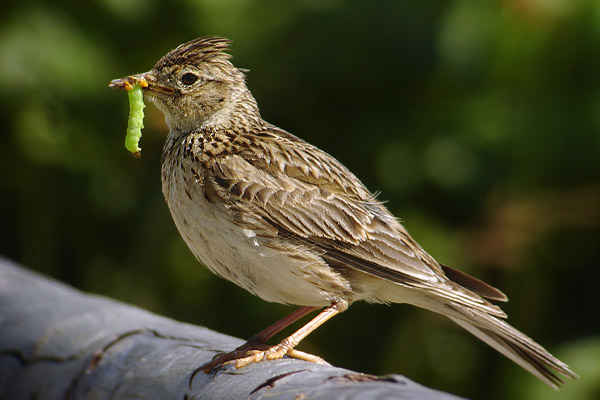
The Eurasian Skylark is a small brownish songbird renowned for its melodious song delivered during hovering flight at high altitude. Its plumage, streaked with brown and beige, provides effective camouflage in the open habitats it frequents. It has a small erectile crest on its head, visible when agitated or alert. This species is widespread across Europe, Asia, and North Africa, including Tunisia. It nests on the ground in discreet depressions scraped in the grass. Its song is traditionally associated with the return of spring in rural areas.
The Skylark measures roughly 18 to 19 cm long with a wingspan of 30 to 36 cm. Its plumage is brown streaked with black on the upperparts, paler and more uniform on the underparts. It is distinguished by a small crest raised on the crown of the head and a conical bill suited to a mixed diet.
Characteristics
Indicative values: they vary by subspecies, sex and region.
Habitat and distribution
The skylark favors open habitats such as grasslands, steppes, agricultural land, and cultivated areas. It avoids dense woodlands and heavily built urban areas. In Tunisia, it is found notably in cereal plains and steppes in the central and northern regions of the country.
CURRENT RANGE
The species is found across a vast range covering Europe, much of Asia, and North Africa. Northern populations migrate south in winter, while some southern populations, including those in North Africa, are more resident. In Tunisia, it is observed both during winter and breeding periods depending on the region.
Behaviour
The Skylark is best known for its song-flight, in which the male rises vertically while uttering a continuous whistling song that can last several minutes. It generally lives alone or in loose small groups, except in winter when larger flocks may form. It is a diurnal species, active from dawn, spending much of its time on the ground foraging for food.
Reproduction
The female typically lays 3 to 5 eggs in a simple nest built on the ground and hidden in grassy vegetation. Incubation lasts around 11 days, and the young leave the nest soon after hatching, before they are fully able to fly. Two to three broods may occur during a single breeding season, between spring and summer.
Peculiarities
The skylark's song in flight, sometimes delivered at altitudes above 100 meters, is one of the species' most distinctive characteristics. This song has inspired numerous literary and musical works throughout European history. The species is also capable of running quickly on the ground thanks to its slender legs adapted for walking and running.
Threats and conservation
The intensification of agriculture, pesticide use, and the loss of natural grasslands are the main threats to the species. Traditional hunting, practiced in certain regions, has also contributed to local population declines. Despite these pressures, the species remains widely distributed and is not considered a major conservation concern globally.
Numbers and trends vary across sources and regions. See the IUCN assessment for the latest reference data.
Gallery
1 documented photographs.
References
Profile updated 19 August 2026 · Reviewed by the TunisieVet editorial team.
Comments (0)
No comments yet.
CONSERVATION STATUS
Least concern (LC)
IUCN source, latest published assessment.
Species health
Documented diseases for this species.
Find a veterinarianThis information is provided for educational purposes only and is not a substitute for a veterinary consultation. If you have any concerns about your animal's health, consult a veterinarian.
Similar animals
Other species documented in Animalpedia.
