
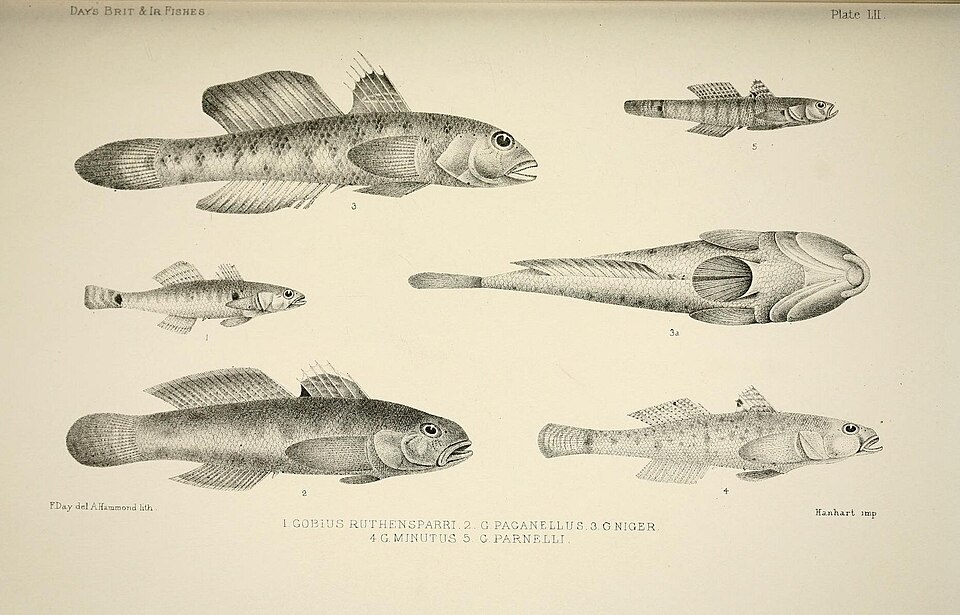
Presentation
Goby is a small bony fish belonging to the family Gobiidae, one of the largest families of marine and freshwater fish. It is characterized by an elongated body, often stocky, and by its fused pelvic fins forming a suction cup which allows it to cling to substrates. It is found in shallow coastal waters, lagoons, estuaries and sometimes in fresh water. Many species live in the Mediterranean, including on the Tunisian coasts. Its small size and discreet habits make it a fish often unknown to the general public despite its abundance.
The body of Goby is spindle-shaped and generally small, rarely larger than 10-15 cm depending on the species. Its head is broad with large, close-set eyes placed in a dorsal position. The most distinctive feature remains the fusion of the pelvic fins into a ventral sucker, absent in most other fish. Coloration varies depending on habitat, often cryptic, ranging from grayish brown to mottled sand.
Characteristics
Indicative values: they vary by subspecies, sex and region.
Habitat and distribution
The Goby frequents a wide variety of shallow aquatic environments: rocky, sandy or muddy bottoms, seagrass beds, lagoons and estuaries. Some species tolerate significant variations in salinity and move up into the brackish or fresh waters of river mouths. It particularly likes sheltered coastal areas where it can find refuge in crevices or empty shells.
CURRENT RANGE
Gobiids are distributed throughout the world, in temperate and tropical seas as well as some freshwater bodies. In the Mediterranean, several species of Gobys are common along the coasts, including in Tunisia where they populate the coastline. The family is also well represented in the Atlantic, Indo-Pacific and Asian seas.
Behaviour
The Goby is a benthic fish, meaning it lives mainly on the bottom rather than in open water. It is generally territorial and defends a shelter or burrow against its peers. Its ventral suction cup allows it to hold on to rocks or in areas with strong currents. Some species establish symbiotic relationships, notably with burrowing shrimp, whose burrow they share in exchange for vigilance against predators.
Reproduction
Goby reproduces by laying eggs, often in a cavity or under a stone chosen by the male. The eggs, laid in sticky clumps, are monitored and ventilated by the male until hatching. Sexual maturity is reached quickly, often in less than a year, which reflects a short-cycle reproductive strategy. The larvae generally go through a pelagic phase before settling on the bottom once metamorphosed.
Peculiarities
The fusion of the pelvic fins into a suction cup is a remarkable anatomical feature shared by almost all gobiids. Some species live in obligate symbiosis with gun shrimp, sharing a common burrow. Goby are among the most diverse vertebrates, with more than 2000 described species worldwide, making them one of the largest families of fish.
Threats and conservation
Populations of Gobys are not globally threatened due to their large numbers and wide distribution. However, some localized species may suffer from the degradation of coastal habitats, water pollution and the destruction of seagrass beds. Some introduced species, such as the black-spotted Goby, are also considered invasive in certain freshwater ecosystems.
Numbers and trends vary across sources and regions. See the IUCN assessment for the latest reference data.
Gallery
1 documented photographs.
References
Profile updated 31 August 2026 · Reviewed by the TunisieVet editorial team.
Comments (0)
No comments yet.
CONSERVATION STATUS
Least concern (LC)
IUCN source, latest published assessment.
Species health
Documented diseases for this species.
Find a veterinarianThis information is provided for educational purposes only and is not a substitute for a veterinary consultation. If you have any concerns about your animal's health, consult a veterinarian.
Similar animals
Other species documented in Animalpedia.

TunisieVet in your pocket 📱🐾 Access your veterinary services wherever you are. [ Download the app ]
Learn more