Presentation
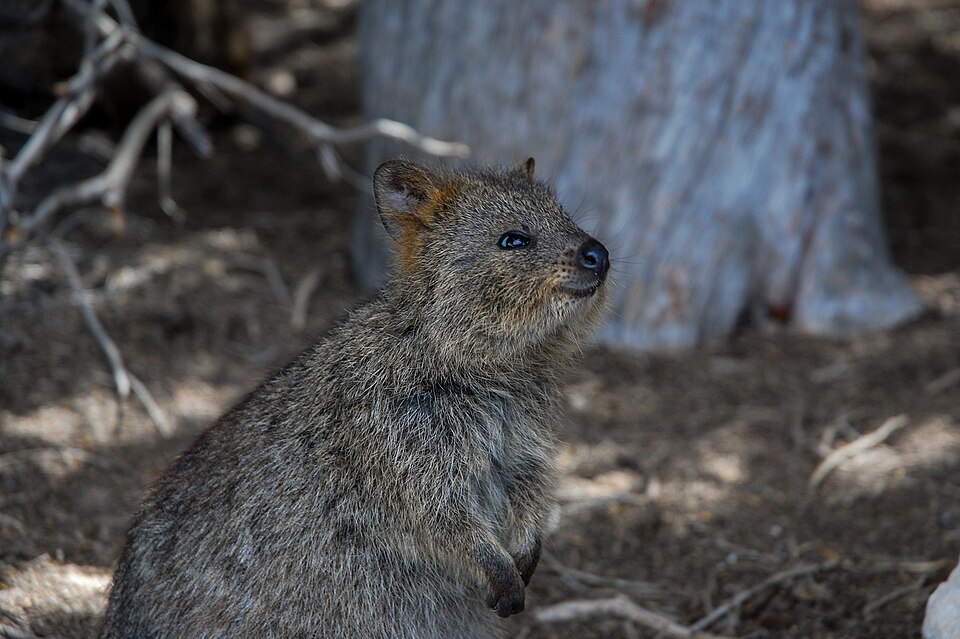
The quokka (Setonix brachyurus) is a small Australian marsupial belonging to the macropodid family, related to kangaroos and wallabies. It is best known for its stocky frame, brown-grey fur, and facial expression that gives it a smiling appearance. The species lives mainly on Rottnest Island and in a few forested areas of southwestern Australia. Its reputation as the "world's happiest animal" stems from numerous viral photographs taken by tourists. It is a nocturnal and gregarious animal, most active at dusk and during the night.
The quokka measures approximately 40 to 54 cm in length, including its short tail, and displays a compact body with small, rounded ears. Its fur is dense and brown-greyish in colour, suited to a warm to temperate climate. Unlike other macropodids, its tail is short and minimally prehensile, not used for carrying materials. Its powerful hind legs allow it to move about by hopping, like other members of its family.
Characteristics
Indicative values: they vary by subspecies, sex and region.
Habitat and distribution
The quokka inhabits dense scrubland, sclerophyll forests, and low vegetation areas that provide shelter from predators and heat. On Rottnest Island, it also occupies the edges of wetlands and seasonal swamps. On the mainland, it favors humid forests of southwestern Australia with dense understory. It requires access to fresh vegetation for feeding and hydration.
CURRENT RANGE
The species is endemic to southwestern Australia, with a primary island population on Rottnest Island and Bald Island, as well as fragmented and rarer mainland populations. Mainland populations have declined sharply due to predation by introduced species. Rottnest Island, lacking certain terrestrial predators, supports the densest and most visible population.
Behaviour
The quokka is a social animal that lives in groups of several dozen individuals, particularly around water sources. It is mainly nocturnal and active at twilight, resting in the shade during the hot hours of the day. Although relatively unafraid of humans, particularly on Rottnest Island, it remains a wild animal and access to it by tourists is now regulated. Males establish dominance hierarchies without great aggression.
Reproduction
The female quokka typically gives birth to a single joey after a brief gestation, followed by an extended development in the pouch for approximately six months. Births are often timed with the rainy season to maximize available food resources. The joey continues nursing after leaving the pouch until fully weaned. Sexual maturity is reached around one year of age.
Peculiarities
The quokka owes its global popularity to "quokka selfies," photographs in which the animal appears to smile at the camera. Like kangaroos, it is among the rare bipedal marsupial mammals that move by hopping. Its ability to survive on little fresh water makes it well-adapted to dry Australian summers.
Threats and conservation
The main threats are predation by introduced red foxes and domestic cats, as well as habitat degradation from fire and urbanization. Climate change, particularly the drying of wetlands in southwestern Australia, increases pressure on mainland populations. The island population on Rottnest remains more stable but vulnerable to tourism and local drought. Conservation and predator control programs are being conducted by Australian authorities.
Numbers and trends vary across sources and regions. See the IUCN assessment for the latest reference data.
Gallery
1 documented photographs.
References
Profile updated 02 September 2026 · Reviewed by the TunisieVet editorial team.
Comments (0)
No comments yet.
CONSERVATION STATUS
Vulnerable (VU)
IUCN source, latest published assessment.
Species health
Documented diseases for this species.
Find a veterinarianThis information is provided for educational purposes only and is not a substitute for a veterinary consultation. If you have any concerns about your animal's health, consult a veterinarian.
Similar animals
Other species documented in Animalpedia.
Be among the first to use our app. Sign up and get early Google Play access.
Discover