
Presentation
The Basking shark is the second largest fish in the world after the whale shark, reaching over 9 meters in length. This giant of the seas feeds exclusively on plankton which it filters using immense gills. Despite its impressive size, it is completely harmless to humans and moves slowly on the surface with its mouth wide open. It is often observed alone or in small groups in temperate and cold waters, including sometimes in the Mediterranean. Its large liver, rich in oil, ensures buoyancy adapted to its pelagic life. The species has been heavily hunted in the past for this oil, which has significantly reduced its populations.
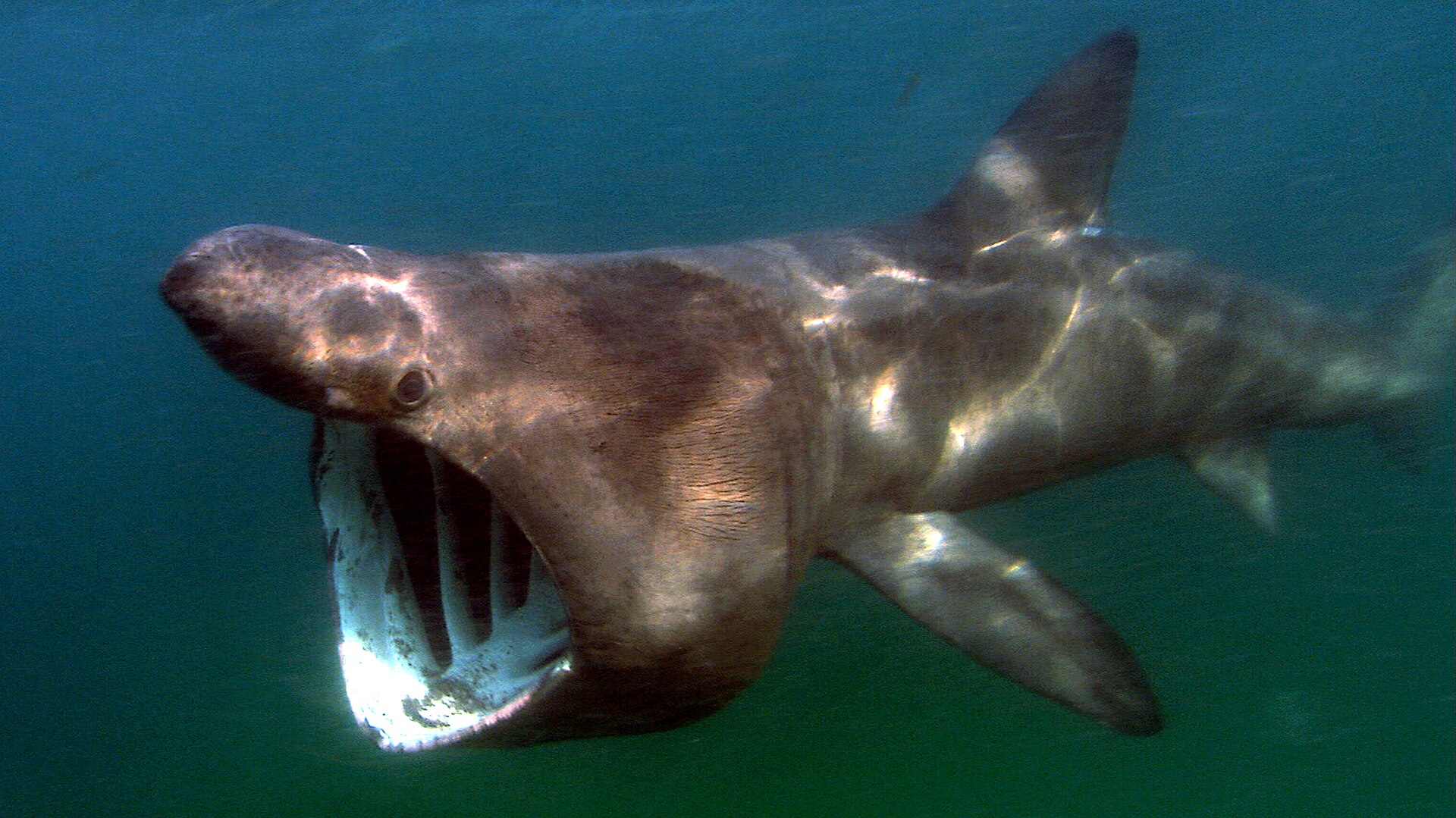
Massive gray-brown to blackish body, conical snout prominent in young birds. Very wide mouth that can open up to a meter, lined with extremely developed gills forming almost circular slits around the neck. High, triangular dorsal fin, often visible on the surface, and crescent-shaped caudal fin. Skin covered with rough dermal denticles as in other sharks.
Characteristics
Indicative values: they vary by subspecies, sex and region.
Habitat and distribution
Basking shark frequents temperate to cold coastal and pelagic waters, often near the surface. It favors areas rich in plankton, notably thermal fronts and coastal upwellings. It can also make deep dives in the open sea. Its presence is seasonal and linked to the abundance of food available.
CURRENT RANGE
The species is present in temperate and subpolar waters of the Atlantic and Pacific oceans and sometimes in the Mediterranean. It is observed in particular off the coasts of Europe, North America and New Zealand. Occasional sightings have been reported in the western and central Mediterranean. Its exact distribution remains partially unknown due to its migratory behavior.
Behaviour
Generally solitary species but sometimes observed in groups during surface plankton concentrations. A slow swimmer, it makes significant seasonal migrations following areas rich in food. It can dive deep, particularly in winter, a period during which its behavior remains poorly understood. Its peaceful behavior and tolerance of approaching boats made it an easy target for historic fishing.
Reproduction
The reproduction of Basking shark remains poorly documented, but the species is ovoviviparous. The gestation would be particularly long, possibly more than a year, or even several years depending on certain hypotheses. Females give birth to a small number of young, already formed and independent. Sexual maturity is late, reached only after several years of growth.
Peculiarities
Its name comes from its habit of swimming on the surface, as if on a pilgrimage. It shares with the whale shark the filter-feeding method, a rare adaptation among large fish. Its size and slowness make it an animal that is easily observed but also easily vulnerable to human activities.
Threats and conservation
The species has been historically overexploited for its liver oil, meat and fins. It remains threatened by accidental captures in fishing nets and collisions with ships. Its slow growth and low fertility slow down the recovery of populations. It now benefits from international protections in several regions.
Numbers and trends vary across sources and regions. See the IUCN assessment for the latest reference data.
Gallery
1 documented photographs.
References
Profile updated 28 August 2026 · Reviewed by the TunisieVet editorial team.
Comments (0)
No comments yet.
CONSERVATION STATUS
Endangered (EN)
IUCN source, latest published assessment.
Species health
Documented diseases for this species.
This information is provided for educational purposes only and is not a substitute for a veterinary consultation. If you have any concerns about your animal's health, consult a veterinarian.
To discover around: Basking shark
Videos, facts, stories and records linked to this species.
RECORD
up to approximately 12 m
Second largest fish in the world
Maximum length reported in a measured individual, behind the whale shark.
Similar animals
Other species documented in Animalpedia.

TunisieVet in your pocket 📱🐾 Access your veterinary services wherever you are. [ Download the app ]
Learn more