
Presentation
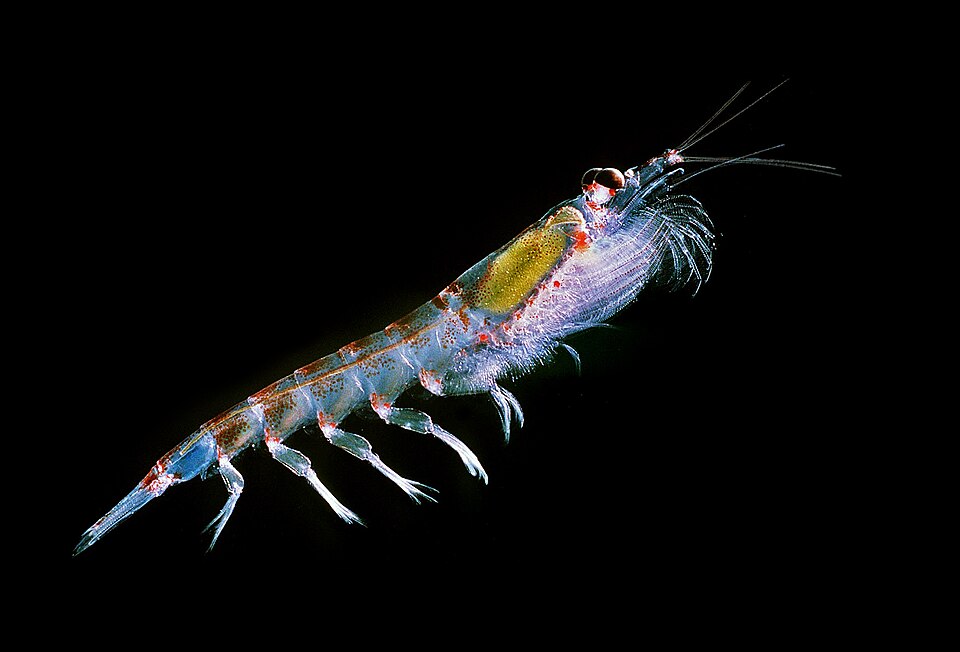
Krill are small marine crustaceans resembling tiny shrimp that live in swarms, sometimes vast in number, in cold and temperate oceans. Antarctic krill (Euphausia superba) is the most widely known and studied species because of its central role in the Southern Ocean ecosystem. These animals filter phytoplankton and provide essential food for numerous marine predators, from fish to whales. Their total biomass ranks among the largest in the animal kingdom. Krill undertake daily vertical migrations through the water column. They are also harvested commercially for krill oil and aquaculture feed.
Krill have a segmented translucent to reddish body, a thin shell and photophore organs that emit faint bioluminescence. Their compound eyes are well developed and adapted to life in dimly lit waters. They measure several centimetres and move by means of several pairs of thoracic and abdominal legs.
Characteristics
Indicative values: they vary by subspecies, sex and region.
Habitat and distribution
Krill occupies the water column of the oceans, from the surface to several hundred meters deep. It is particularly abundant in cold, nutrient-rich waters such as the Southern Ocean. Some species are also found in temperate or coastal waters.
CURRENT RANGE
Antarctic krill is distributed around the Antarctic continent in the Southern Ocean. Other krill species are present throughout the world's oceans, including in the Mediterranean. Its distribution depends heavily on ocean currents and local plankton productivity.
Behaviour
Krill live in dense swarms that can number millions of individuals; this behaviour provides them with some protection from predation. They perform daily vertical migrations, rising toward the surface at night to feed and descending to deeper water during the day. This gregarious organisation also facilitates reproduction and larval dispersal.
Reproduction
The female releases thousands of eggs that sink to the depths before larvae hatch. The larvae then gradually rise toward the surface while passing through several developmental stages. Sexual maturity is reached after approximately two to three years depending on the species and environmental conditions.
Peculiarities
Antarctic krill forms one of the largest known animal biomasses on Earth, estimated at several hundred million tons. It plays a crucial role in the ocean carbon cycle through its carbon-rich droppings that settle into the depths. Its natural bioluminescence is a distinctive trait among planktonic crustaceans.
Threats and conservation
Climate warming and the melting of sea ice are changing habitats favorable to Antarctic krill. Commercial fishing, expanding for krill oil and aquaculture, is subject to international regulation to prevent overexploitation. Ocean acidification may also affect the survival of larvae.
Numbers and trends vary across sources and regions. See the IUCN assessment for the latest reference data.
Gallery
1 documented photographs.
References
Profile updated 13 September 2026 · Reviewed by the TunisieVet editorial team.
Comments (0)
No comments yet.
CONSERVATION STATUS
Least concern (LC)
IUCN source, latest published assessment.
Species health
Documented diseases for this species.
Find a veterinarianThis information is provided for educational purposes only and is not a substitute for a veterinary consultation. If you have any concerns about your animal's health, consult a veterinarian.
To discover around: Krill
Videos, facts, stories and records linked to this species.
RECORD
several hundred million tonnes
One of the largest animal biomasses
Estimate of the total biomass of Antarctic krill (Euphausia superba) in the Southern Ocean...
Similar animals
Other species documented in Animalpedia.
