
Presentation
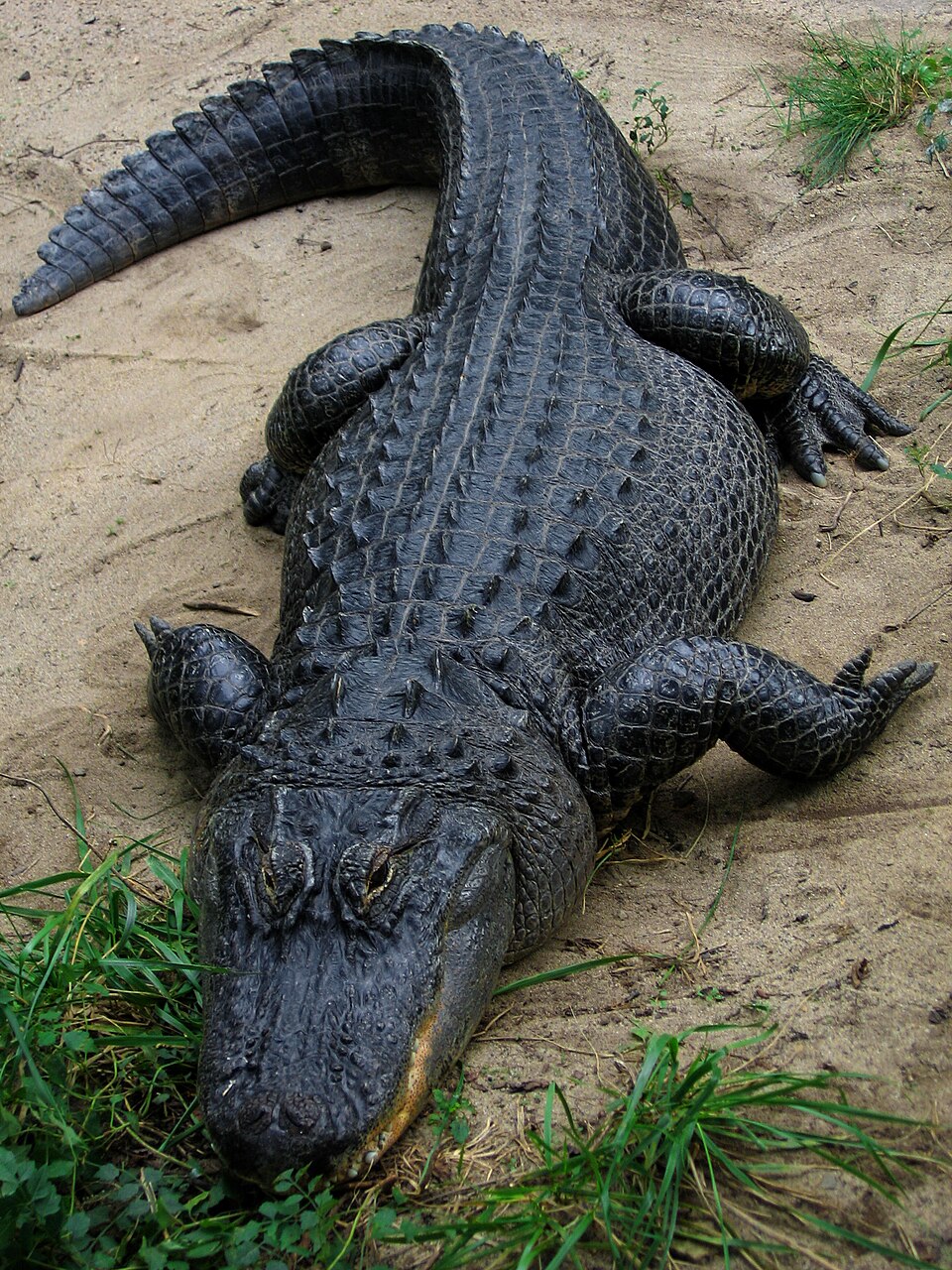
The American Alligator (Alligator mississippiensis) is a large crocodilian reptile living in the southeastern United States. It is distinguished from the crocodile by its broad, rounded snout and its lower teeth that are invisible when the mouth is closed. An opportunistic predator installed at the top of the food chain in wetlands, it plays a major ecological role by digging ponds which benefit many other species. Long hunted for its skin, it was the subject of a protection program which remains cited as an example of successful recovery of an endangered species. It should not be confused with the Chinese Alligator, a distinct and much rarer species.
Massive body covered with osteoderms, wide U-shaped snout, gray-black to olive coloring depending on the environment. Powerful laterally flattened tail used for swimming and defense. Very powerful jaws armed with conical teeth adapted to capturing a variety of prey.
Characteristics
Indicative values: they vary by subspecies, sex and region.
Habitat and distribution
Frequents marshes, bayous, slow-moving rivers, lakes and freshwater wetlands, sometimes slightly brackish waters. Prefers calm environments offering abundant vegetation to hide. Sometimes digs burrows or water holes which serve as a refuge in times of drought.
CURRENT RANGE
Found in the southeastern United States, from Louisiana and Florida to the Carolinas and Texas. Naturally absent from Africa, Europe and Asia. Species not present in Tunisia, neither in the wild nor in common breeding.
Behaviour
Essentially solitary animal outside the breeding season, active especially at dusk and at night. Spends long hours motionless in the sun or submerged, leaving only the eyes and nostrils visible. Territorial, it emits low-pitched growls audible at long distances to mark its presence.
Reproduction
The female builds a nest of decomposing vegetation where she lays around thirty eggs. The incubation temperature determines the sex of the young. She monitors the nest and helps the young hatch, providing them with close protection during the first months.
Peculiarities
Its bite is among the most powerful in the animal kingdom in proportion to its size. It can remain submerged for long minutes while slowing down its metabolism. Contrary to popular belief, it generally flees from humans rather than attacking them.
Threats and conservation
The species was heavily hunted in the 20th century for its skin, leading to a significant decline. Thanks to strict legal protection and sustainable management, its populations have largely recovered. The destruction of wetlands remains the main residual threat today.
Numbers and trends vary across sources and regions. See the IUCN assessment for the latest reference data.
Gallery
1 documented photographs.
References
Profile updated 01 September 2026 · Reviewed by the TunisieVet editorial team.
Comments (0)
No comments yet.
CONSERVATION STATUS
Least concern (LC)
IUCN source, latest published assessment.
Species health
Documented diseases for this species.
This information is provided for educational purposes only and is not a substitute for a veterinary consultation. If you have any concerns about your animal's health, consult a veterinarian.
To discover around: Alligator
Videos, facts, stories and records linked to this species.
Similar animals
Other species documented in Animalpedia.

TunisieVet in your pocket 📱🐾 Access your veterinary services wherever you are. [ Download the app ]
Learn more