Presentation
The clam is a marine bivalve mollusk that lives buried in sandy or muddy sediments in coastal areas. Its soft body is protected by two symmetrical calcium carbonate shells connected by a hinge. A filter feeder, it feeds by pumping seawater and extracting organic particles and plankton from it. Several species are harvested commercially for human consumption, particularly in the Mediterranean and Atlantic regions. It plays an important role in filtering water and maintaining the balance of coastal ecosystems.
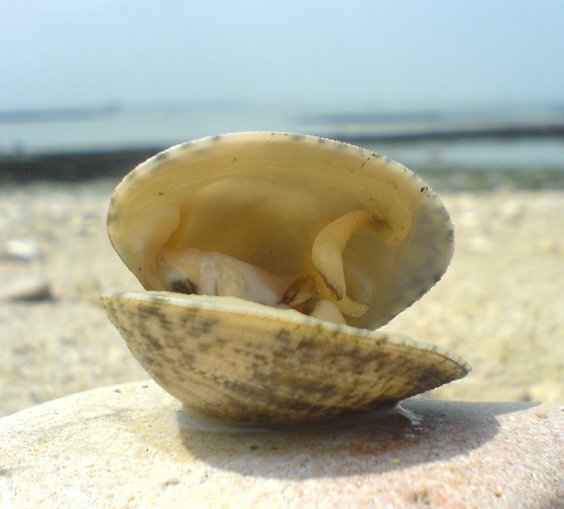
The clam has an oval shell marked by striated concentric growth lines, with coloring that varies by species and habitat. It has two retractable siphons that allow it to draw in and expel water while remaining buried. Its muscular foot helps it burrow into soft substrate.
Characteristics
Indicative values: they vary by subspecies, sex and region.
Habitat and distribution
The clam lives buried in sandy, muddy, or mixed sandy-muddy bottoms in shallow intertidal and subtidal zones. It prefers estuaries, lagoons, and sheltered bays where salinity remains stable. It can be found from the shoreline to several meters deep.
CURRENT RANGE
Clams are found along the Atlantic and Mediterranean coasts of Europe and North Africa, as well as in other temperate seas around the world. Some species have been introduced outside their native range for aquaculture. In Tunisia, they are present notably in lagoons and coastal areas such as Lake Bizerte and the Gulf of Gabès.
Behaviour
A sedentary animal, the clam remains buried in sand or mud and moves only rarely, using its muscular foot. It responds to vibrations and changes in salinity by retracting into its shell. Its filtering activity continues as long as environmental conditions allow.
Reproduction
Reproduction occurs through external fertilization: males and females release eggs and sperm into the water during seasonal spawning. Planktonic larvae drift for several weeks before settling and burrowing into the sediment. Sexual maturity is reached in one to two years depending on the species and water temperature.
Peculiarities
The clam can seal its shell hermetically to protect itself from drying out and predators during low tide. Some species can live for several decades, a remarkable lifespan for a bivalve mollusk. Its presence is often used as an indicator of coastal water quality.
Threats and conservation
Overfishing, pollution of coastal waters, and degradation of lagoon habitats threaten some local populations. Climate change and ocean acidification can affect shell formation. Some production areas are also subject to health-related closures linked to toxic algal blooms.
Numbers and trends vary across sources and regions. See the IUCN assessment for the latest reference data.
Gallery
1 documented photographs.
References
Profile updated 30 August 2026 · Reviewed by the TunisieVet editorial team.
Comments (0)
No comments yet.
CONSERVATION STATUS
Least concern (LC)
IUCN source, latest published assessment.
Species health
Documented diseases for this species.
This information is provided for educational purposes only and is not a substitute for a veterinary consultation. If you have any concerns about your animal's health, consult a veterinarian.
Similar animals
Other species documented in Animalpedia.

Be among the first to use our app. Sign up and get early Google Play access.
Discover