
Presentation
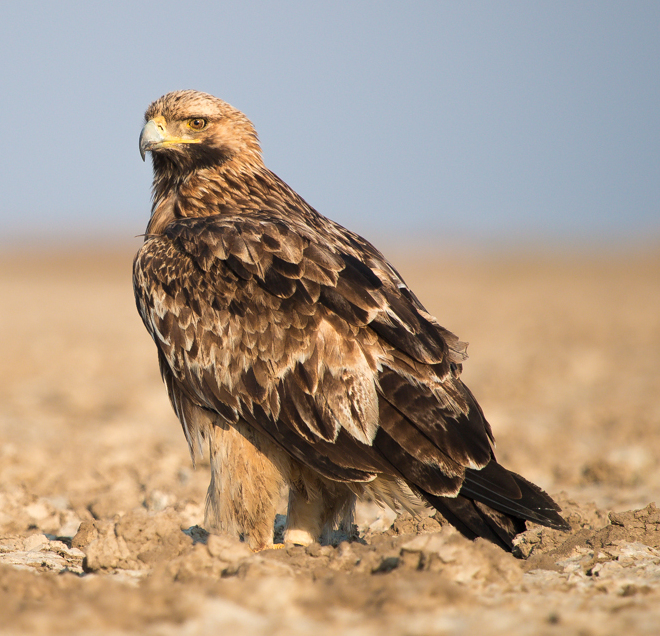
The Imperial Eagle (Aquila heliaca) is a large diurnal raptor native to Eastern Europe and Central Asia. It is distinguished by its dark brown plumage and the characteristic white spots on its shoulders. A powerful hunter, it occupies open, semi-forested environments where it finds both nesting sites and hunting grounds. The species is threatened by habitat loss, poisoning and direct persecution. It is among the emblematic raptors of the Eurasian fauna and benefits from protection measures in several countries. In Tunisia, it remains an occasional visitor observed mainly during migrations.
The Imperial Eagle measures between 72 and 84 cm long with a wingspan of up to 2.1 meters. Its plumage is dark brown with a lighter crown and distinctive white spots on the scapulars. The bill is powerful and hooked, suitable for capturing and butchering medium-sized prey. Juveniles have a lighter livery, spotted with beige, which gradually darkens with age.
Characteristics
Indicative values: they vary by subspecies, sex and region.
Habitat and distribution
The Imperial Eagle frequents steppes, semi-forested areas and agricultural plains bordered by groves. It avoids dense forests and steep mountainous areas, preferring open landscapes with good visibility for hunting. The presence of large isolated trees is essential for the installation of nests.
CURRENT RANGE
The species breeds from central and eastern Europe to central Asia and Mongolia. European populations winter mainly in Northeast Africa and the Middle East. Erratic or migratory individuals can be observed as far away as North Africa, including occasionally in Tunisia.
Behaviour
This species is territorial and fiercely defends its nesting area against intruders. It is generally solitary or observed in pairs, the partners remaining faithful over several seasons. Northern populations are migratory while some southern populations are sedentary or make limited movements.
Reproduction
The couple builds a voluminous nest of branches, often reused and enlarged from year to year, generally placed at the top of a large tree. The female lays an average of two to three eggs, incubated for approximately 43 days. The young take flight around 60 to 65 days but remain dependent on the parents for several additional weeks.
Peculiarities
The scientific name heliaca evokes a historical connection with the sun in certain ancient cultural traditions. This species has long been confused with the golden eagle due to its similar silhouette, although the white scapular spots help distinguish them. The Imperial Eagle is a national symbol in several Eastern European countries.
Threats and conservation
The main threats are the destruction and fragmentation of steppe habitat, electrocution on power lines and poisoning, intentional or accidental. Poaching and persecution by some breeders also contribute to the decline of local populations. The scarcity of main prey, notably gophers, is increasing the pressure on the species.
Numbers and trends vary across sources and regions. See the IUCN assessment for the latest reference data.
Gallery
1 documented photographs.
References
Profile updated 03 September 2026 · Reviewed by the TunisieVet editorial team.
Comments (0)
No comments yet.
CONSERVATION STATUS
Vulnerable (VU)
IUCN source, latest published assessment.
Species health
Documented diseases for this species.
This information is provided for educational purposes only and is not a substitute for a veterinary consultation. If you have any concerns about your animal's health, consult a veterinarian.
To discover around: Imperial Eagle
Videos, facts, stories and records linked to this species.
Similar animals
Other species documented in Animalpedia.

TunisieVet in your pocket 📱🐾 Access your veterinary services wherever you are. [ Download the app ]
Learn more