
Presentation
The Alpaca (Vicugna pacos) is a domestic camelid native to the Andes of South America, raised mainly for its textile fiber. It descends from the wild vicuña, domesticated several millennia ago by Andean populations. Medium in size, it is distinguished from the llama by its smaller silhouette and its fuller, finer fleece. Today raised on several continents, it remains associated with high quality textile craftsmanship. The species lives in herds and has a calm and sociable temperament.
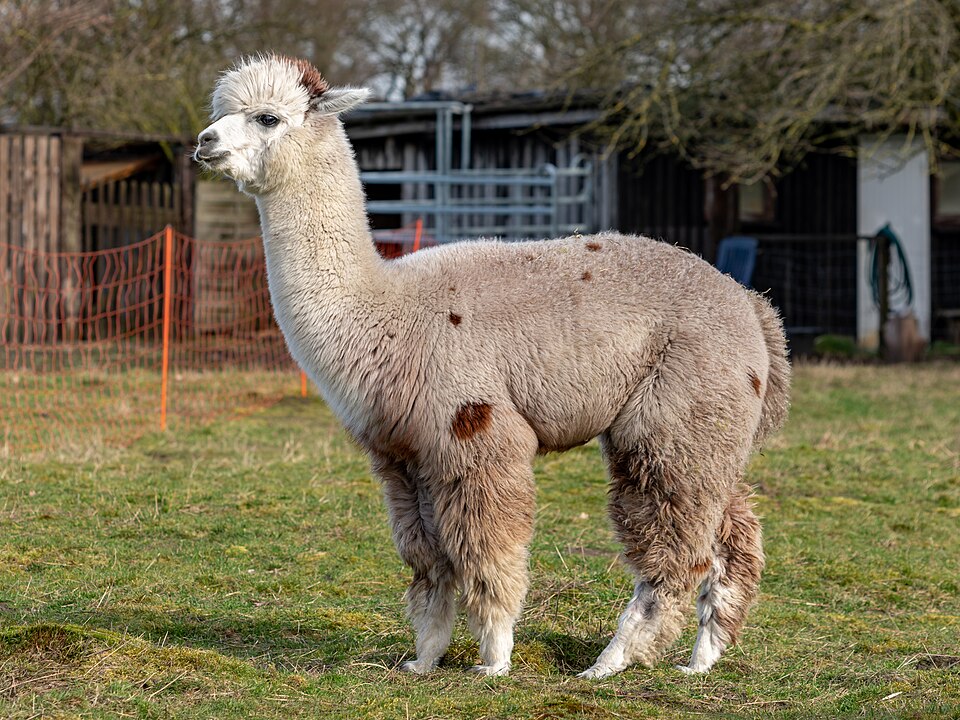
The Alpaca has a body covered in a thick woolly fleece, available in around twenty natural shades ranging from white to black. Its head is small with large, erect ears and expressive eyes. Its slender legs end in plantar pads adapted to rocky terrain. There are two types depending on the texture of the fiber: Huacaya, with a curly and dense fleece, and Suri, with a long and smooth fiber.
Characteristics
Indicative values: they vary by subspecies, sex and region.
Habitat and distribution
In its original state, Alpaca evolves in the Andean highlands, between 3500 and 5000 meters above sea level, a cold and mountainous environment. In breeding, however, it adapts to meadows and lowland pastures in varied climates. It appreciates open spaces with abundant herbaceous vegetation. Its thick fleece effectively protects it from the cold but makes it sensitive to extreme heat.
CURRENT RANGE
The Alpaca is native to the Andes, mainly Peru, Bolivia, Chile and Ecuador, where the majority of the world's livestock is still concentrated. The species has been exported since the 20th century to many countries for breeding, notably in Europe, North America and Oceania. Its presence in North Africa, including Tunisia, remains anecdotal and limited to a few specialized breeding farms or educational farms. It does not live in the wild outside its native Andean range.
Behaviour
The Alpaca is a gregarious animal that lives in hierarchical herds, feeling safe in groups. It communicates through a variety of sounds, including a characteristic purr called “humming,” as well as body postures. Generally docile and curious towards humans, it may spit when it feels threatened or to establish a social hierarchy. It is active mainly during the day and often rests in a sitting position.
Reproduction
The female Alpaca has a gestation of approximately 11 months and gives birth to a single young, called a cria. Alpaca is an induced ovulation species, with mating triggering the ovulation process in the female. Weaning generally occurs between 6 and 8 months. Sexual maturity is reached around 12 to 18 months depending on the sex and rearing conditions.
Peculiarities
Alpaca produces one of the most sought-after textile fibers in the world, renowned for its softness, lightness and thermal properties. Unlike the llama, it is not used as a pack animal. His spitting behavior, while defensive, is often exaggerated in the popular imagination. It shares with other South American camelids an absence of a dorsal hump, unlike camels and dromedaries.
Threats and conservation
The domestic Alpaca is not threatened, its global numbers being stable thanks to controlled breeding. The main risks concern health management in captivity, such as internal parasites or respiratory diseases. Andean climate change, particularly the scarcity of water at altitude, can affect traditional populations. No conservation threat in the strict sense applies to this domesticated species.
Numbers and trends vary across sources and regions. See the IUCN assessment for the latest reference data.
Gallery
1 documented photographs.
References
Profile updated 20 August 2026 · Reviewed by the TunisieVet editorial team.
Comments (0)
No comments yet.
CONSERVATION STATUS
Least concern (LC)
IUCN source, latest published assessment.
Species health
Documented diseases for this species.
See the 8 diseases of this species Find a veterinarianThis information is provided for educational purposes only and is not a substitute for a veterinary consultation. If you have any concerns about your animal's health, consult a veterinarian.
To discover around: Alpaca
Videos, facts, stories and records linked to this species.
Similar animals
Other species documented in Animalpedia.

TunisieVet in your pocket 📱🐾 Access your veterinary services wherever you are. [ Download the app ]
Learn more