
Presentation
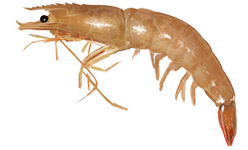
The brown shrimp is a marine decapod crustacean native to the Gulf of Mexico and the western Atlantic. Its elongated, segmented body bears a brownish-red carapace, sometimes tinted with greenish hues depending on habitat. Adults typically measure between 10 and 18 cm in length. This species lives primarily on soft coastal seabeds, where it partially buries itself during the day. It holds significant economic importance, being widely harvested and exported for human consumption. Its life cycle alternates between shallow coastal waters for breeding and deeper waters for growth.
The body is divided into a cephalothorax and abdomen, covered in a brown-red chitinous exoskeleton. The rostrum bears characteristic serrations that distinguish this species from other penaeid shrimp. The antennae are long and slender, used to sense the environment in often-turbid waters.
Characteristics
Indicative values: they vary by subspecies, sex and region.
Habitat and distribution
This species frequents sandy or muddy bottoms in coastal waters, estuaries, and the continental shelf. Juveniles particularly favor nutrient-rich littoral wetlands that shelter them from predators. Adults migrate toward deeper offshore waters as they grow.
CURRENT RANGE
The brown shrimp is native to the western Atlantic, ranging from the northeastern United States to the Gulf of Mexico. It has been introduced accidentally or deliberately to certain regions, notably to the Mediterranean through the Suez Canal or via ballast water discharge. Its presence has been reported in some Mediterranean coastal areas, including Tunisia.
Behaviour
This shrimp exhibits nocturnal behaviour, remaining buried in sediment during the day to escape predators. It undertakes seasonal migrations between shallow coastal zones and deeper offshore waters. Juveniles often aggregate in estuaries and mangrove areas that serve as nurseries.
Reproduction
Reproduction takes place mainly in deep waters, where females lay several hundred thousand eggs. The larvae pass through several planktonic stages before drifting toward coastal zones. Growth to sexual maturity occurs over a few months, with a short lifespan.
Peculiarities
This species is invasive in certain parts of the Mediterranean, where it competes with local shrimp. Its brown coloration provides good camouflage on sedimentary bottoms. It represents a major fishery resource in its native North American range.
Threats and conservation
In its native range, overfishing and degradation of coastal and estuarine habitats constitute the main pressures. Pollution of littoral areas and destruction of nursery mangroves affect juvenile recruitment. In the Mediterranean, its invasive character raises ecological concerns rather than threats to the species itself.
Numbers and trends vary across sources and regions. See the IUCN assessment for the latest reference data.
Gallery
1 documented photographs.
References
Profile updated 27 October 2026 · Reviewed by the TunisieVet editorial team.
Comments (0)
No comments yet.
CONSERVATION STATUS
Data deficient (DD)
IUCN source, latest published assessment.
Species health
Documented diseases for this species.
See the 4 diseases of this species Find a veterinarianThis information is provided for educational purposes only and is not a substitute for a veterinary consultation. If you have any concerns about your animal's health, consult a veterinarian.
Similar animals
Other species documented in Animalpedia.
