
Presentation
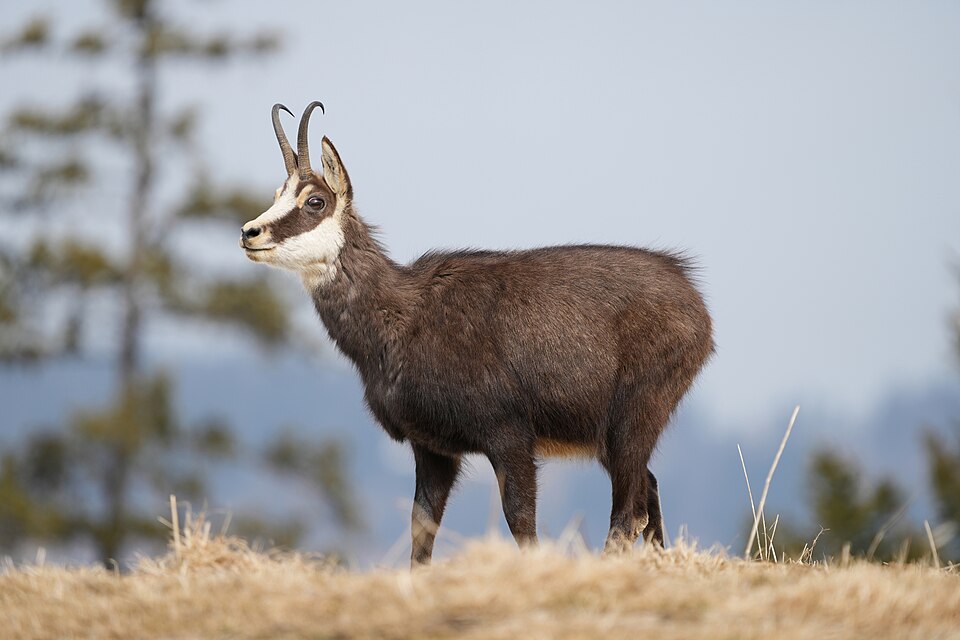
The Chamois is a medium-sized ungulate mammal adapted to life in high mountains. It can be recognized by its reddish-brown coat in summer, turning dark brown in winter, as well as its black horns curved into a hook at the end, present in both sexes. Agile and robust, it moves with ease on steep rocky terrain and steep slopes. Its stocky body and powerful limbs give it great jumping and balancing ability. The species is emblematic of the mountainous massifs of Europe where it occupies various altitudinal levels depending on the seasons.
The Chamois has a compact body, thin but muscular legs and a coat whose color varies depending on the season. Its hooves have a particular structure with hard edges and a soft center, promoting grip on rock. The horns, present in both males and females, end in a characteristic hook.
Characteristics
Indicative values: they vary by subspecies, sex and region.
Habitat and distribution
The Chamois frequents mountainous areas, including mountain pastures, rocky cliffs and high altitude coniferous forests. It migrates vertically seasonally, descending to lower, forested elevations in winter to escape the cold and deep snow. In summer, it returns to alpine meadows and higher rocky areas.
CURRENT RANGE
The species is present in the main mountain ranges of Europe, notably the Alps, the Carpathians, the Balkans and certain massifs of Asia Minor. It has also been introduced to some regions outside its natural range. Chamois is not present in North Africa or Tunisia.
Behaviour
The Chamois is a diurnal animal, often active at sunrise and sunset. Females and young live in small groups called herds, while adult males are more often solitary outside of the breeding season. The species is renowned for its exceptional agility, capable of leaping and climbing steep rock faces to escape predators.
Reproduction
The rut takes place in autumn, during which males compete for access to females. Gestation lasts about six months and ends with the birth of a single young in the spring. The young, called a kid or kid, quickly follows its mother and becomes independent after a few months.
Peculiarities
The Chamois is capable of impressive leaps that can exceed several meters in length to overcome rocky obstacles. Its specialized hooves give it remarkable grip on slippery or very steep surfaces. It also has retrocornual glands whose secretions play a role in chemical communication, particularly during the rut.
Threats and conservation
Major threats include hunting, fragmentation of its montane habitat, and competition with domestic livestock for food resources. Climate change, by modifying snow cover and altitude vegetation, constitutes additional pressure on certain local populations. Overall, however, the species remains relatively abundant in its range.
Numbers and trends vary across sources and regions. See the IUCN assessment for the latest reference data.
Gallery
1 documented photographs.
References
Profile updated 20 August 2026 · Reviewed by the TunisieVet editorial team.
Comments (0)
No comments yet.
CONSERVATION STATUS
Least concern (LC)
IUCN source, latest published assessment.
Species health
Documented diseases for this species.
See the 8 diseases of this species Find a veterinarianThis information is provided for educational purposes only and is not a substitute for a veterinary consultation. If you have any concerns about your animal's health, consult a veterinarian.
Similar animals
Other species documented in Animalpedia.

TunisieVet in your pocket 📱🐾 Access your veterinary services wherever you are. [ Download the app ]
Learn more