
Presentation
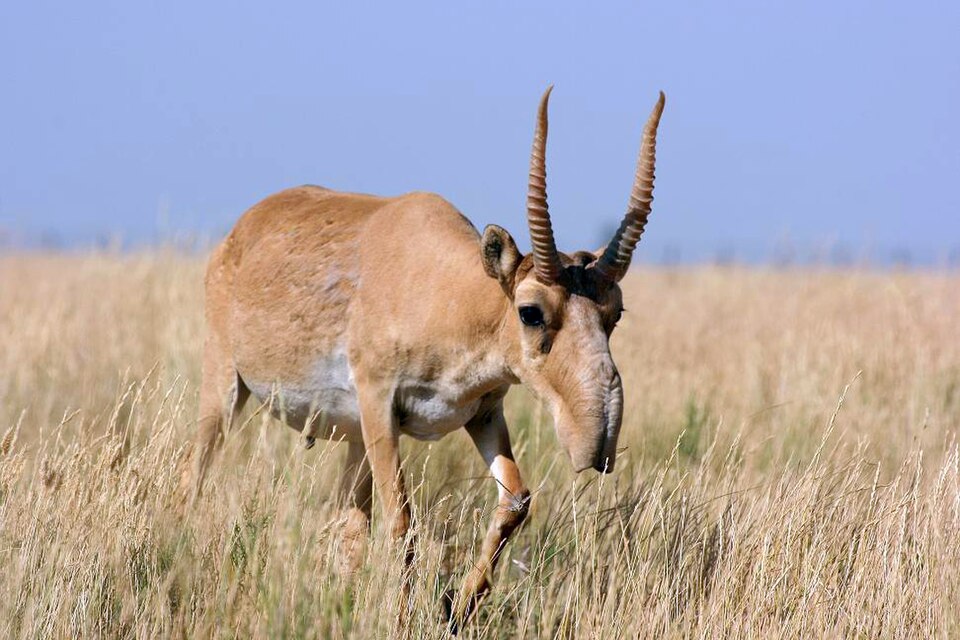
The saiga (Saiga tatarica) is a medium-sized antelope, recognized by its distinctive protruding muzzle shaped like a short, flexible trunk. This unique feature allows it to filter dust and warm cold air before it reaches the lungs. The species once lived in vast migratory herds across the Eurasian steppes, from Eastern Europe to Mongolia. Its population collapsed in the twentieth century and again during the 1990s and 2000s due to intensive poaching for its horns, used in traditional medicine. Today, most of the world population is concentrated in Kazakhstan. The saiga remains emblematic of conservation efforts for Central Asian steppes.
The saiga measures approximately 24 to 31 inches at the shoulder and weighs 55 to 110 pounds. Its coat varies from light beige in summer to a thicker grayish-white in winter, adapted to extreme cold. Only males bear translucent ringed horns, reaching 10 to 12 inches. Its bulbous, mobile muzzle is its most striking distinctive feature.
Characteristics
Indicative values: they vary by subspecies, sex and region.
Habitat and distribution
The saiga lives in the arid and semi-desert steppes of Central Asia, an open and windy environment. It also frequents areas near semi-deserts where vegetation is low and sparse. These extreme habitats experience large temperature swings between summer and winter.
CURRENT RANGE
The species is today mainly found in Kazakhstan, with small populations in Russia and Mongolia. It has disappeared from most of its historical range, which once extended as far as Eastern Europe. Reintroduction programmes are underway in certain areas of Uzbekistan.
Behaviour
The saiga is a gregarious animal that forms large herds, especially during seasonal migrations and calving. It can run at high speed to escape predators such as wolves. Males gather in small harems during the rutting season, a period when they may lose considerable weight while defending their females.
Reproduction
The rut takes place in winter, followed by a gestation of approximately five months. Females gather in large numbers to give birth at the same time, which dilutes the risk of predation on young. They give birth to one or two calves, capable of following the herd after just a few days.
Peculiarities
The saiga's muzzle, unique among antelopes, acts as a natural filter against steppe dust. The species survived the last ice age alongside mammoths and woolly rhinoceroses. It has experienced episodes of sudden mass mortality linked to opportunistic bacteria favoured by particular climatic conditions.
Threats and conservation
Poaching for horns, highly prized in Asian traditional medicine, constitutes the main historical threat. Episodes of mass mortality caused by bacterial disease have also decimated hundreds of thousands of individuals within days. Degradation of the steppes and human infrastructure also fragment its natural habitat.
Numbers and trends vary across sources and regions. See the IUCN assessment for the latest reference data.
Gallery
1 documented photographs.
References
Profile updated 06 September 2026 · Reviewed by the TunisieVet editorial team.
Comments (0)
No comments yet.
CONSERVATION STATUS
Critically endangered (CR)
IUCN source, latest published assessment.
Species health
Documented diseases for this species.
This information is provided for educational purposes only and is not a substitute for a veterinary consultation. If you have any concerns about your animal's health, consult a veterinarian.
Related species
Similar animals
Other species documented in Animalpedia.

TunisieVet in your pocket 📱🐾 Access your veterinary services wherever you are. [ Download the app ]
Learn more