
Presentation
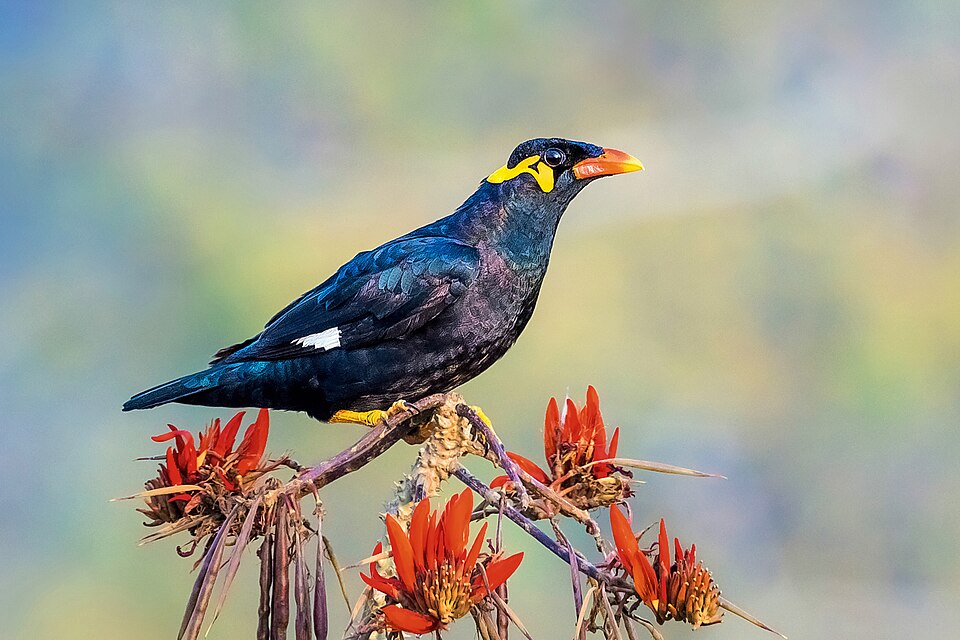
The Hill Myna is a bird native to South and Southeast Asia, renowned for its exceptional ability to mimic human speech and various environmental sounds. It displays glossy black plumage with iridescent green and violet reflections, along with characteristic yellow-orange wattles around the head and nape. Medium-sized, it inhabits tropical forests where it feeds mainly on fruits. Highly sociable and intelligent, it is widely sought after as an exotic pet worldwide, particularly because of its unique vocal talents among birds.
The Hill Myna measures approximately 25 to 29 cm in length and weighs 150 to 220 grams. Its plumage is black with iridescent green, blue, and violet reflections depending on the light. It is distinguished by fleshy bright yellow to orange wattles on the sides of the head and nape, as well as a bright orange beak and legs.
Characteristics
Indicative values: they vary by subspecies, sex and region.
Habitat and distribution
Hill mynas inhabit primarily dense, humid tropical forests, as well as forest edges and wooded areas near agricultural land. They favor the canopy where they find fruit and nesting cavities. They are also occasionally encountered on the outskirts of urban areas within their native range.
CURRENT RANGE
The hill myna is native to the Indian subcontinent, mainland Southeast Asia, and certain islands of Indonesia and the Philippines. Several subspecies exist depending on geographic region. Introduced or escaped captive populations also exist in other parts of the world.
Behaviour
The Hill Myna is a highly sociable bird that lives in pairs or small groups in its natural habitat. It possesses remarkable intelligence and exceptional vocal memory, capable of mimicking human speech and various ambient sounds with great precision. Active during the day, it spends considerable time foraging in the forest canopy. In captivity, it requires significant mental stimulation and regular interaction with humans.
Reproduction
The breeding season for hill mynas generally runs from spring through summer, depending on the region. The female typically lays two eggs in a tree cavity and incubates them for about two weeks. Both parents feed the young, which fledge after approximately one month.
Peculiarities
The hill myna is considered one of the finest vocal mimics in the avian world, rivaling African grey parrots. Its yellow wattles and iridescent black plumage give it a distinctive appearance that is easily recognized. Its ability to faithfully reproduce human speech makes it a highly prized pet but also sometimes a victim of illegal trafficking.
Threats and conservation
Hill mynas are threatened by illegal capture for the pet trade due to their highly sought-after mimicry abilities. Deforestation in their natural range also reduces available habitat. Certain island subspecies are particularly vulnerable because of their limited range.
Numbers and trends vary across sources and regions. See the IUCN assessment for the latest reference data.
Gallery
1 documented photographs.
References
Profile updated 04 September 2026 · Reviewed by the TunisieVet editorial team.
Comments (0)
No comments yet.
CONSERVATION STATUS
Least concern (LC)
IUCN source, latest published assessment.
Species health
Documented diseases for this species.
This information is provided for educational purposes only and is not a substitute for a veterinary consultation. If you have any concerns about your animal's health, consult a veterinarian.
Similar animals
Other species documented in Animalpedia.

TunisieVet in your pocket 📱🐾 Access your veterinary services wherever you are. [ Download the app ]
Learn more