
Presentation
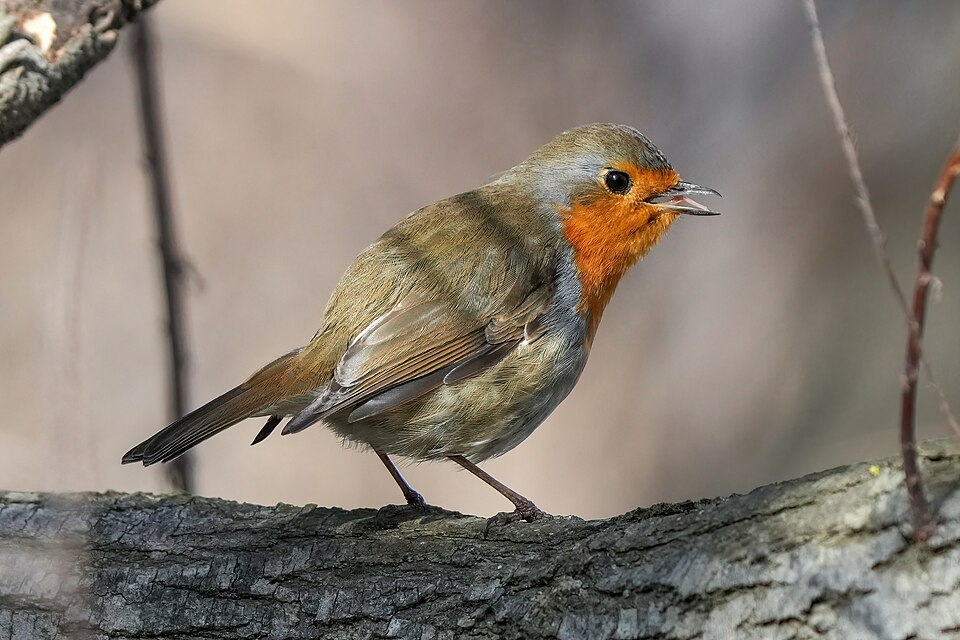
The European Robin (Erithacus rubecula) is a small songbird easily recognized by its orange-red throat and breast bordered with grey. Found across Europe, North Africa, and Western Asia, it inhabits gardens, hedgerows, and woodland edges. In Tunisia, it appears mainly as a winter visitor, particularly in the northern regions. A territorial bird, usually seen alone, it sings throughout the year to defend its territory. Its small size and tame nature make it a familiar sight around homes. It ranks among Europe's most beloved birds.
Characteristics
Indicative values: they vary by subspecies, sex and region.
Habitat and distribution
The robin frequents forests, hedgerows, gardens and urban parks with dense vegetation cover. It favours woodlands with thick scrub layers, suitable for nesting and ground foraging. In Tunisia, it is found mainly in wooded areas and northern gardens during winter.
CURRENT RANGE
The species is widely distributed across Europe, North Africa and parts of Western Asia. Northern European populations migrate south and west in winter, while southern populations are more sedentary. In Tunisia, it is observed chiefly as a winter visitor, from the north to more wooded areas of the country.
Behaviour
A solitary and highly territorial bird, even outside the breeding season. It defends its territory vigorously through song and displays of intimidation toward other robins. Curious and unafraid of humans, it often approaches gardeners to exploit the insects disturbed by soil work. Some populations are migratory while others are resident, depending on latitude.
Reproduction
The breeding season runs from April to July, typically producing two broods per year. The female builds a neat cup-shaped nest, usually hidden in dense cover, a bank, or a cavity, and lays 4 to 6 eggs. Incubation lasts about 13 to 15 days and chicks fledge after approximately two weeks. Both parents may participate in feeding the young.
Peculiarities
The robin is known for its melodious and complex song, which it sings even in winter. Its orange-red breast, often linked to winter cultural imagery in Europe, serves not to attract a mate but to defend territory against rivals. It is capable of singing at night in artificially lit areas.
Threats and conservation
The species is not globally threatened, but it suffers local habitat loss from the decline of hedgerows and woodlands. Pesticides that reduce insect populations also affect its food resources. Domestic cats and collisions with window glass are significant causes of mortality.
Numbers and trends vary across sources and regions. See the IUCN assessment for the latest reference data.
Gallery
1 documented photographs.
References
Profile updated 04 September 2026 · Reviewed by the TunisieVet editorial team.
Comments (0)
No comments yet.
CONSERVATION STATUS
Least concern (LC)
IUCN source, latest published assessment.
Species health
Documented diseases for this species.
See the 4 diseases of this species Find a veterinarianThis information is provided for educational purposes only and is not a substitute for a veterinary consultation. If you have any concerns about your animal's health, consult a veterinarian.
Similar animals
Other species documented in Animalpedia.

TunisieVet in your pocket 📱🐾 Access your veterinary services wherever you are. [ Download the app ]
Learn more