
Presentation
The Electric eel (Electrophorus electricus) is a freshwater fish native to South America, famous for its ability to produce powerful electrical discharges. Despite its name, it does not belong to the eel family but to the Gymnotidae family, closer to catfish. It lives in rivers, marshes and flooded areas of the Amazon region and the Orinoco. Its elongated body houses specialized electrical organs which are used for hunting, defense and communication. This species is well known to the general public because of its role in scientific research into animal electricity. However, it remains little present in amateur aquarium collections due to its dangerousness.
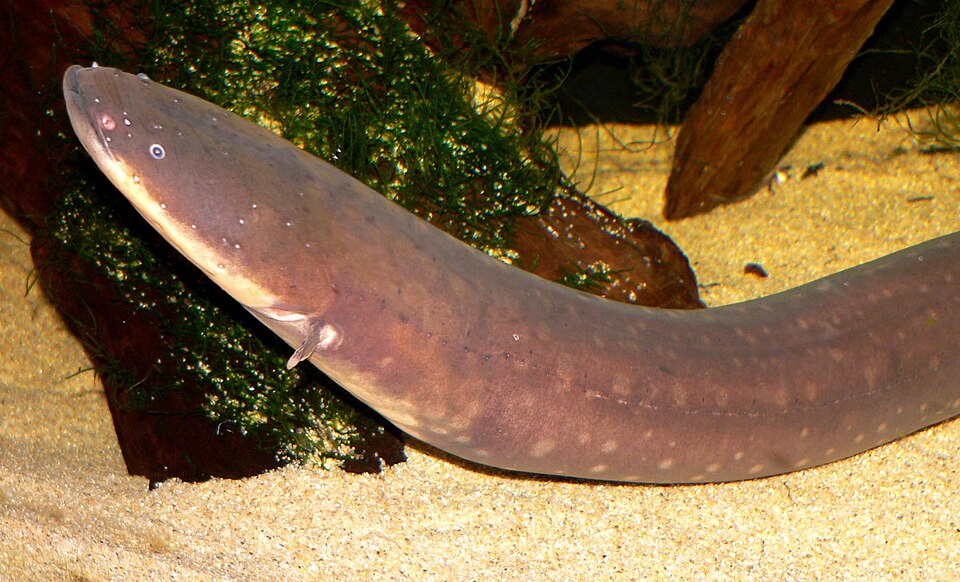
Electric eel has an elongated, cylindrical body, devoid of visible scales, grayish brown to black in color with an orange belly. It is not a true eel but a fish related to catfish, classified among the Gymnotiformes. It has electrical organs occupying approximately 80% of its body, allowing it to produce discharges of up to several hundred volts. Its very long anal fin runs almost the entire length of the body and provides most of its propulsion.
Characteristics
Indicative values: they vary by subspecies, sex and region.
Habitat and distribution
The Electric eel lives in the calm and often turbid fresh waters of rivers, swamps and flooded areas of South America. It prefers waters with a low oxygen content, which explains its complementary air respiration. It is found in the tributaries of the Amazon and the Orinoco, particularly in areas of flooded tropical forest. It seeks habitats offering dense plant cover to hide.
CURRENT RANGE
The species occurs in the Amazon-Orinoco basin in tropical South America. It is found in particular in Brazil, Peru, Colombia, Venezuela and the Guianas. It inhabits calm streams, swamps and flooded areas of the rainforest. It does not occur naturally on any other continent.
Behaviour
The Electric eel is a solitary, nocturnal animal, which hunts primarily using electrical discharges to detect and immobilize its prey. It has three specialized electrical organs capable of generating low intensity discharges for navigation and detection, and high intensity for hunting or defense. It must rise regularly to the surface to breathe atmospheric air thanks to a particular adaptation of its vascularized mouth. This behavior makes it a species dependent on atmospheric oxygen, even in poorly oxygenated waters.
Reproduction
Reproduction takes place in the dry season, when the male builds a moss nest in which the female lays her eggs. A single nest can contain several thousand eggs, and the male protects the nest until hatching. The fry first feed on the unfertilized eggs before switching to a meat diet. Sexual maturity is reached after several years.
Peculiarities
The Electric eel is capable of generating electrical discharges of up to 600 volts, used for hunting, defense and navigation. It has the particularity of having to breathe atmospheric air on the surface every few minutes. Its electrical organs take up most of its body, leaving little room for conventional internal organs. It is capable of detecting movements and the presence of prey thanks to a low intensity electric field that it emits continuously.
Threats and conservation
The species is not considered globally threatened, although degradation of its aquatic habitat due to pollution and deforestation may locally affect its populations. Incidental fishing and capture for the specialist aquarium trade represent minor pressures. Climate change and modification of Amazonian hydrological regimes could ultimately affect its habitat.
Numbers and trends vary across sources and regions. See the IUCN assessment for the latest reference data.
Gallery
1 documented photographs.
References
Profile updated 30 August 2026 · Reviewed by the TunisieVet editorial team.
Comments (0)
No comments yet.
CONSERVATION STATUS
Least concern (LC)
IUCN source, latest published assessment.
Species health
Documented diseases for this species.
Find a veterinarianThis information is provided for educational purposes only and is not a substitute for a veterinary consultation. If you have any concerns about your animal's health, consult a veterinarian.
To discover around: Electric eel
Videos, facts, stories and records linked to this species.
RECORD
up to approximately 860 volts
The fish with the highest voltage
Maximum discharge measured in some individuals during laboratory studies, a record among e...
Similar animals
Other species documented in Animalpedia.

TunisieVet in your pocket 📱🐾 Access your veterinary services wherever you are. [ Download the app ]
Learn more