
Presentation
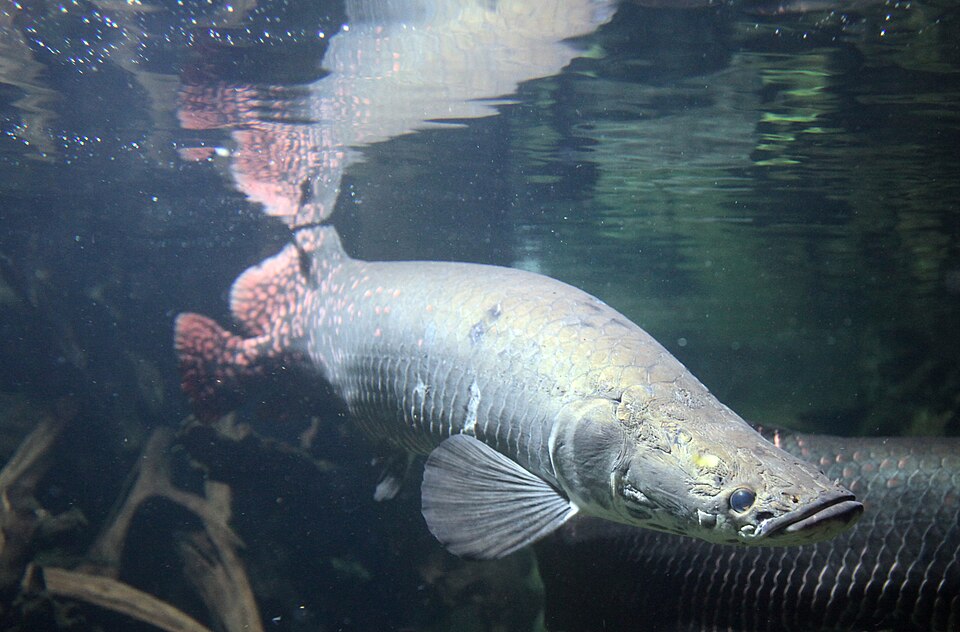
The Arapaima (Arapaima gigas) is one of the largest freshwater fish in the world, native to the Amazon basin. This fish has an elongated body covered with large, rigid scales, often tinged red towards the tail. A formidable predator, it hunts other fish and supplements its respiration thanks to a primitive lung allowing it to breathe atmospheric air. Its impressive size and appreciated flesh make it a highly sought-after species by local and international fishing. It is today threatened by overfishing in certain regions of its range.
The Arapaima has a massive, elongated body, covered in thick, tough scales that protect it from piranha attacks. Its head is flat and its wide mouth allows it to suck in its prey. It has a swim bladder modified into a respiratory organ, which requires it to regularly rise to the surface to breathe.
Characteristics
Indicative values: they vary by subspecies, sex and region.
Habitat and distribution
Arapaima lives in slow-moving rivers, lakes and flooded areas of the Amazon basin. It particularly likes stagnant or poorly oxygenated waters, where its air breathing gives it an advantage over other fish. It is also found in swampy areas and floodplains during flood season.
CURRENT RANGE
The species is native to the Amazon basin and its tributaries in South America, notably Brazil, Peru and Guyana. It has been introduced to other tropical regions for aquaculture. It does not occur naturally outside the South American continent.
Behaviour
This fish is rather solitary outside of breeding periods. It must rise to the surface regularly, approximately every 10 to 20 minutes, to breathe atmospheric air using its primitive lung. It is active mainly in calm, poorly oxygenated waters, where this respiratory adaptation gives it a clear advantage.
Reproduction
Reproduction generally takes place in the low water season. Both parents help protect the nest and fry, a rare behavior among fish. The male secretes a substance on his forehead which attracts and guides the young around him for several weeks.
Peculiarities
The Arapaima breathes atmospheric air using a vascularized swim bladder that functions like a lung. Its very hard scales have inspired research in materials science for their resistance to punctures. It is among the largest freshwater fish in the world.
Threats and conservation
Overfishing poses the main threat to the species in many regions of its range. The degradation and fragmentation of its aquatic habitat linked to deforestation and dams also aggravate its local decline. Management and supervised fishing programs now exist in certain protected areas of Brazil.
Numbers and trends vary across sources and regions. See the IUCN assessment for the latest reference data.
Gallery
1 documented photographs.
References
Profile updated 30 August 2026 · Reviewed by the TunisieVet editorial team.
Comments (0)
No comments yet.
CONSERVATION STATUS
Data deficient (DD)
IUCN source, latest published assessment.
Species health
Documented diseases for this species.
This information is provided for educational purposes only and is not a substitute for a veterinary consultation. If you have any concerns about your animal's health, consult a veterinarian.
To discover around: Arapaima
Videos, facts, stories and records linked to this species.
RECORD
up to 4 m / 200 kg
One of the largest freshwater fish
Measurements taken from exceptional wild specimens from the Amazon basin.
Similar animals
Other species documented in Animalpedia.

TunisieVet in your pocket 📱🐾 Access your veterinary services wherever you are. [ Download the app ]
Learn more