
Presentation
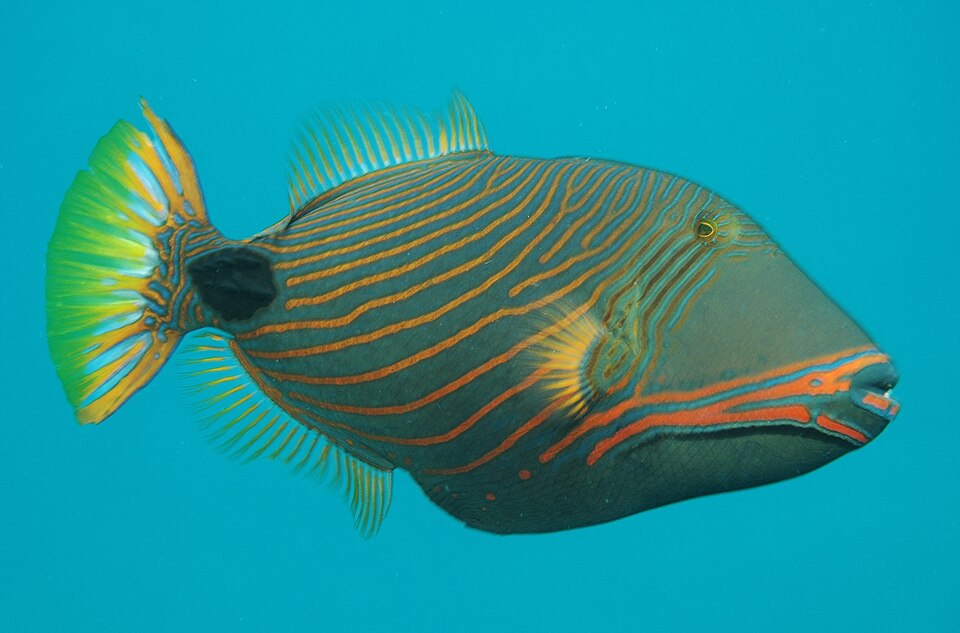
The Ballista is a marine fish of the Balistidae family, recognizable by its laterally compressed body and its spiny dorsal fin that it can erect in case of danger. It is found in temperate and tropical waters, particularly in the Mediterranean where it is regularly caught by Tunisian fishermen. Its colorful coat and powerful jaws with strong teeth allow it to feed on hard-shelled organisms. This fish is known for its territorial character and sometimes aggressive towards divers who approach its nest. Several species exist throughout the world, some living in tropical reef areas, others in the Mediterranean and the Atlantic. Its flesh is appreciated locally although its consumption remains less widespread than other fish.
The body of Ballista is oval, laterally flattened, covered with thick, rough skin rather than conventional scales. Its first dorsal fin has a sturdy spiny that it can lock in an erect position for protection. Its eyes, placed high on the head, can move independently of each other. The powerful jaws carry strong teeth suitable for crushing shellfish and crustaceans.
Characteristics
Indicative values: they vary by subspecies, sex and region.
Habitat and distribution
The Ballista frequents rocky, sandy or reef seabeds, generally at shallow to medium depths. It appreciates coastal areas rich in benthic invertebrates on which it feeds. In the Mediterranean, it is commonly found near the Tunisian coast.
CURRENT RANGE
Ballista is found in temperate and tropical seas worldwide, including the Mediterranean, Atlantic, and Indo-Pacific reef areas depending on the species. In Tunisia, it is regularly observed and fished along the coasts.
Behaviour
The Ballista is a rather solitary and territorial fish, particularly during the breeding season when it actively defends its nest. It may be aggressive towards intruders, including divers, by charging or biting. It moves by undulating its dorsal and anal fins, which gives it good maneuverability near the bottom.
Reproduction
The female lays her eggs in a depression on the seabed that she and the male watch vigilantly. The parents actively defend the nest against predators and intruders during the incubation period. After hatching, the larvae join the plankton before developing into benthic juveniles.
Peculiarities
The Ballista can lock its backbone to wedge itself into a rocky crevice and escape a predator. Its independently movable eyes give it a wide field of vision. Its thick, rough skin replaces a classic covering of scales.
Threats and conservation
Coastal fishing and the degradation of reef and rocky habitats constitute the main pressures on certain local populations. Overall, the species is not considered globally threatened. However, certain Mediterranean populations are subject to notable fishing pressure.
Numbers and trends vary across sources and regions. See the IUCN assessment for the latest reference data.
Gallery
1 documented photographs.
References
Profile updated 31 August 2026 · Reviewed by the TunisieVet editorial team.
Comments (0)
No comments yet.
CONSERVATION STATUS
Least concern (LC)
IUCN source, latest published assessment.
Species health
Documented diseases for this species.
See the 4 diseases of this species Find a veterinarianThis information is provided for educational purposes only and is not a substitute for a veterinary consultation. If you have any concerns about your animal's health, consult a veterinarian.
Similar animals
Other species documented in Animalpedia.

TunisieVet in your pocket 📱🐾 Access your veterinary services wherever you are. [ Download the app ]
Learn more