
Presentation
The sea bass, also called bass in the Mediterranean, is a marine fish appreciated for its fine flesh and its commercial value. It has an elongated, silvery body, suitable for fast swimming in open water. This predator lives in schools near coasts, estuaries and sometimes in brackish water. It is widely fished and also raised in aquaculture, particularly in the Mediterranean. In Tunisia, it is among the most sought-after marine species, both in artisanal fishing and in farming. Its robustness and ability to adapt to variable salinities make it a widespread species on the Atlantic and Mediterranean coasts.
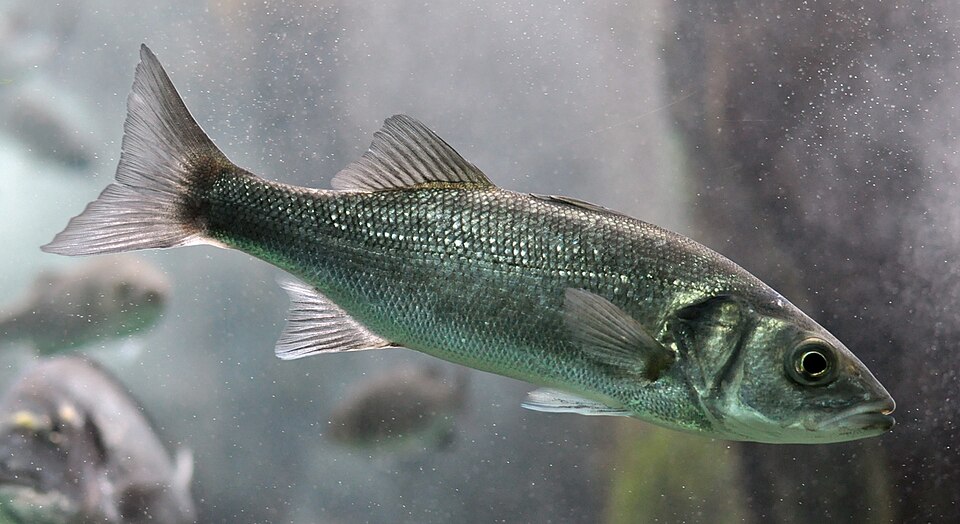
The sea bass has a silvery, tapered body, a pointed head and two distinct dorsal fins, the first spiny. Its mouth is wide with small teeth, suitable for capturing lively prey. Juveniles sometimes have small dark spots on their sides, disappearing with age.
Characteristics
Indicative values: they vary by subspecies, sex and region.
Habitat and distribution
The bass frequents coastal waters, estuaries, lagoons and sometimes the brackish waters of coastal wetlands. It tolerates wide variations in salinity and temperature. Juveniles often settle in shallow areas rich in food.
CURRENT RANGE
The species occurs along the coasts of the Northeast Atlantic, from Norway to Morocco, as well as in the Mediterranean Sea and the Black Sea. It is common on the Tunisian coasts, where it is actively fished. Bass is also introduced or raised in various Mediterranean aquaculture basins.
Behaviour
The bass is a gregarious fish which forms schools, especially in its juvenile state. It is active and moves between coastal areas and estuaries depending on the seasons and water temperature. Adults become more solitary and territorial as breeding approaches.
Reproduction
Breeding takes place at sea, usually in winter and early spring, in deeper waters. The female releases a large number of pelagic eggs which drift with the currents. The larvae and then the juveniles then reach coastal areas and estuaries, considered essential nurseries.
Peculiarities
The bass is capable of living in both salt water and brackish water, which reflects good physiological tolerance. It is one of the main marine aquaculture species in the Mediterranean, particularly in Tunisia. Its sporty catch at the line is highly prized for the resistance it offers.
Threats and conservation
Overfishing and the degradation of coastal habitats, particularly estuaries and lagoons serving as nurseries, weigh on certain wild populations. Pollution of coastal waters also poses a local threat. Aquaculture helps reduce pressure on natural stocks while posing its own environmental challenges.
Numbers and trends vary across sources and regions. See the IUCN assessment for the latest reference data.
Gallery
1 documented photographs.
References
Profile updated 29 August 2026 · Reviewed by the TunisieVet editorial team.
Comments (0)
No comments yet.
CONSERVATION STATUS
Least concern (LC)
IUCN source, latest published assessment.
Species health
Documented diseases for this species.
See the 8 diseases of this species Find a veterinarianThis information is provided for educational purposes only and is not a substitute for a veterinary consultation. If you have any concerns about your animal's health, consult a veterinarian.
To discover around: Bar
Videos, facts, stories and records linked to this species.
Similar animals
Other species documented in Animalpedia.

TunisieVet in your pocket 📱🐾 Access your veterinary services wherever you are. [ Download the app ]
Learn more