
Presentation
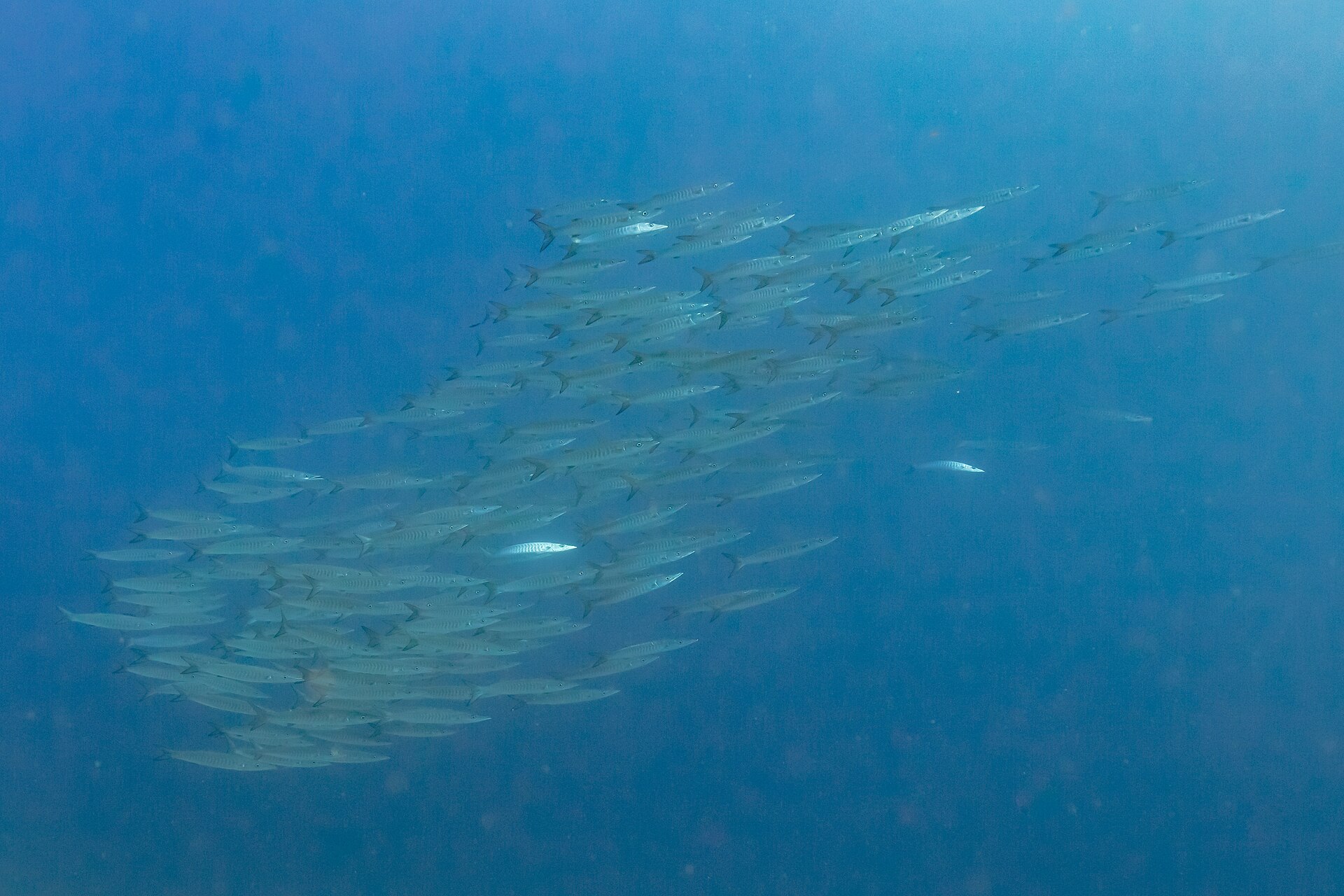
The Barracuda is a predatory marine fish recognizable by its elongated, spindle-shaped body and its powerful jaw filled with sharp teeth. It lives in tropical and warm temperate seas, often near coral reefs, seagrass beds or in open coastal waters. A fast and opportunistic hunter, it feeds mainly on fish. The name “Barracuda” brings together several species of the genus Sphyraena, the best known of which is the large Barracuda (Sphyraena Barracuda). This fish has a fearsome reputation among swimmers and divers, although attacks on humans remain rare. In the Mediterranean, particularly on the Tunisian coasts, a smaller species, the becune (Sphyraena sphyraena), is present.
The body of the Barracuda is long, cylindrical and silvery, suitable for fast, straight-line swimming. Its head is pointed with a prominent lower jaw and very sharp triangular teeth. It can measure from 60 cm to more than 1.80 m depending on the species and age. Its forked caudal fin allows it to make sudden accelerations to capture its prey.
Characteristics
Indicative values: they vary by subspecies, sex and region.
Habitat and distribution
The Barracuda frequents coastal marine waters and sometimes the open sea, particularly around coral reefs, seagrass beds and rocky areas. It tolerates a wide range of depths, from the surface to several tens of meters. Juveniles prefer sheltered waters such as lagoons and mangroves.
CURRENT RANGE
The large Barracuda occurs in tropical and subtropical waters of the Atlantic, Indo-Pacific, and Caribbean Sea. In the Mediterranean, the species present is the bécune, observed particularly along the Tunisian and North African coasts. The distribution varies according to the species of the genus Sphyraena, present on almost all the warm coastlines of the globe.
Behaviour
Adult Barracuda are often solitary, while juveniles form schools to protect themselves from predators. It is active mainly during the day and hunts by ambush, remaining motionless before rushing towards its prey. It can be curious towards divers, attracted by shiny objects, without being aggressive towards humans. Its top speed allows it to carry out lightning attacks over short distances.
Reproduction
Reproduction takes place by spawning in open water, generally during seasonal gatherings linked to water temperature. The eggs and larvae are pelagic and drift with the currents before the juveniles reach shallow coastal areas, such as seagrass beds or mangroves, which serve as nurseries. Sexual maturity is reached after a few years depending on the species.
Peculiarities
The Barracuda is sometimes confused with a dangerous predator for humans because of its threatening appearance, but incidents remain exceptional and often linked to poor visibility or confusion with a shiny bait. Some large species can accumulate ciguatoxin, making their flesh unsafe to eat in some areas. Its asymmetrical jaw, with the lower mandible protruding beyond the upper, is characteristic of the genus.
Threats and conservation
Overfishing and sport fishing are putting pressure on some local populations of Barracuda. The degradation of coral reefs and seagrass beds, which serve as nurseries for juveniles, constitutes an indirect threat. Overall, the species remains widespread and is not considered globally threatened.
Numbers and trends vary across sources and regions. See the IUCN assessment for the latest reference data.
Gallery
1 documented photographs.
References
Profile updated 31 August 2026 · Reviewed by the TunisieVet editorial team.
Comments (0)
No comments yet.
CONSERVATION STATUS
Least concern (LC)
IUCN source, latest published assessment.
Species health
Documented diseases for this species.
This information is provided for educational purposes only and is not a substitute for a veterinary consultation. If you have any concerns about your animal's health, consult a veterinarian.
To discover around: Barracuda
Videos, facts, stories and records linked to this species.
Similar animals
Other species documented in Animalpedia.

TunisieVet in your pocket 📱🐾 Access your veterinary services wherever you are. [ Download the app ]
Learn more