Presentation
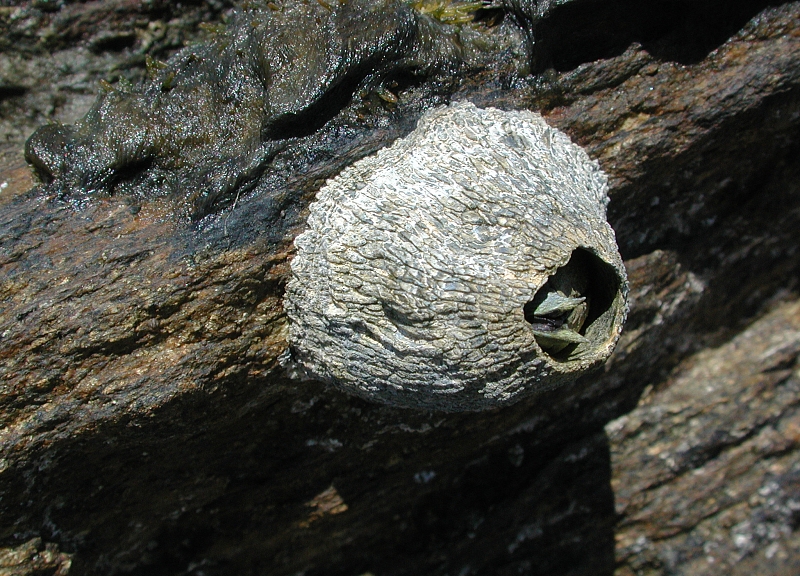
The barnacle is a sessile marine crustacean belonging to the group Cirripedia, often mistakenly confused with a mollusk because of its calcareous shell. It becomes permanently attached at the larval stage to hard surfaces such as rocks, ship hulls, or the shells of other animals. Its body is protected by a series of calcareous plates forming a truncated cone, open at the top by a mobile operculum. At low tide, it closes this operculum to retain moisture, then opens it at high tide to deploy its feathery appendages for capturing food. This fixed lifestyle and its distinctive architecture make it an emblematic organism of rocky intertidal zones worldwide. Despite its small size, it plays an important ecological role in intertidal communities.
The barnacle has a calcareous shell made up of overlapping plates, conical or cylindrical in shape depending on the species. It is hermaphroditic but generally practices cross-fertilization through a highly elongated copulatory organ. Its cirri, feathery appendages homologous to crustacean legs, emerge from the opercular opening to filter water. Size varies from a few millimeters to several centimeters depending on the species.
Characteristics
Indicative values: they vary by subspecies, sex and region.
Habitat and distribution
The barnacle colonizes rocky intertidal zones, jetties, ship hulls, and various hard substrates that are submerged or periodically exposed to air. It tolerates wide fluctuations in temperature, salinity, and air exposure typical of the intertidal zone. Some species also attach to mobile marine organisms such as whales, sea turtles, or crabs.
CURRENT RANGE
Barnacles are found in all oceans worldwide, from polar zones to tropical regions. They occur on rocky coasts at all latitudes, including the Mediterranean and Tunisian coasts. Their wide distribution is explained by their planktonic larval phase, which can drift over long distances.
Behaviour
Completely sessile as an adult, the barnacle never moves after its permanent attachment to a substrate. It alternates between phases of active filtering at high tide and phases of rest with the operculum closed at low tide. Barnacles often live in dense colonies, which optimizes their chances of cross-fertilization. They can also attach to mobile animals such as whales or sea turtles, thus benefiting from passive transport.
Reproduction
The barnacle is hermaphroditic but avoids self-fertilization by using an extensible penis that can reach several times its body length to fertilize a neighboring individual. Fertilized eggs are incubated in the mantle cavity before being released as planktonic nauplius larvae. These larvae pass through several molting stages before transforming into the cypris stage, the final substrate-seeking phase. Once a suitable surface is found, the cypris larva attaches permanently and metamorphoses into a sedentary adult barnacle.
Peculiarities
The barnacle possesses, proportionally to its size, one of the longest copulatory organs in the animal kingdom, allowing it to fertilize neighbors without moving. Its calcareous shell is so resistant it can damage ship hulls and requires regular cleaning called de-fouling. Barnacle larvae release an adhesive substance among the most powerful known in nature, which is being studied for biomimetic applications.
Threats and conservation
The barnacle is globally not threatened and its populations remain abundant on most coastlines. It can, however, be affected locally by pollution, warming of coastal waters, and habitat modification of rocky areas due to coastal urbanization. It is sometimes considered a harmful invasive species when it massively colonizes human infrastructure.
Numbers and trends vary across sources and regions. See the IUCN assessment for the latest reference data.
Gallery
1 documented photographs.
References
Profile updated 29 August 2026 · Reviewed by the TunisieVet editorial team.
Comments (0)
No comments yet.
CONSERVATION STATUS
Least concern (LC)
IUCN source, latest published assessment.
Species health
Documented diseases for this species.
Find a veterinarianThis information is provided for educational purposes only and is not a substitute for a veterinary consultation. If you have any concerns about your animal's health, consult a veterinarian.
To discover around: Barnacle
Videos, facts, stories and records linked to this species.
Similar animals
Other species documented in Animalpedia.

Be among the first to use our app. Sign up and get early Google Play access.
Discover