
Presentation
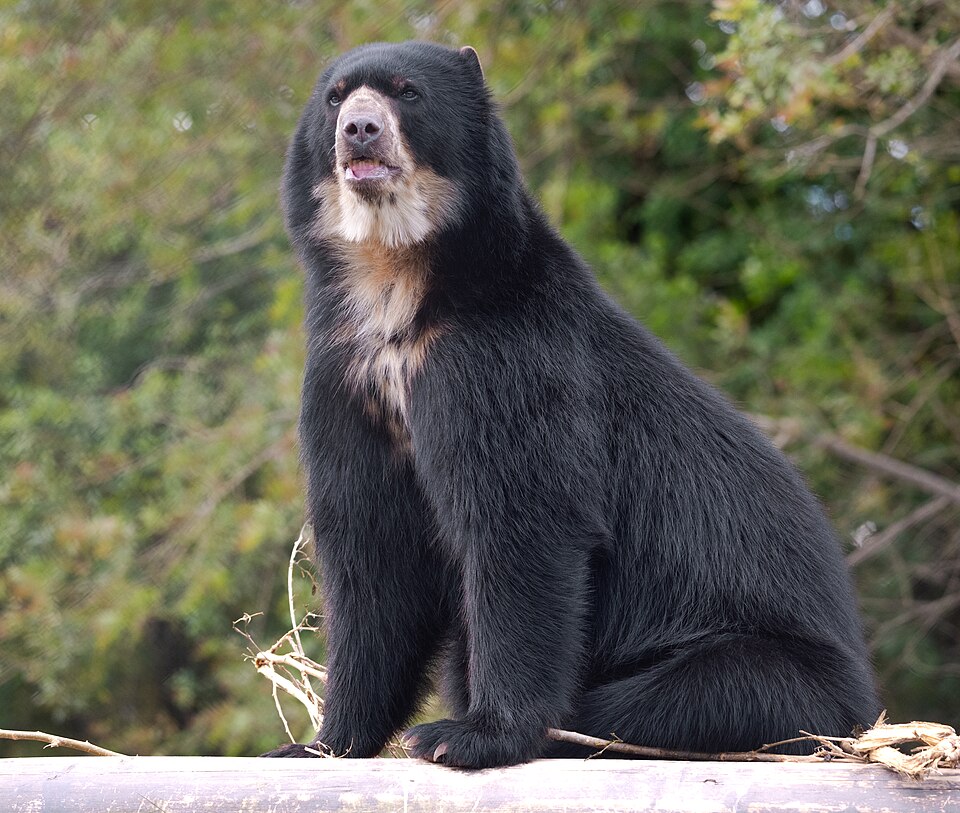
Bear with glasses is the only current representative of the Ursidae family in South America. It owes its name to the light markings sometimes surrounding its eyes, which contrast with its black-brown coat. Discreet and rather solitary, it lives mainly in the Andean forests, from Venezuela to Bolivia. A good climber, it sometimes builds platforms in trees to rest or feed. His diet is largely vegetarian, which makes him an atypical bear. The species is threatened by deforestation and habitat fragmentation. It has a black to dark brown coat, often decorated with whitish or cream spots around the eyes, muzzle and chest, unique to each individual. Its body is massive but less imposing than that of other large ursids. Its powerful, curved claws make it easier to climb trees.
Characteristics
Indicative values: they vary by subspecies, sex and region.
Habitat and distribution
It mainly frequents the cloud forests and tropical montane forests of the Andes, up to high altitudes. It is also found in certain areas of páramo and dry forest on the outskirts of its range. This diversity of habitats reflects its capacity for altitudinal adaptation.
CURRENT RANGE
The species is present along the Andes, from Venezuela and Colombia to Bolivia, passing through Ecuador and Peru. Its distribution is fragmented by deforestation and agricultural expansion. It is the only bear in South America.
Behaviour
The Bear with glasses is essentially solitary and discreet in habits, active at dusk and at night. It climbs trees skillfully, particularly to reach fruit or escape disturbances. Its territory can be vast, depending on the availability of food resources.
Reproduction
The female gives birth after a gestation which includes a phase of embryonic diapause, resulting in the birth of one to two cubs. The young are born blind and dependent, in a protected shelter. They stay with their mother for several months before becoming independent.
Peculiarities
It is the last living representative of the short-faced ursids in South America, a formerly more diverse lineage. The clear facial markings, which vary depending on the individual, sometimes allow them to be visually distinguished. His very vegetarian diet clearly sets him apart from other bears.
Threats and conservation
Habitat loss and fragmentation due to deforestation and agriculture pose the main threat. Poaching and conflicts with breeders, in retaliation for alleged predation on livestock, also affect populations. These pressures have led to a continued decline of the species.
Numbers and trends vary across sources and regions. See the IUCN assessment for the latest reference data.
Gallery
1 documented photographs.
References
Profile updated 26 August 2026 · Reviewed by the TunisieVet editorial team.
Comments (0)
No comments yet.
CONSERVATION STATUS
Vulnerable (VU)
IUCN source, latest published assessment.
Species health
Documented diseases for this species.
This information is provided for educational purposes only and is not a substitute for a veterinary consultation. If you have any concerns about your animal's health, consult a veterinarian.
To discover around: Bear with glasses
Videos, facts, stories and records linked to this species.
Similar animals
Other species documented in Animalpedia.
