
Presentation
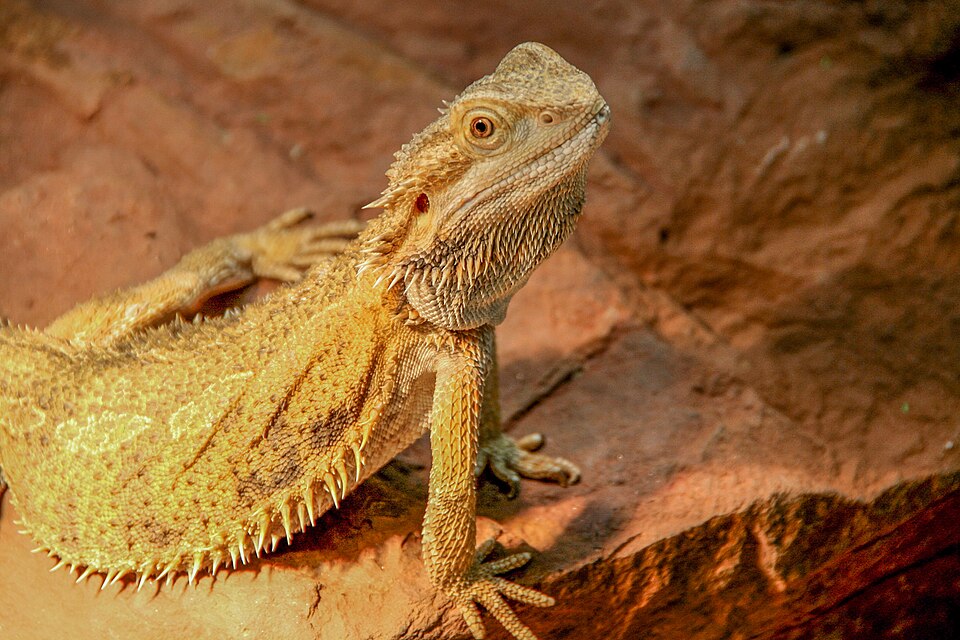
The bearded dragon is a robust and impressive lizard, easily recognized by the characteristic structure of its head and the pocket of extensible skin under its throat, which bristles when threatened or during intimidating behavior. Native to Australia, it is a terrestrial and semi-arboreal reptile very popular in captivity.
The bearded dragon has a stocky silhouette with a dorsoventrally flattened body and a characteristic triangular head. Its skin, rough and dusty, generally has gray, brown or ocher hues with variable patterns. The throat scales, called a "beard", swell during intimidation, giving the reptile its distinctive name.
Characteristics
Indicative values: they vary by subspecies, sex and region.
Habitat and distribution
The bearded dragon inhabits the arid and semi-arid regions of Australia: deserts, rocky steppes and arid savannah areas. It prefers environments with moderate shrub cover, allowing both basking and shelters, as well as sandy or rocky substrates conducive to thermoregulation and burrow construction.
CURRENT RANGE
The bearded dragon is endemic to central and eastern Australia. Its natural range extends mainly across New South Wales, Queensland, South Australia and Central Australia. The species is not found in Tunisia in the wild, but is widely represented in private and institutional collections.
Behaviour
The bearded dragon is diurnal and semi-arboreal, spending part of its time on the ground and part on rocks or bushes. It is a generally solitary animal but tolerant towards its conspecifics in captivity. He communicates through distinctive body positions, including straightening his "beard" and flexing his body sideways to establish his hierarchical status or express stress.
Reproduction
Bearded dragon reproduction is oviparous. The female generally lays 15 to 25 eggs in a cavity or burrow dug in the sand, which she abandons after laying eggs. Incubation lasts approximately 60 to 70 days depending on temperature. Juveniles are completely independent upon hatching and receive no parental care.
Peculiarities
The throat inflation mechanism is a dramatic behavioral adaptation: the guttural pouch fills with blood and bristles, transforming the dragon into an imposing silhouette intended to deter predators. This species is also renowned for its remarkable adaptability to life in captivity, hence its worldwide popularity in terrariums. Its longevity and generally docile temperament make it a popular pet for beginners.
Threats and conservation
In Australia, bearded dragon populations face no major threats and the species maintains a favorable conservation status. Capture for the pet trade has no significant impact on wild populations. However, habitat modification and extreme climate variations could pose long-term risks.
Numbers and trends vary across sources and regions. See the IUCN assessment for the latest reference data.
Gallery
1 documented photographs.
References
UICN — Liste rouge des espèces menacées
Profile updated 17 August 2026 · Reviewed by the TunisieVet editorial team.
Comments (0)
No comments yet.
CONSERVATION STATUS
Least concern (LC)
IUCN source, latest published assessment.
Species health
Documented diseases for this species.
This information is provided for educational purposes only and is not a substitute for a veterinary consultation. If you have any concerns about your animal's health, consult a veterinarian.
To discover around: Bearded dragon
Videos, facts, stories and records linked to this species.
Similar animals
Other species documented in Animalpedia.

TunisieVet in your pocket 📱🐾 Access your veterinary services wherever you are. [ Download the app ]
Learn more