
Presentation
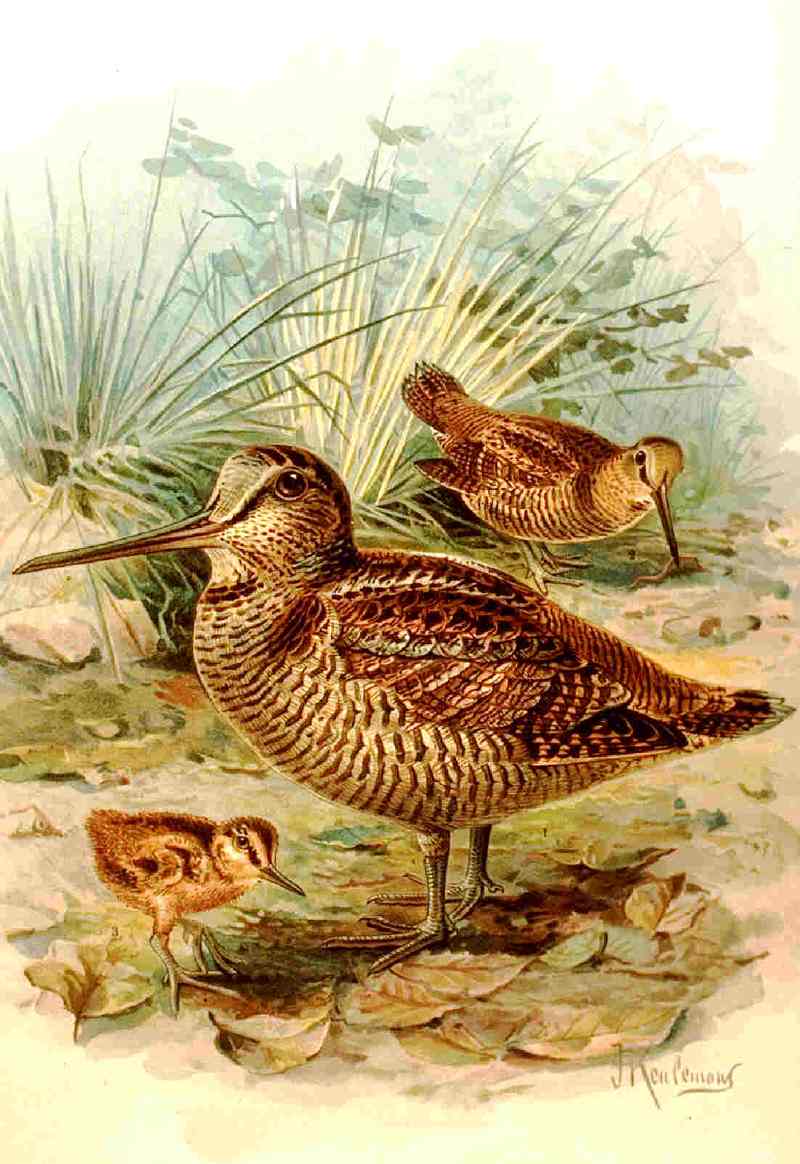
The Eurasian woodcock is a stocky wading bird with rust-brown plumage, finely mottled to blend seamlessly into the forest floor. It has a long, straight, supple bill perfectly adapted for probing soft soil for prey, and large eyes positioned high on its head that give it nearly panoramic vision. Secretive and nocturnal, it remains motionless on the ground throughout the day and feeds mainly at dusk and during the night. Its seasonal migration takes it from the forests of northern Europe to milder regions, including North Africa. Prized by hunters for the difficulty of flushing it out, it nonetheless remains a discreet bird, seldom seen by the casual observer.
It measures approximately 33 to 38 cm in length, with a rounded body and broad, rounded wings. Its cryptic plumage of brown, rust, and black mimics dead leaves and forest humus perfectly. The long, flexible bill, equipped with a sensitive tip, allows the bird to detect earthworms beneath the soil surface without seeing them.
Characteristics
Indicative values: they vary by subspecies, sex and region.
Habitat and distribution
The woodcock inhabits damp forests with dense undergrowth, either deciduous or mixed woodland, offering soft, invertebrate-rich soil. In winter, it also frequents wetlands, hedgerow grasslands, and forest edges. In Tunisia, it winters in the forests and maquis of the northern regions.
CURRENT RANGE
The species breeds in the temperate forests of Europe and Asia, from the United Kingdom to Japan. Northern populations migrate in winter to Western Europe, the Mediterranean region, and North Africa. Tunisia serves as a regular wintering ground, notably in the forested regions of the north and centre.
Behaviour
An essentially crepuscular and nocturnal species, it remains concealed and motionless in undergrowth during the day, relying on its camouflage. It is solitary outside the breeding season and performs characteristic aerial displays called "roding" in spring. Wary and discreet, it flushes suddenly and noisily when disturbed, flying in a zigzag pattern between trees.
Reproduction
The female typically lays 4 eggs directly on the ground in a shallow depression lined with leaves. Incubation lasts about 21 to 24 days and is carried out by the female alone. The young are precocial and leave the nest shortly after hatching, though the mother continues to protect them for several weeks.
Peculiarities
Its eyes, positioned very high and laterally on the skull, give it a field of vision close to 360 degrees, allowing it to monitor its surroundings even with its head down while probing the soil. The tip of its bill is mobile and richly innervated, enabling it to catch prey detected underground without needing to open it completely.
Threats and conservation
Hunting, as a traditionally sought-after game species, places significant pressure on certain populations. Degradation and fragmentation of damp forest habitats also threaten its breeding and wintering areas. Climate change could further alter its migration routes and timing.
Numbers and trends vary across sources and regions. See the IUCN assessment for the latest reference data.
Gallery
1 documented photographs.
References
Profile updated 08 September 2026 · Reviewed by the TunisieVet editorial team.
Comments (0)
No comments yet.
CONSERVATION STATUS
Least concern (LC)
IUCN source, latest published assessment.
Species health
Documented diseases for this species.
Find a veterinarianThis information is provided for educational purposes only and is not a substitute for a veterinary consultation. If you have any concerns about your animal's health, consult a veterinarian.
Similar animals
Other species documented in Animalpedia.

TunisieVet in your pocket 📱🐾 Access your veterinary services wherever you are. [ Download the app ]
Learn more