
Presentation
The American Bison (Bison Bison) is the largest land mammal in North America. Massive and stocky, it is distinguished by its muscular dorsal hump, its imposing head and its thick fleece at the front of the body. Once present in tens of millions in the Great Plains, it almost disappeared in the 19th century before being saved by conservation programs. It lives in herds and plays an important ecological role in maintaining grasslands. A close cousin, the European Bison (Bison bonasus), also occurs in the forests of Eastern Europe.
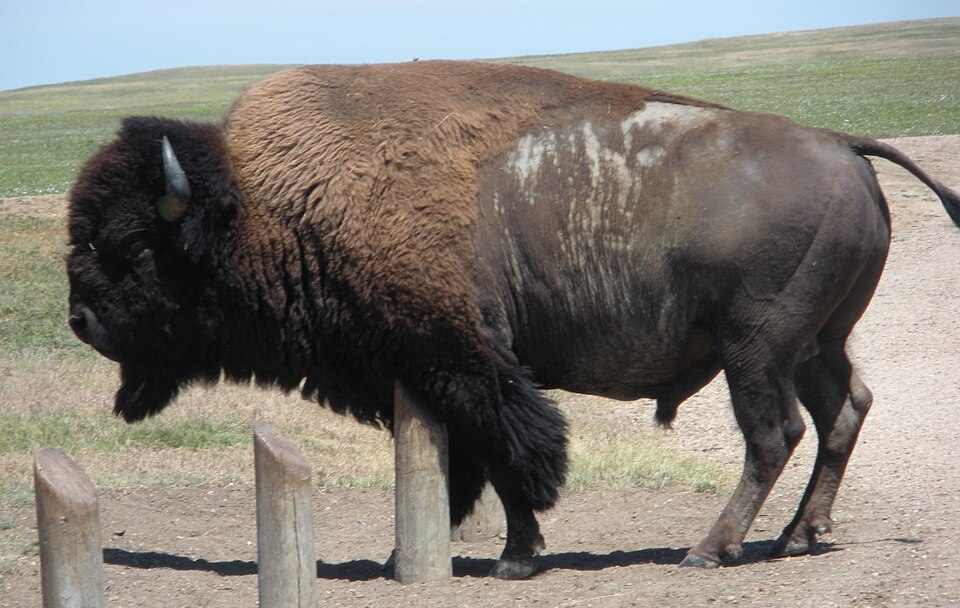
The Bison has a massive body with the forequarters more developed than the hindquarters, topped with a muscular hump. Its head is broad, with short, curved horns present in both sexes. Thick dark brown fur covers the head, neck and shoulders, contrasting with shorter coat on the rear of the body.
Characteristics
Indicative values: they vary by subspecies, sex and region.
Habitat and distribution
The Bison mainly frequents large prairies, grassy steppes and some open wooded areas of North America. It needs large areas offering both pasture and water points. Some populations survive today in national parks and protected reserves.
CURRENT RANGE
Historically, Bison occupied much of the plains of North America, from Canada to Mexico. Today, its presence is restricted to national parks, reserves and private ranches, particularly in the United States and Canada. The European Bison, a distinct species, is found in some forests of Poland and Belarus.
Behaviour
The Bison lives in herds whose size varies according to the season, the females and young forming groups distinct from the solitary males or in small groups. It is renowned for its robust character but can be unpredictable and aggressive, especially during the rutting period. Despite its size, it can reach high running speeds over short distances.
Reproduction
The Bison's mating season occurs in summer, during which males compete for access to females through fighting and vocalizations. Gestation lasts approximately nine months and ends with the birth of a single calf in the spring. The young stay with its mother for several months before joining the larger herd.
Peculiarities
The Bison can charge surprisingly quickly despite its heavy weight. Its dorsal hump is actually made up of powerful muscles supporting its massive head, useful for clearing snow from the ground in winter in search of food. The species experienced a dramatic decline in the 19th century, going from several million individuals to a few hundred.
Threats and conservation
The Bison was hunted extensively in the 19th century, leading to near extinction of the species. Today, the main threats concern habitat fragmentation and genetic management of remaining herds, often hybridized with domestic cattle. Conservation programs have helped stabilize wild populations.
Numbers and trends vary across sources and regions. See the IUCN assessment for the latest reference data.
Gallery
1 documented photographs.
References
Profile updated 27 August 2026 · Reviewed by the TunisieVet editorial team.
Comments (0)
No comments yet.
CONSERVATION STATUS
Near threatened (NT)
IUCN source, latest published assessment.
Species health
Documented diseases for this species.
See the 4 diseases of this species Find a veterinarianThis information is provided for educational purposes only and is not a substitute for a veterinary consultation. If you have any concerns about your animal's health, consult a veterinarian.
To discover around: Bison
Videos, facts, stories and records linked to this species.
RECORD
up to 1,000 kg
Largest land mammal in North America
Measurement taken on wild adult males in good physical condition.
Similar animals
Other species documented in Animalpedia.

TunisieVet in your pocket 📱🐾 Access your veterinary services wherever you are. [ Download the app ]
Learn more