
Presentation
The European bison is the largest wild terrestrial mammal on the European continent. Massive and stocky, it differs from its American cousin by a less pronounced hump and shorter fur. Long hunted, it disappeared from the wild in the early twentieth century before being reintroduced from individuals preserved in captivity. It lives today in herds in several forests of central and eastern Europe, particularly in Poland and Belarus. The species remains emblematic of European wildlife conservation programs.
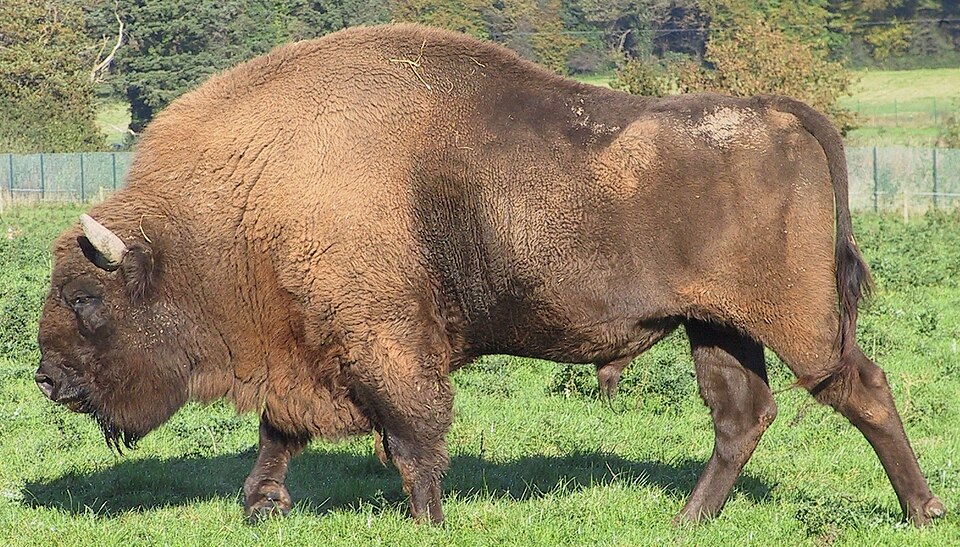
The European bison has a massive body, a broad head topped with short curved horns, and a dorsal hump less pronounced than that of the American bison. Its dark brown coat is longer over the head and neck. Males are distinctly more imposing than females.
Characteristics
Indicative values: they vary by subspecies, sex and region.
Habitat and distribution
The species inhabits mixed and deciduous forests with clearings and open areas for grazing. It prefers wooded areas near meadows or wetlands. Reintroduction programs have focused on protected forest massifs capable of supporting stable herds.
CURRENT RANGE
The European bison is found mainly in Poland, Belarus, Lithuania, and several other Central and Eastern European countries through reintroduction programs. The Białowieża Forest, spanning Poland and Belarus, is home to one of the largest populations. Smaller populations also exist in other European countries as a result of conservation projects.
Behaviour
The European bison lives in small herds composed of females and young, while adult males are often solitary or grouped in small bands outside the breeding season. It is a generally calm animal but capable of charging rapidly if it feels threatened. It is primarily active during the day, with phases of rest and rumination.
Reproduction
The rut occurs between August and October, a period when males compete for access to females. Gestation lasts approximately nine months and typically results in the birth of a single calf. The calf stays close to its mother for several months before becoming fully integrated into the herd.
Peculiarities
The species came close to complete extinction in the wild, with all current individuals descending from a very limited number of captive survivors. This low genetic diversity remains a major concern for its long-term conservation. The European bison is now a powerful symbol of the restoration of large wild fauna in Europe.
Threats and conservation
The main threats are fragmentation of its forest habitat and low genetic diversity in current populations. Disease and conflicts linked to agricultural expansion around protected areas also pose risks. Population management remains closely monitored by conservation programs.
Numbers and trends vary across sources and regions. See the IUCN assessment for the latest reference data.
Gallery
1 documented photographs.
References
Profile updated 06 September 2026 · Reviewed by the TunisieVet editorial team.
Comments (0)
No comments yet.
CONSERVATION STATUS
Vulnerable (VU)
IUCN source, latest published assessment.
Species health
Documented diseases for this species.
See the 4 diseases of this species Find a veterinarianThis information is provided for educational purposes only and is not a substitute for a veterinary consultation. If you have any concerns about your animal's health, consult a veterinarian.
To discover around: European Bison
Videos, facts, stories and records linked to this species.
RECORD
up to approximately 900–1000 kg
Europe's largest wild land mammal
Measurement taken from adult males in good physical condition in reintroduced populations.
Similar animals
Other species documented in Animalpedia.

TunisieVet in your pocket 📱🐾 Access your veterinary services wherever you are. [ Download the app ]
Learn more