
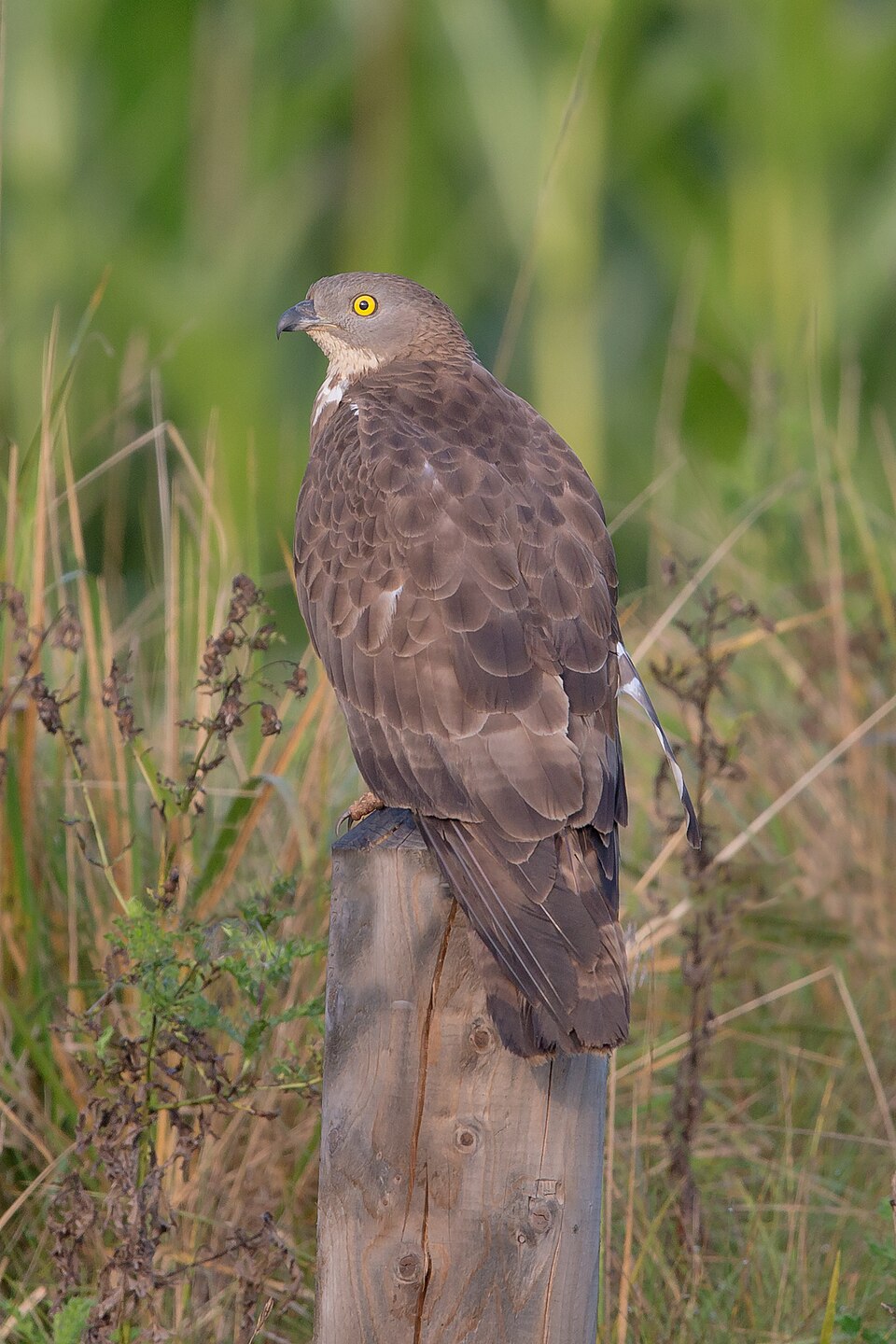
Presentation
The apivorous Buzzard (Pernis apivorus) is a medium-sized diurnal raptor belonging to the Accipitridae family. It is distinguished from other raptors by its specialized diet, largely composed of social insects such as wasps and bees. A long-term migrant, it nests in Europe and winters in sub-Saharan Africa, crossing Tunisia during its migrations. Its variable plumage, ranging from light brown to dark brown, makes its identification sometimes difficult. It has unique physical adaptations, such as stiff feathers around its beak and eyes, protecting it from insect bites.
The Buzzard measures between 52 and 60 cm long with a wingspan of 135 to 150 cm. Its plumage varies greatly depending on the individual, from very light to very dark, which complicates its identification in flight. It has a small head in proportion to the body, a thin neck and yellow to orange-red eyes. Its wings are long and its tail has characteristic bands.
Characteristics
Indicative values: they vary by subspecies, sex and region.
Habitat and distribution
The Buzzard frequents deciduous and mixed forests, generally near clearings or open areas suitable for hunting hymenoptera. She appreciates bocage landscapes and forest edges. In migration, it crosses various environments, including semi-arid zones and steppes.
CURRENT RANGE
The species breeds across most of Europe and western Asia, and winters in sub-Saharan Africa. It crosses Tunisia during its seasonal migrations, particularly at Cape Bon, a strategic crossing point between Europe and Africa. These migratory stopovers make it a species observed regularly but not nesting in the country.
Behaviour
The Buzzard is a migratory bird that travels long distances between Europe and sub-Saharan Africa, often in large groups forming columns as they pass over straits. It is rather discreet and silent outside the breeding season. Its flight is characteristic, with shallow wingbeats and periods of gliding. She locates hymenoptera nests by observing their comings and goings from a lookout post.
Reproduction
The Buzzard builds a nest of branches in a tree, often reused or rebuilt each year. The female usually lays two eggs, incubated by both parents for about 30 to 35 days. The young remain in the nest for about 40 to 44 days before fledging, fed mainly on insect larvae brought by the adults.
Peculiarities
The Buzzard has stiff, scaly feathers around its eyes and forehead, providing protection against insect bites when skinning nests. It can ingest honey and wax in addition to the larvae. Its burrowing behavior to reach underground wasp nests is unique among European raptors.
Threats and conservation
The main threats to the Buzzard include the destruction of its forest habitat, the use of pesticides reducing the populations of insects on which it feeds, and poaching during migrations in certain Mediterranean countries. Collisions with energy infrastructure also constitute a risk during migratory movements.
Numbers and trends vary across sources and regions. See the IUCN assessment for the latest reference data.
Gallery
1 documented photographs.
References
Profile updated 03 September 2026 · Reviewed by the TunisieVet editorial team.
Comments (0)
No comments yet.
CONSERVATION STATUS
Least concern (LC)
IUCN source, latest published assessment.
Species health
Documented diseases for this species.
This information is provided for educational purposes only and is not a substitute for a veterinary consultation. If you have any concerns about your animal's health, consult a veterinarian.
Similar animals
Other species documented in Animalpedia.

TunisieVet in your pocket 📱🐾 Access your veterinary services wherever you are. [ Download the app ]
Learn more