
Presentation
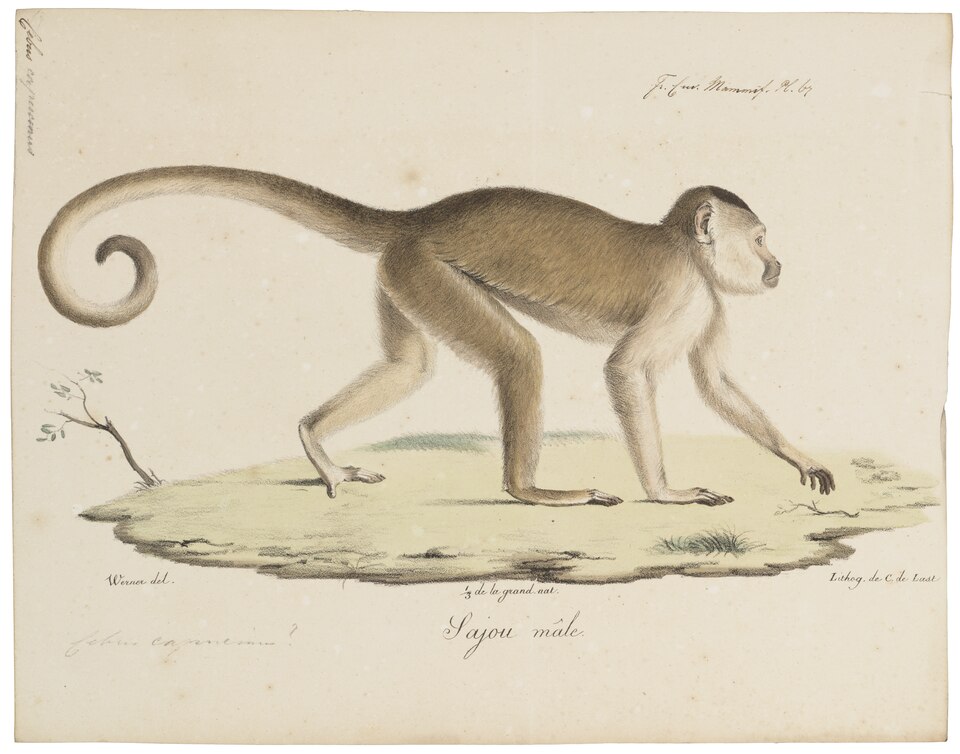
The Capuchin is a small monkey from tropical America, recognizable by its light face surrounded by dark hairs evoking the hood of the Capuchins monks, hence its name. Very intelligent, he sometimes uses tools like stones to crack nuts. This primate lives in structured social groups in the tropical forests of Central and South America. Its capacity for adaptation allows it to frequent various types of wooded environments, from dense forests to more degraded areas. It is frequently cited for its high cognitive abilities, comparable to those of certain great apes. The Capuchin has also been used historically as a pet or show animal.
The Capuchin has a slender body, a long prehensile tail and agile limbs adapted to arboreal life. Its face is hairless and light, contrasting with a brown, black or beige coat depending on the species. Its proportionally large brain explains its learning and problem-solving abilities noted by researchers.
Characteristics
Indicative values: they vary by subspecies, sex and region.
Habitat and distribution
The Capuchin mainly frequents humid tropical forests, but also dry forests and certain areas of wooded savannah. It favors medium and high arboreal strata for moving and feeding. Some populations tolerate proximity to areas disturbed by humans.
CURRENT RANGE
The Capuchin is native to Central and South America, where it occupies a vast territory from Honduras to northern Argentina. Its distribution mainly follows the tropical forest massifs of the continent. It does not occur in the wild outside of this region.
Behaviour
The Capuchin lives in social groups that can number from a few individuals to several dozen, organized according to a hierarchy. He communicates by varied vocalizations and by touch, particularly during social delousing sessions. Its exploratory behavior and curiosity make it an animal capable of using rudimentary tools, such as stones to open nuts.
Reproduction
The Capuchin female usually gives birth to a single calf after a gestation of about five to six months. The young remains dependent on its mother for several months, clinging to her back when traveling. Sexual maturity is reached between three and five years depending on sex and species.
Peculiarities
Capuchin is known for its tool use, a rare behavior among non-human primates. It is among the most intelligent New World monkeys studied in the laboratory and in the wild. Its name comes from the resemblance of its facial coat to the hood of the monks of the order of Capuchins.
Threats and conservation
Deforestation and the fragmentation of its forest habitat are the main threats to Capuchin. The illegal pet trade and capture for entertainment also affects some local populations. Hunting remains marginal but exists in certain regions.
Numbers and trends vary across sources and regions. See the IUCN assessment for the latest reference data.
Gallery
1 documented photographs.
References
Profile updated 26 August 2026 · Reviewed by the TunisieVet editorial team.
Comments (0)
No comments yet.
CONSERVATION STATUS
Least concern (LC)
IUCN source, latest published assessment.
Species health
Documented diseases for this species.
This information is provided for educational purposes only and is not a substitute for a veterinary consultation. If you have any concerns about your animal's health, consult a veterinarian.
To discover around: Capuchin
Videos, facts, stories and records linked to this species.
Similar animals
Other species documented in Animalpedia.

TunisieVet in your pocket 📱🐾 Access your veterinary services wherever you are. [ Download the app ]
Learn more