
Presentation
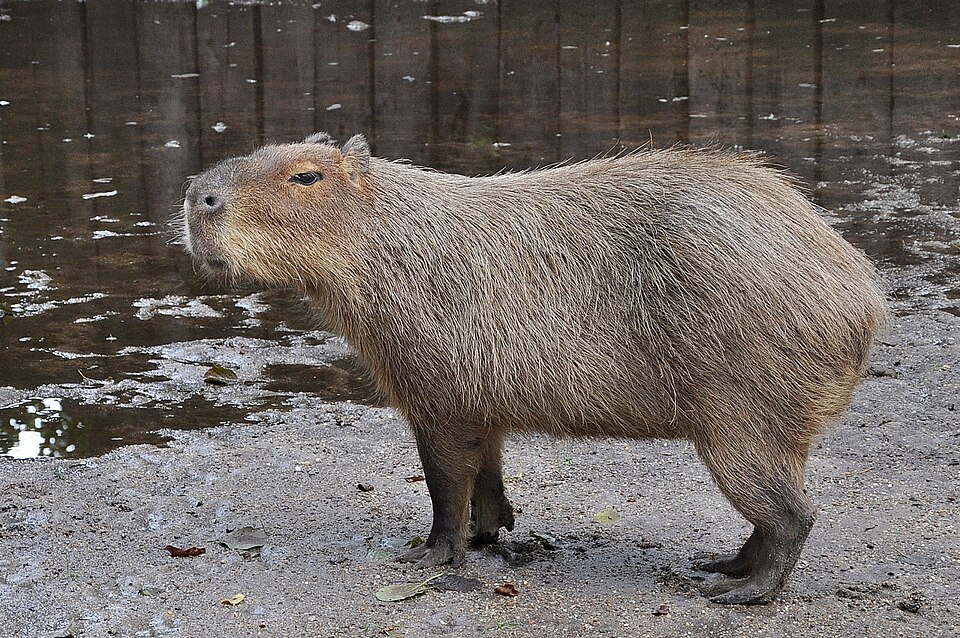
The Capybara is the world's largest rodent, native to South America. It lives in social groups along the rivers, marshes and wetlands of South America, often in troops of ten to twenty individuals. Its massive body, short legs and semi-webbed feet make it an excellent swimmer and diver. Its rough, sparse reddish-brown fur, as well as its square muzzle and small round ears make it easily recognizable. Due to its docile character, it is increasingly sought after as a new pet, although its breeding remains regulated in many countries.
The Capybara has a stocky body, a large head and eyes, ears and nostrils placed at the top of the skull, which allows it to remain almost submerged while observing its surroundings. Its hind legs are slightly longer than the front ones and its toes are joined by a membrane making it easier to swim. Its fur is coarse, reddish-brown to gray-brown in color, providing camouflage in aquatic vegetation.
Characteristics
Indicative values: they vary by subspecies, sex and region.
Habitat and distribution
The Capybara frequents the banks of rivers, lakes, swamps and wetlands bordered by dense vegetation. It needs permanent access to water, both for feeding, to escape predators and to regulate its body temperature. It is also found in areas of floodable savannah and tropical forest near water points.
CURRENT RANGE
The species is widely distributed in South America, from Venezuela and Colombia to northern Argentina, including Brazil, Paraguay and Uruguay. It occupies a wide diversity of low-altitude wetlands on this continent. Introduced populations occasionally exist elsewhere, notably in North America, but remain marginal.
Behaviour
A gregarious animal, the Capybara lives in family groups led by a dominant male, generally numbering between ten and twenty individuals. It communicates by hissing, growling and chattering teeth to signal danger or maintain group cohesion. Active especially at dusk and dawn, it spends much of the day in or near water to protect itself from the heat and predators. It is known for its calm and tolerant temperament, especially towards other animal species.
Reproduction
Female Capybara can breed throughout the year, peaking during the rainy season. After a gestation of approximately one hundred and fifty days, she gives birth to two to eight young, capable of moving and feeding shortly after birth. The young are raised collectively within the group, with several females nursing the young indifferently.
Peculiarities
The Capybara is the largest rodent currently alive, far exceeding the size of other members of this order. Its ability to remain submerged for several minutes, leaving only the top of its head emerging, constitutes a remarkable adaptation to semi-aquatic life. It maintains astonishing tolerant relationships with many other species, birds and even caimans, which sometimes perch on its back.
Threats and conservation
In its natural range, the Capybara is hunted for its meat and skin, although this pressure remains generally moderate compared to the size of its populations. The degradation and drying of wetlands constitutes a more significant local threat than hunting. The species is currently not considered globally threatened.
Numbers and trends vary across sources and regions. See the IUCN assessment for the latest reference data.
Gallery
1 documented photographs.
References
Profile updated 22 August 2026 · Reviewed by the TunisieVet editorial team.
Comments (0)
No comments yet.
CONSERVATION STATUS
Least concern (LC)
IUCN source, latest published assessment.
Species health
Documented diseases for this species.
See the 8 diseases of this species Find a veterinarianThis information is provided for educational purposes only and is not a substitute for a veterinary consultation. If you have any concerns about your animal's health, consult a veterinarian.
To discover around: Capybara
Videos, facts, stories and records linked to this species.
RECORD
up to 65 kg and 130 cm long
The largest rodent in the world
Measurement taken in wild adult individuals in South America.
Similar animals
Other species documented in Animalpedia.

TunisieVet in your pocket 📱🐾 Access your veterinary services wherever you are. [ Download the app ]
Learn more