Presentation
The sand cat (Felis margarita) is a small wild felid adapted to life in the deserts of North Africa and Central Asia. Its compact body structure, large ears, and thick fur under its paws allow it to survive in extremely arid environments. Elusive and primarily nocturnal, it is rarely observed even in areas where it is present. It is one of the few carnivores capable of living without a permanent water source, obtaining the moisture it needs from its prey. This feline is found in Tunisia, particularly in the desert regions of the south.
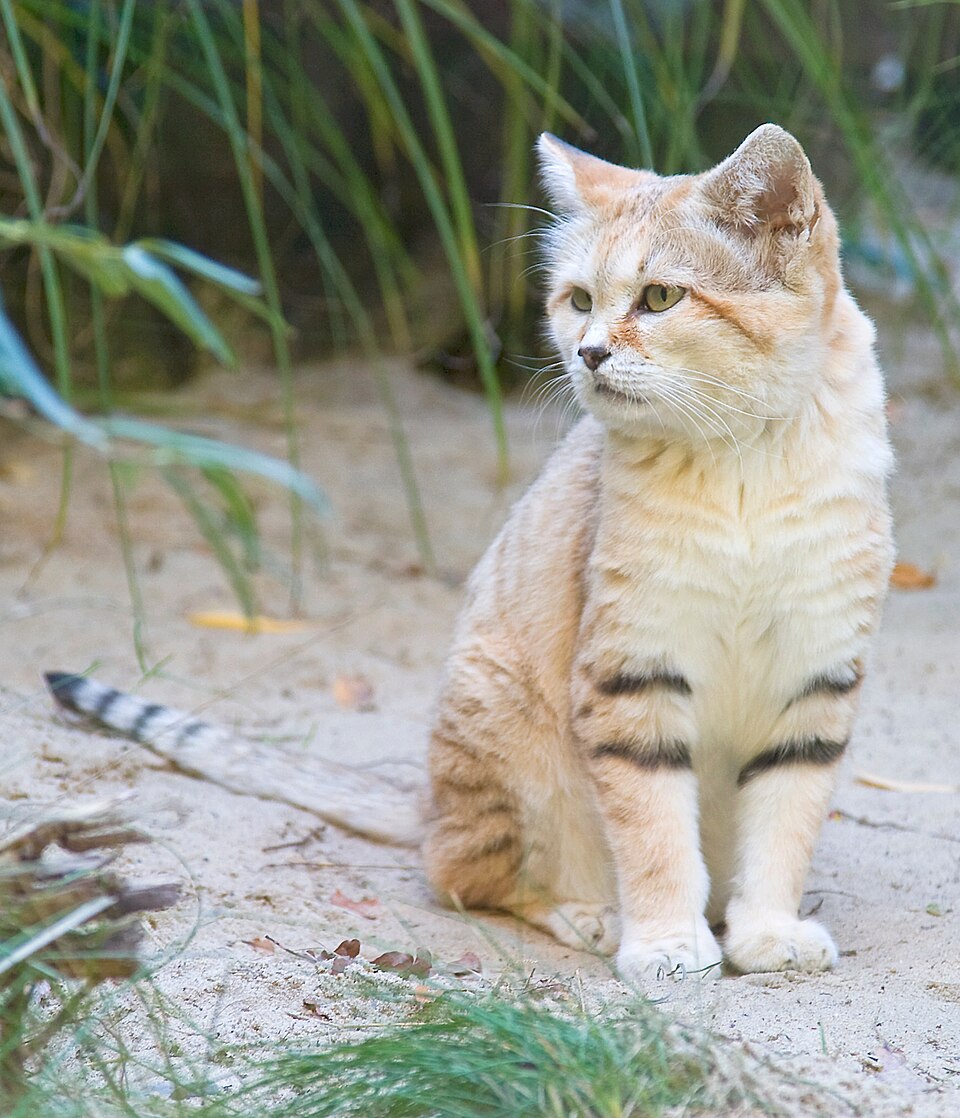
The sand cat has a stocky body, short legs, and a broad head with large, close-set ears. Its coat is sand-coloured to greyish-yellow, providing effective camouflage in its environment. The pads of its paws are covered in dense hair that protects it from scorching sand and enables silent movement.
Characteristics
Indicative values: they vary by subspecies, sex and region.
Habitat and distribution
This species is strictly confined to desert environments, including sandy dune areas and arid rocky plains. It avoids densely vegetated zones, preferring open spaces where it can move discreetly. Its tolerance of extreme temperatures makes it a typical inhabitant of hot deserts.
CURRENT RANGE
The sand cat is distributed discontinuously across the Sahara, the Arabian Peninsula, and certain regions of Central Asia. In North Africa, it is present in Algeria, Morocco, Tunisia, and Libya. Its distribution remains poorly understood due to its elusive nature and the difficulty of accessing some of its habitats.
Behaviour
The sand cat is solitary and essentially nocturnal, spending the day in burrows to escape the heat. It digs its own shelters or uses those of other animals. Its stealthy behaviour and natural discretion make observation difficult in the wild.
Reproduction
Females give birth after a gestation of approximately two months, producing litters of two to four kittens. Young are born in a protected burrow and remain with their mother for several months before becoming independent. Sexual maturity is reached around one year of age.
Peculiarities
The sand cat can survive without drinking water for long periods, obtaining the necessary hydration from its prey. Its paws are covered with dense fur, allowing it to walk on hot sand without burning and to partially obscure its tracks. It also possesses exceptional hearing ability, useful for locating underground prey.
Threats and conservation
The species is threatened by degradation of its desert habitat, hunting, and accidental capture in traps intended for other animals. Predation by stray dogs and competition with introduced species also pose threats. The lack of precise data complicates accurate assessment of its conservation status.
Numbers and trends vary across sources and regions. See the IUCN assessment for the latest reference data.
Gallery
1 documented photographs.
References
Profile updated 18 September 2026 · Reviewed by the TunisieVet editorial team.
Comments (0)
No comments yet.
CONSERVATION STATUS
Least concern (LC)
IUCN source, latest published assessment.
Species health
Documented diseases for this species.
Find a veterinarianThis information is provided for educational purposes only and is not a substitute for a veterinary consultation. If you have any concerns about your animal's health, consult a veterinarian.
Related species
To discover around: Sand Cat
Videos, facts, stories and records linked to this species.
Similar animals
Other species documented in Animalpedia.