
Presentation
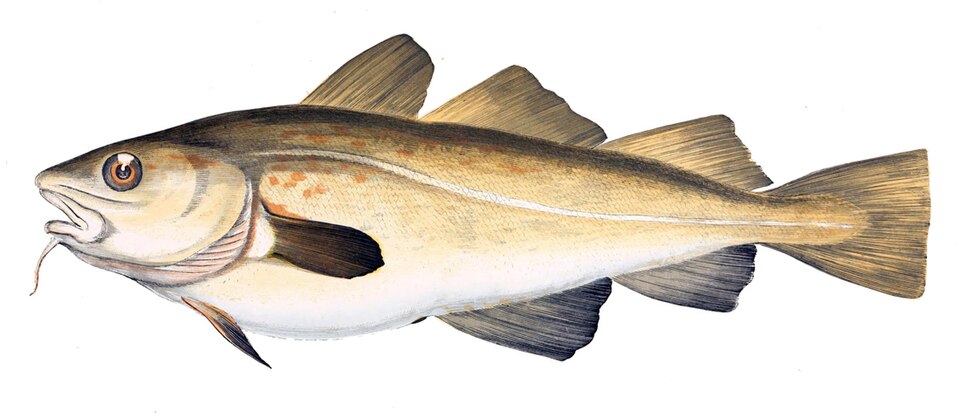
The Cod (Gadus morhua) is a marine fish of the gadidae family, widely fished in the North Atlantic. Its elongated body, brown-green spotted skin and characteristic chin barbel make it an easily recognizable species. It lives in cold and temperate waters, often near the bottom, at varying depths depending on the season. An emblematic species of European and North American commercial fishing, it has occupied an important place in human nutrition for centuries. Its populations experienced a marked decline in the 20th century due to overfishing. It is not present in Tunisian waters, the Mediterranean not being its natural area.
The Cod has a spindle-shaped body, three dorsal fins and two distinct anal fins. Its color varies from olive brown to grayish green, punctuated with small dark spots, with a whitish belly. A sensory barbel under the lower jaw helps it detect prey on the seabed. The light, curved lateral line is also typical of the species.
Characteristics
Indicative values: they vary by subspecies, sex and region.
Habitat and distribution
Cod lives in cold, temperate marine waters, generally between the surface and several hundred meters deep. It frequents rocky, sandy or muddy bottoms of the continental shelf. Juveniles often prefer shallow coastal areas, while adults move to deeper waters.
CURRENT RANGE
The species is present in the North Atlantic, on both sides of the ocean, including the North Sea, the Barents Sea, Iceland and the Canadian and American coasts. It is not naturally present in the Mediterranean or in Tunisia. The populations are divided into several regional stocks managed separately by the fishing authorities.
Behaviour
The Cod is a gregarious fish that often moves in schools, particularly during seasonal migrations to spawning areas. It makes significant vertical and horizontal movements between deep waters and coastal areas depending on the water temperature. Active mainly during the day, it hunts near the seabed.
Reproduction
Spawning takes place in winter and spring, in specific areas where females lay several million pelagic eggs. Fertilization is external and the eggs drift with the currents before the larvae hatch. No parental care is given to the eggs or fry.
Peculiarities
The liver of the Cod is rich in oil, historically exploited as a source of vitamins A and D. The species has long provided the economic base of entire coastal communities, notably in Newfoundland and Norway. Its collapse in certain areas in the 1990s remains a textbook case in fisheries management.
Threats and conservation
Overfishing constitutes the main threat, having caused the collapse of several historic stocks such as that of Newfoundland. Warming waters also modify its distribution area and breeding areas. Strict fishing quotas have been put in place in several regions to try to restore populations.
Numbers and trends vary across sources and regions. See the IUCN assessment for the latest reference data.
Gallery
1 documented photographs.
References
Profile updated 29 August 2026 · Reviewed by the TunisieVet editorial team.
Comments (0)
No comments yet.
CONSERVATION STATUS
Vulnerable (VU)
IUCN source, latest published assessment.
Species health
Documented diseases for this species.
This information is provided for educational purposes only and is not a substitute for a veterinary consultation. If you have any concerns about your animal's health, consult a veterinarian.
To discover around: Cod
Videos, facts, stories and records linked to this species.
Similar animals
Other species documented in Animalpedia.

TunisieVet in your pocket 📱🐾 Access your veterinary services wherever you are. [ Download the app ]
Learn more