
Presentation
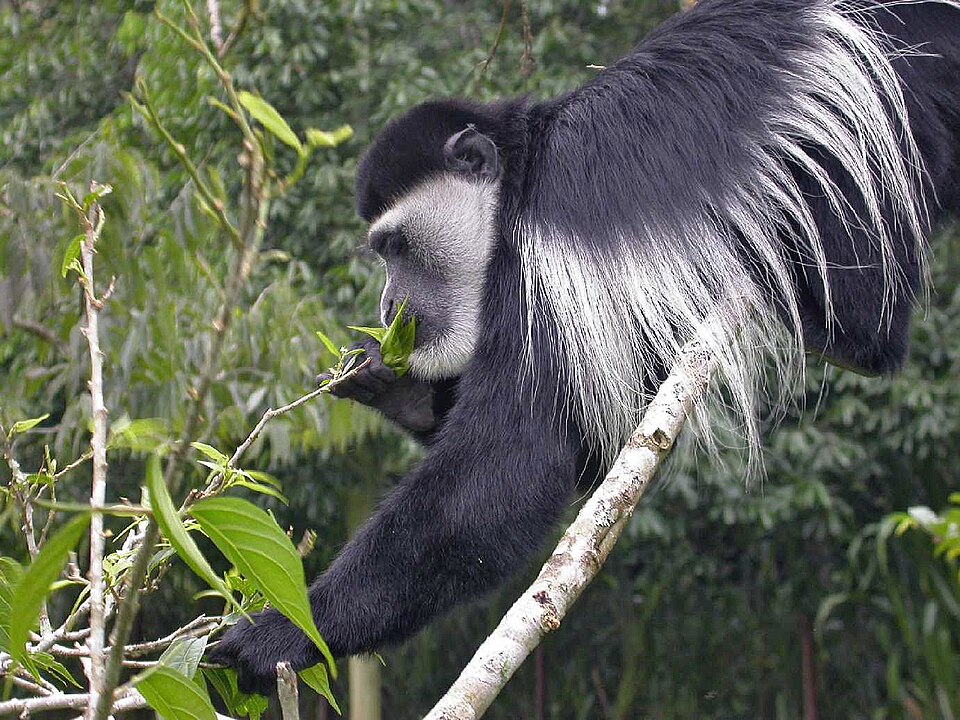
The Colobus is an arboreal monkey from sub-Saharan Africa, recognizable by the absence or extreme reduction of its thumb. Its name comes from the Greek “kolobos” meaning mutilated, in reference to this anatomical particularity. Several species exist, including the black and white Colobus and the red Colobus, distributed in African tropical forests. This animal lives in organized social groups and moves with agility between branches. It plays an important ecological role in seed dispersal and forest regeneration. Some species are threatened by deforestation and hunting.
The Colobus is distinguished by an often contrasting coat, black and white in some species, red or brown in others. Its thumb is atrophied or absent, an adaptation that facilitates rapid movement through the canopy. Its tail is long and bushy, serving as a balancer when jumping between trees. The body is slender and muscular, adapted to a strictly arboreal life.
Characteristics
Indicative values: they vary by subspecies, sex and region.
Habitat and distribution
The Colobus mainly inhabits the dense, humid tropical forests of Africa. It also frequents certain mountain forests and gallery forests along watercourses. Its life is strictly linked to the presence of a continuous canopy allowing its arboreal movements. Forest fragmentation constitutes a direct threat to its habitat.
CURRENT RANGE
Colobus is present in several regions of sub-Saharan Africa, including central, eastern and western Africa. The different species occupy distribution areas that are sometimes restricted and disjointed. It does not occur naturally in North Africa or Tunisia. Its distribution closely follows that of the continent's tropical forests.
Behaviour
The Colobus lives in social groups of varying size, generally dominated by one or more adult males. It is active during the day and spends most of its time in trees, rarely descending to the ground. Movements are made by spectacular jumps from one branch to another. Vocal communication, including territorial calls, plays an important role in group cohesion and territory defense.
Reproduction
The Colobus female generally gives birth to a single young after a gestation of several months. The newborn often has a different coat color than adults, which makes it easier to identify by the group. The young remain dependent on their mother for several months before gaining independence. Sexual maturity is generally reached between three and five years of age depending on the species.
Peculiarities
Thumb reduction is a unique feature among Old World primates, giving the genus its name. Newborns of some species are born with a pristine white coat that gradually transforms. The Colobus has a multi-compartmental stomach reminiscent of that of ruminants, a rare feature among primates.
Threats and conservation
Deforestation linked to agriculture and logging greatly reduces the habitat of Colobus. Hunting for bushmeat and sometimes fur poses a significant threat in some areas. Forest fragmentation isolates populations and limits genetic exchange. Several species of Colobuss are among the most endangered African primates.
Numbers and trends vary across sources and regions. See the IUCN assessment for the latest reference data.
Gallery
1 documented photographs.
References
Profile updated 26 August 2026 · Reviewed by the TunisieVet editorial team.
Comments (0)
No comments yet.
CONSERVATION STATUS
Vulnerable (VU)
IUCN source, latest published assessment.
Species health
Documented diseases for this species.
This information is provided for educational purposes only and is not a substitute for a veterinary consultation. If you have any concerns about your animal's health, consult a veterinarian.
To discover around: Colobus
Videos, facts, stories and records linked to this species.
Similar animals
Other species documented in Animalpedia.
