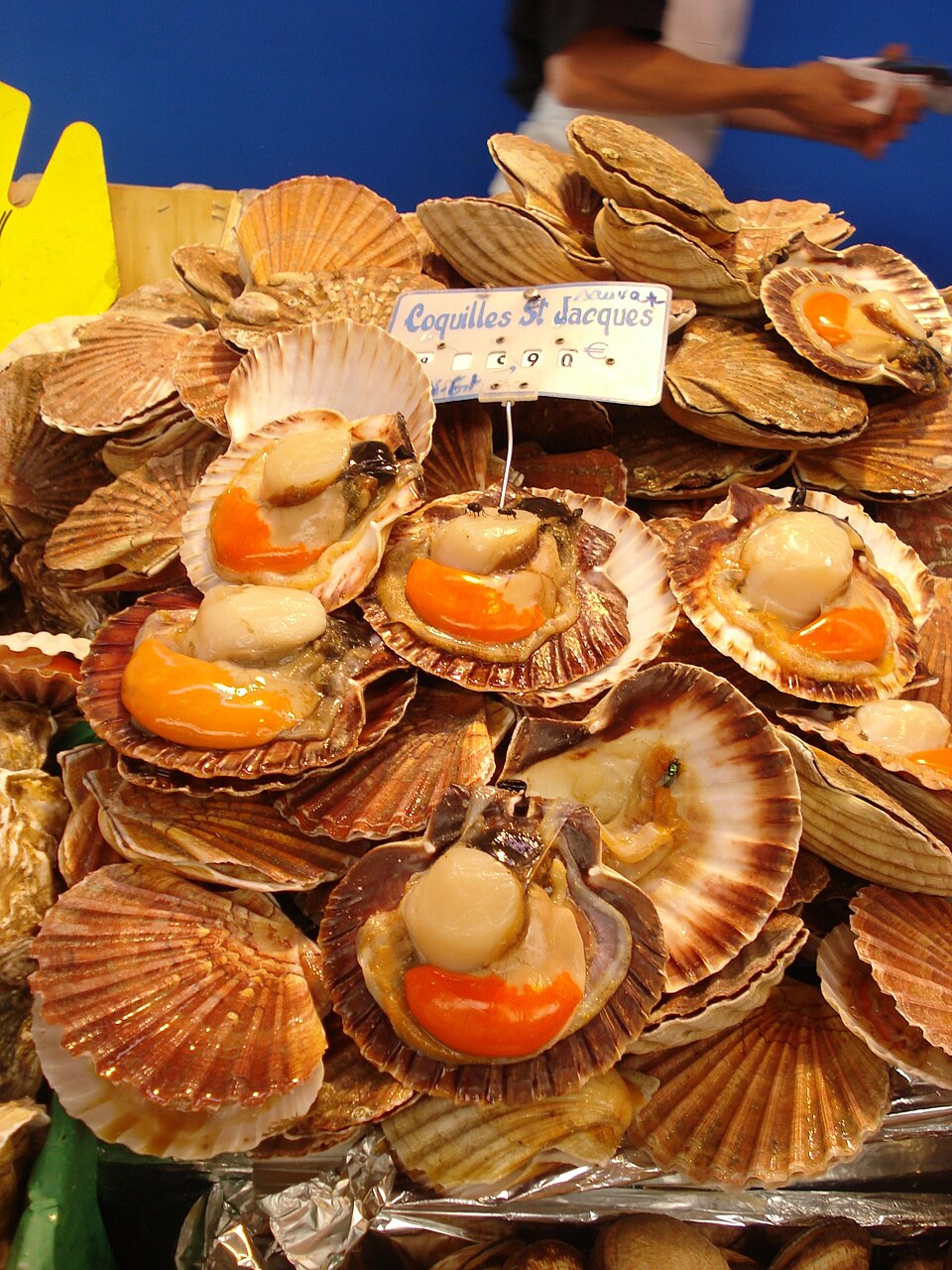
Presentation
The great scallop is a marine bivalve mollusc distinguished by its fan-shaped striated shell made up of two asymmetrical valves. The upper valve is flat and slightly convex, while the lower valve is concave. This animal lives attached to sandy or gravelly seabeds, mainly in the temperate waters of the north-east Atlantic and the Mediterranean. It is highly prized in gastronomy for its flesh and roe, making it a species of major economic importance. Its slow growth and longevity make it a valued indicator for studying marine environmental conditions. It moves occasionally through sharp valve contractions that produce a propulsive water jet.
The shell displays well-marked radiating ribs and varies in colour from reddish-brown to whitish depending on the valve. The animal has numerous simple eyes arranged along its mantle, capable of detecting changes in light and movement. The central adductor muscle is highly developed, allowing rapid closure of the valves.
Characteristics
Indicative values: they vary by subspecies, sex and region.
Habitat and distribution
The species lives on sandy, gravelly, or muddy seabeds at depths reaching up to about a hundred meters. It prefers areas where currents bring a constant supply of suspended food. It is found partially buried, with only the shell edge exposed above the sediment.
CURRENT RANGE
The scallop is found along the coasts of the northeastern Atlantic, from Norway to the Iberian Peninsula, as well as in the western Mediterranean. The main commercial fishing zones are located in France, particularly in the English Channel and the Brest roadstead. Its presence in the Mediterranean remains more localized and less abundant.
Behaviour
This animal usually remains motionless, partially buried in sediment, with the flat valve facing upward. When threatened—such as by an approaching predatory starfish—it can make short jumps by snapping its valves to escape. It is able to detect shadows and movements through its peripheral eyes, triggering an escape or closure response.
Reproduction
The scallop is hermaphroditic, producing both male and female gametes within a single two-colored gonad. Fertilization is external and occurs in open water following gamete release, typically in spring or summer depending on the population. Planktonic larvae drift for several weeks before settling on the seabed and developing their permanent shell.
Peculiarities
It has up to a hundred small blue eyes arranged along the mantle edge, a feature that is rare in bivalves. Its age can be determined by counting the growth lines visible on its shell, similar to the growth rings of a tree.
Threats and conservation
Overfishing driven by strong gastronomic demand represents the main pressure on wild populations. Minimum capture size regulations and controlled fishing seasons have been implemented in several countries to protect stocks. Seabed degradation from certain dredging practices also affects spawning habitats.
Numbers and trends vary across sources and regions. See the IUCN assessment for the latest reference data.
Gallery
1 documented photographs.
References
Profile updated 30 August 2026 · Reviewed by the TunisieVet editorial team.
Comments (0)
No comments yet.
CONSERVATION STATUS
Least concern (LC)
IUCN source, latest published assessment.
Species health
Documented diseases for this species.
See the 4 diseases of this species Find a veterinarianThis information is provided for educational purposes only and is not a substitute for a veterinary consultation. If you have any concerns about your animal's health, consult a veterinarian.
To discover around: Great Scallop
Videos, facts, stories and records linked to this species.
Similar animals
Other species documented in Animalpedia.

Be among the first to use our app. Sign up and get early Google Play access.
Discover