
Presentation
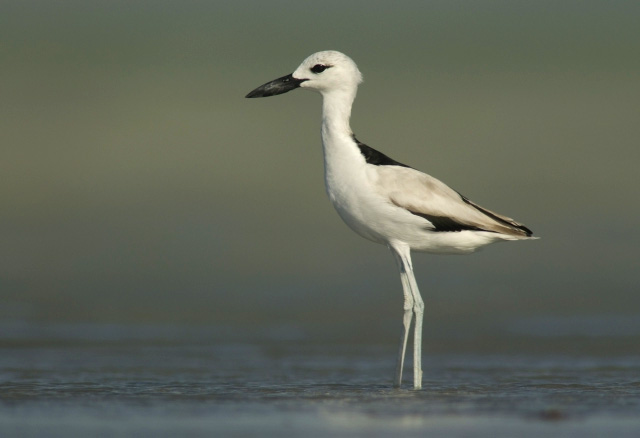
The Crab Plover is a medium-sized wading bird and the sole member of the family Dromadidae. It stands out with predominantly white plumage contrasted by black on the wings, along with a powerful black conical bill. This species inhabits sandy coasts, mudflats, and coastal lagoons of the Indian Ocean and Red Sea. Unlike most waders, it digs deep burrows in the sand for nesting, a rare behavior among birds. Active mainly at dusk and night, it feeds chiefly on crabs and other marine invertebrates. Its range remains largely coastal, and it sometimes forms loose flocks on beaches.
The Crab Plover measures roughly 40 cm in length with white plumage and distinctly marked black wings. Its black bill is long and robust, suited for catching crabs. Long grey legs enable it to move easily over sand and in shallow water.
Characteristics
Indicative values: they vary by subspecies, sex and region.
Habitat and distribution
The Crab Plover frequents sandy beaches, coastal mudflats, and coastal lagoons. It generally avoids inland areas, remaining closely tied to intertidal zones. Dunes near the shoreline serve as nesting sites.
CURRENT RANGE
The species occurs on coasts of the Red Sea, Persian Gulf, and Indian Ocean, from East Africa to South Asia. It is absent from North Africa and has not been recorded in Tunisia. Some populations undertake seasonal movements along the coasts.
Behaviour
The Crab Plover is a gregarious bird that gathers in small groups on beaches and mudflats. It displays marked crepuscular and nocturnal activity, unlike many diurnal waders. It digs burrows in sandy dunes for resting and nesting, singular behavior among coastal birds.
Reproduction
The female lays a single egg in a burrow excavated deep in sand, sometimes more than a metre down. Both parents share incubation duties and raise the chick, which remains in the burrow during its first weeks. This underground nesting shelters the egg and young from heat and predators.
Peculiarities
The Crab Plover is the only known bird to regularly excavate a deep burrow for laying a single egg. This trait sets it apart clearly from other waders and shorebirds. Its nocturnal activity and specialised diet of crabs make it a singular species among coastal birds.
Threats and conservation
Degradation of coastal habitats and human disturbance on beaches threaten the species locally. Marine pollution and coastal urbanisation reduce available nesting sites. The species remains, however, widely distributed and is not considered globally threatened.
Numbers and trends vary across sources and regions. See the IUCN assessment for the latest reference data.
Gallery
1 documented photographs.
References
Profile updated 08 September 2026 · Reviewed by the TunisieVet editorial team.
Comments (0)
No comments yet.
CONSERVATION STATUS
Least concern (LC)
IUCN source, latest published assessment.
Species health
Documented diseases for this species.
Find a veterinarianThis information is provided for educational purposes only and is not a substitute for a veterinary consultation. If you have any concerns about your animal's health, consult a veterinarian.
Similar animals
Other species documented in Animalpedia.

TunisieVet in your pocket 📱🐾 Access your veterinary services wherever you are. [ Download the app ]
Learn more