
Presentation
The Momentum (Alces alces) is the largest current representative of the deer family. It is distinguished by its massive silhouette, its long legs and its prominent and flexible muzzle. Males bear impressive webbed antlers, renewed each year. This solitary herbivore lives in boreal and cold temperate regions of the northern hemisphere, often near wetlands and forests. A good swimmer, it readily frequents lakes and rivers to feed on aquatic plants.
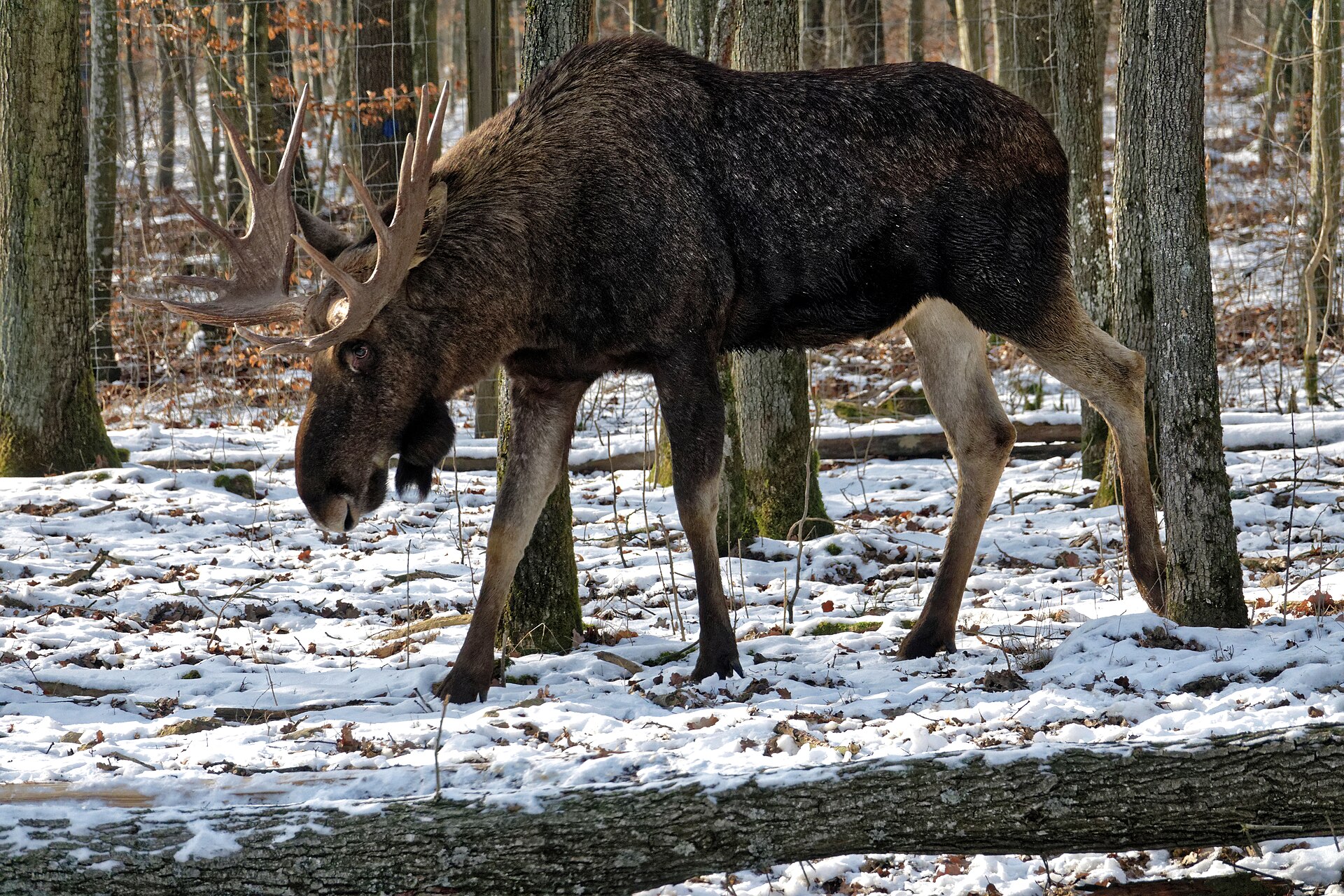
The Momentum has a dark brown to blackish coat, lighter on the legs. Its elongated head has a soft muzzle overhanging a characteristic hanging upper lip. A dewlap of skin, called a bell, hangs below the throat of certain individuals. The male's antlers, webbed and reaching a width of almost two meters, are lost and regenerated each year.
Characteristics
Indicative values: they vary by subspecies, sex and region.
Habitat and distribution
The Momentum likes boreal forests, marshy areas and the edges of lakes and rivers. He particularly looks for environments offering both forest cover and water points rich in aquatic vegetation. Wet forest areas are its preferred habitat, especially in summer.
CURRENT RANGE
Momentum is found in the boreal forests of North America, Scandinavia, Russia and northern Asia. Its range covers the circumpolar regions of the northern hemisphere. It is absent from tropical and desert areas.
Behaviour
The Momentum leads a mostly solitary life, except during the rutting period in autumn. It is active at dawn and dusk, during which it moves to feed. Despite its imposing size, it can run quickly and swim long distances. Males become particularly aggressive and noisy during the mating season.
Reproduction
The rut takes place in the fall, during which males fight for access to females. After a gestation of about eight months, the female gives birth to one or two fawns in the spring. The young stay with their mother for about a year before becoming independent.
Peculiarities
The very mobile muzzle of the Momentum allows it to precisely grasp plants. Unlike many deer, it is an excellent swimmer capable of diving its head underwater to feed. Its long legs allow it to move easily in deep snow.
Threats and conservation
Regulated hunting puts pressure on certain populations, although the species is not globally threatened. Climate change affects its habitat by modifying vegetation and favoring certain parasites such as ticks. Road collisions also represent a notable cause of mortality in populated areas.
Numbers and trends vary across sources and regions. See the IUCN assessment for the latest reference data.
Gallery
1 documented photographs.
References
Profile updated 20 August 2026 · Reviewed by the TunisieVet editorial team.
Comments (0)
No comments yet.
CONSERVATION STATUS
Least concern (LC)
IUCN source, latest published assessment.
Species health
Documented diseases for this species.
See the 8 diseases of this species Find a veterinarianThis information is provided for educational purposes only and is not a substitute for a veterinary consultation. If you have any concerns about your animal's health, consult a veterinarian.
To discover around: Momentum
Videos, facts, stories and records linked to this species.
RECORD
up to 2.1 m at the withers / 700 kg
The largest current deer
Measurement taken on adult males of the Alaskan subspecies, the largest.
Similar animals
Other species documented in Animalpedia.

TunisieVet in your pocket 📱🐾 Access your veterinary services wherever you are. [ Download the app ]
Learn more