Presentation
Kirk's dik-dik is a small antelope from East Africa, notable for its tiny size and long, mobile snout shaped like a trunk. Its name is thought to come from the sharp alarm cry it emits when in danger, resembling "dik-dik." Discreet and shy, it lives in territorial pairs within brushy savanna. Despite its small size, it plays an important ecological role as prey for many predators and by dispersing the seeds of plants it consumes.
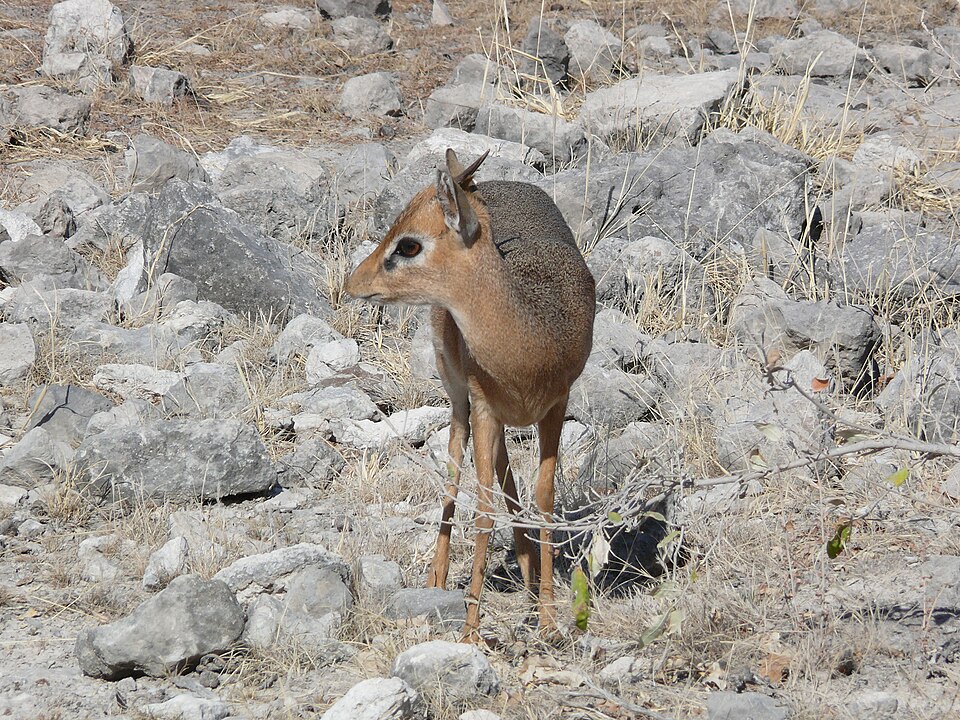
The Kirk's dik-dik displays reddish-brown to grey fur on its back and lighter fur on its belly, with a tuft of erectile hair on the crown of its skull. Its elongated, flexible muzzle, resembling a small trunk, allows it to cool its blood through evaporation in warm regions. Only males bear small, short, striated horns, often hidden by the tuft of frontal hair. Its large eyes ringed with black and its visible preorbital glands serve territorial marking.
Characteristics
Indicative values: they vary by subspecies, sex and region.
Habitat and distribution
Kirk's dik-dik inhabits brushy savannas, dry thickets, and semi-arid zones in East Africa. It prefers habitats with dense vegetation cover to hide from predators while having open areas available for feeding. It avoids overly humid zones and favors well-drained terrain.
CURRENT RANGE
The species is found in East Africa, particularly in Kenya, Tanzania, Somalia, and Ethiopia. It occupies fragmented habitats according to the availability of bushy vegetation. Its range is closely tied to dry to semi-arid savanna zones.
Behaviour
This antelope is monogamous and lives in territorial pairs that it actively defends against intruders through scent marking with its preorbital glands. It is primarily active at dawn, dusk, and during the night, resting in the shade during the hottest hours. When frightened, it emits a repeated sharp cry and flees in a zigzag pattern through the brush. Its discreet behavior and constant vigilance allow it to escape from many predators.
Reproduction
The female gives birth to a single offspring after a gestation period of approximately six months, typically twice per year. The young remains hidden in dense vegetation for the first few weeks to avoid predators. Weaning occurs at around three to five months of age, and independence is reached before one year of age. Young males must leave the parental territory to find their own mate.
Peculiarities
Kirk's dik-dik is one of the smallest antelopes in the world, weighing barely a few kilograms as an adult. Its trunk-like snout, unique among antelopes of its size, serves to regulate body temperature through nasal evaporation. Pairs remain bonded for life and mark their shared territory with scent secretions deposited on twigs.
Threats and conservation
Habitat loss due to agricultural expansion and overstocking of domestic livestock poses a threat to the species in some regions. Natural predation by felids, raptors, and large snakes remains an important cause of mortality. Poaching for bushmeat affects some populations locally.
Numbers and trends vary across sources and regions. See the IUCN assessment for the latest reference data.
Gallery
1 documented photographs.
References
Profile updated 03 September 2026 · Reviewed by the TunisieVet editorial team.
Comments (0)
No comments yet.
CONSERVATION STATUS
Least concern (LC)
IUCN source, latest published assessment.
Species health
Documented diseases for this species.
This information is provided for educational purposes only and is not a substitute for a veterinary consultation. If you have any concerns about your animal's health, consult a veterinarian.
Related species
Similar animals
Other species documented in Animalpedia.

Be among the first to use our app. Sign up and get early Google Play access.
Discover