
Presentation
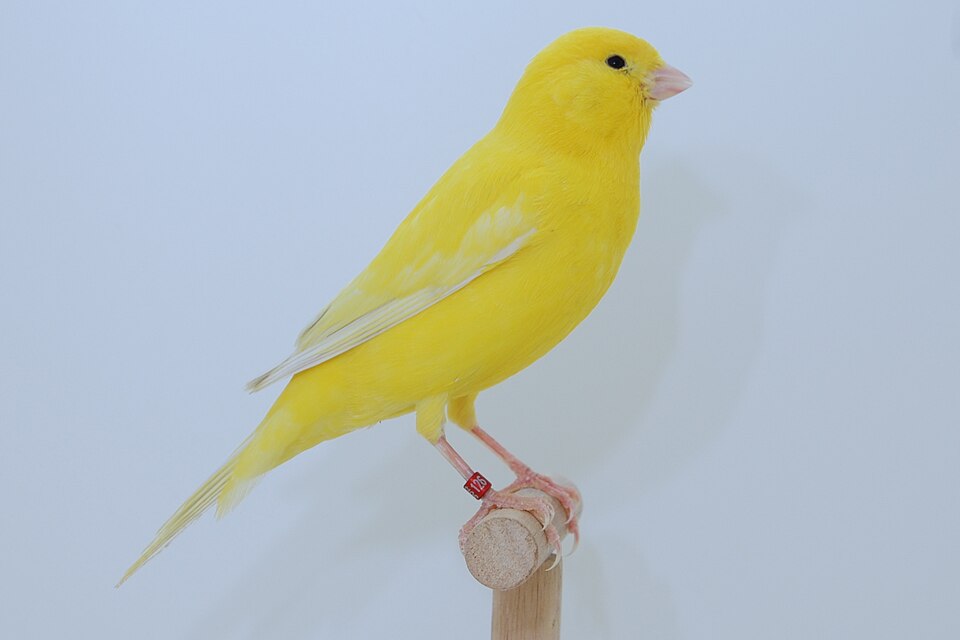
The Domestic canary is a small singing passerine resulting from the domestication of the Canary Islands serin (Serinus canaria), practiced since the 15th century by the Spanish and then spread to Europe. Selected for its melodious song and the variety of its colors, it is today one of the most widespread cage birds in the world. There are many breeds, distinguished by plumage color, posture or ability to sing. Unlike its predominantly greenish wild ancestor, the Domestic canary often sports bright yellow, orange or white plumage. It is a pet appreciated for its modest size, its relatively simple maintenance and its characteristic song, especially in males.
The Domestic canary measures between 12 and 20 cm depending on the breed, with a stocky body and a short conical bill adapted to granivory. Its plumage varies from classic yellow to white, orange, red or two-tone depending on the lines selected. Males are generally better singers than females, a criterion often used to distinguish the sexes. Some breeds are distinguished by a particular posture (posture canary) or a crest on the head.
Characteristics
Indicative values: they vary by subspecies, sex and region.
Habitat and distribution
As a domestic species, the canary lives exclusively in captivity, in cages or aviaries. Its wild ancestor, the Canary Islands canary, inhabits wooded areas, gardens and semi-open environments of the Canary Islands, Madeira and Azores. The Domestic canary requires an environment protected from drafts and extreme temperatures.
CURRENT RANGE
The Domestic canary is bred worldwide as a pet bird, with no natural distribution of its own since it is a domesticated species. Its wild ancestor is native to the Canary Islands, Madeira and the Azores, in the Atlantic Ocean. Canary breeding developed mainly in Europe from the 16th century before spreading worldwide.
Behaviour
The canary is a rather solitary bird or living in small groups, active especially during the day. Males sing profusely, particularly in spring, to mark their territory and attract females. It is a species that is not very aggressive towards humans, easy to tame although rarely cuddly like a parrot can be. He likes to fly in sufficient space and can be stressed in a cage that is too cramped or in the presence of loud noises.
Reproduction
Breeding of Domestic canary is commonly practiced in captivity, generally in spring under controlled light and temperature conditions. The female lays 3 to 6 eggs which she incubates alone for approximately 13 to 14 days. The chicks are born blind and without feathers, and are fed by both parents until fledging, around 18 to 21 days old. Several clutches per year are possible depending on breeding conditions.
Peculiarities
The canary is known for its sensitivity to toxic gases, which led to its former use in coal mines as an early detector of carbon monoxide. Certain breeds such as the Gloster canary or the crested canary have distinctive morphological characteristics. Its singing, specific to each lineage, is the subject of specialized competitions in several countries.
Threats and conservation
As a domestic species, the canary is not threatened and is not the subject of any conservation concerns. Its wild ancestor, the Canary Islands canary, is stable in its native area. The main risks for domestic canaries concern unsuitable breeding conditions, respiratory diseases and parasites.
Numbers and trends vary across sources and regions. See the IUCN assessment for the latest reference data.
Gallery
1 documented photographs.
References
Profile updated 17 August 2026 · Reviewed by the TunisieVet editorial team.
Comments (0)
No comments yet.
CONSERVATION STATUS
Least concern (LC)
IUCN source, latest published assessment.
Species health
Documented diseases for this species.
See the 8 diseases of this species Find a veterinarianThis information is provided for educational purposes only and is not a substitute for a veterinary consultation. If you have any concerns about your animal's health, consult a veterinarian.
Similar animals
Other species documented in Animalpedia.

TunisieVet in your pocket 📱🐾 Access your veterinary services wherever you are. [ Download the app ]
Learn more