
Presentation
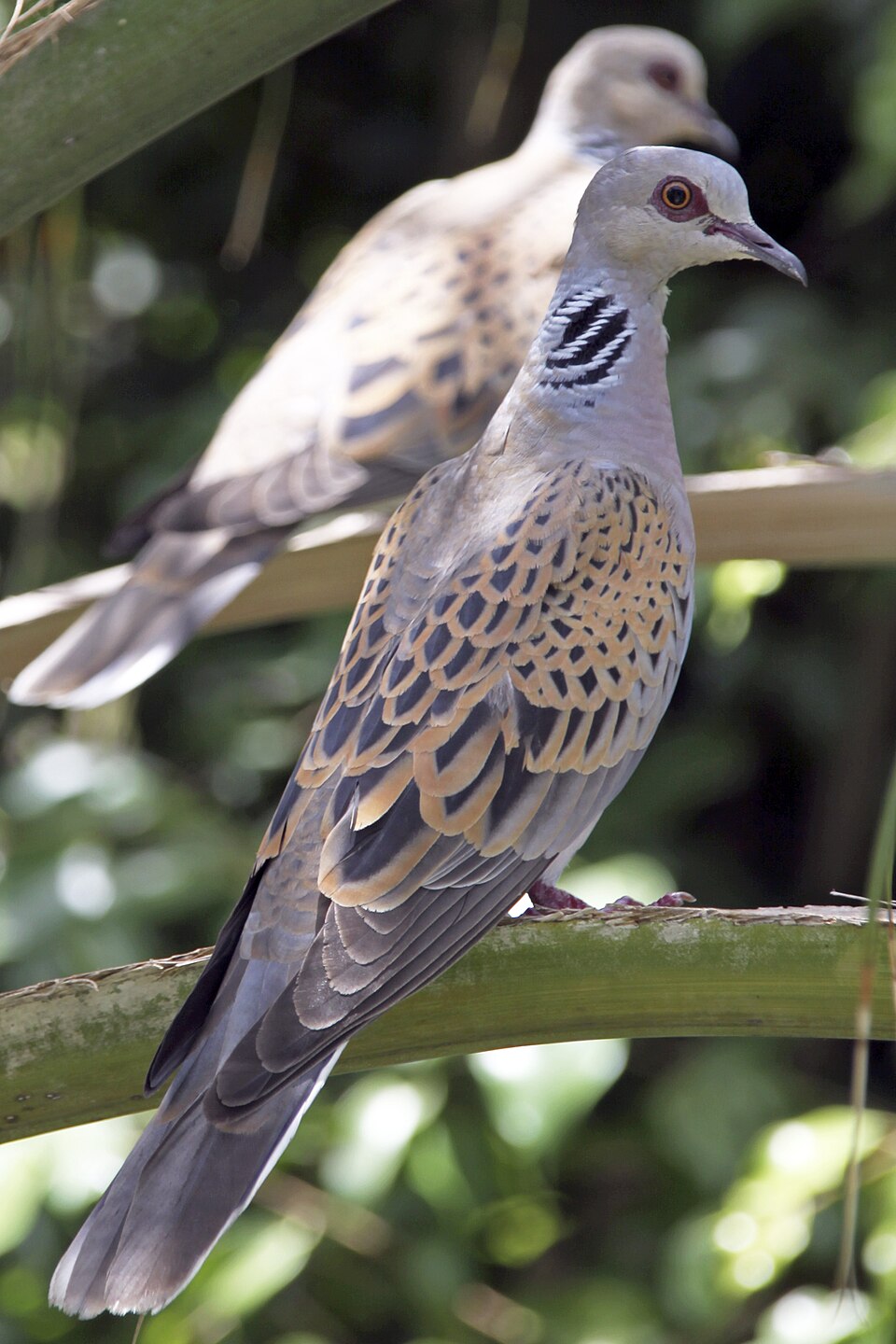
The dove is a medium-sized bird belonging to the pigeon family, related to pigeons but slimmer and with a more graceful silhouette. Its plumage varies by species, from rufous-brown spotted with black in the Turtle Dove to uniform grey-beige in the Collared Dove, often marked with a distinctive black half-collar on the nape. Found across Europe, North Africa, and Asia, it has adapted well to human-modified habitats. In Tunisia, it ranks among the most familiar birds in gardens, oases, and agricultural areas. Its characteristic cooing call is associated with calm and rural life. It is generally a gregarious species outside the breeding season, often seen in small groups or pairs.
It measures small to medium in size, with a compact body, small head, and pointed wings suited for fast, direct flight. The bill is short and fine, typical of seed-eating doves. The tail is often graduated, edged with white in some species and visible in flight. The legs are short and pinkish.
Characteristics
Indicative values: they vary by subspecies, sex and region.
Habitat and distribution
Doves occupy a wide range of open and semi-open environments: farmland, oases, gardens, urban parks, and forest edges. They prefer areas near water sources and cultivated zones that provide reliable food. Some species have adapted particularly well to towns and villages. They avoid dense habitats or areas with little vegetation cover.
CURRENT RANGE
Depending on the species, doves are found in Europe, North Africa, the Middle East, and Asia. The collared dove underwent dramatic expansion across Europe during the twentieth century. In North Africa, particularly in Tunisia, several species are present year-round or pass through during migration.
Behaviour
It is a diurnal bird, most active in early morning and late afternoon. Cooing, produced mainly by males, serves to establish territory and attract females. Doves may form flocks outside the breeding season, particularly when feeding or migrating. Some species, such as the Turtle Dove, are migratory, while others, such as the Collared Dove, are sedentary.
Reproduction
The nest is a simple platform of twigs built in a tree, shrub, or sometimes on a man-made structure. The female typically lays two white eggs, which both parents take turns incubating for about two weeks. Chicks are fed by both parents through regurgitation of a nutrient-rich crop milk. Several broods may occur during a single breeding season.
Peculiarities
The soft, rhythmic cooing of the dove is an iconic sound of Mediterranean countryside and gardens. The black half-collar present in certain species is a simple identification feature. Unlike the rock pigeon, the dove has a slimmer shape and a longer, more tapered tail.
Threats and conservation
Some populations of turtle doves experienced notable decline in Europe, linked to loss of traditional farmland habitat and hunting during migration. The collared dove, by contrast, maintains stable or expanding populations. Degradation of hedgerows and small woodlands remains a threat to the most sensitive species.
Numbers and trends vary across sources and regions. See the IUCN assessment for the latest reference data.
Gallery
1 documented photographs.
References
Profile updated 06 September 2026 · Reviewed by the TunisieVet editorial team.
Comments (0)
No comments yet.
CONSERVATION STATUS
Least concern (LC)
IUCN source, latest published assessment.
Species health
Documented diseases for this species.
See the 4 diseases of this species Find a veterinarianThis information is provided for educational purposes only and is not a substitute for a veterinary consultation. If you have any concerns about your animal's health, consult a veterinarian.
Similar animals
Other species documented in Animalpedia.

TunisieVet in your pocket 📱🐾 Access your veterinary services wherever you are. [ Download the app ]
Learn more