Presentation
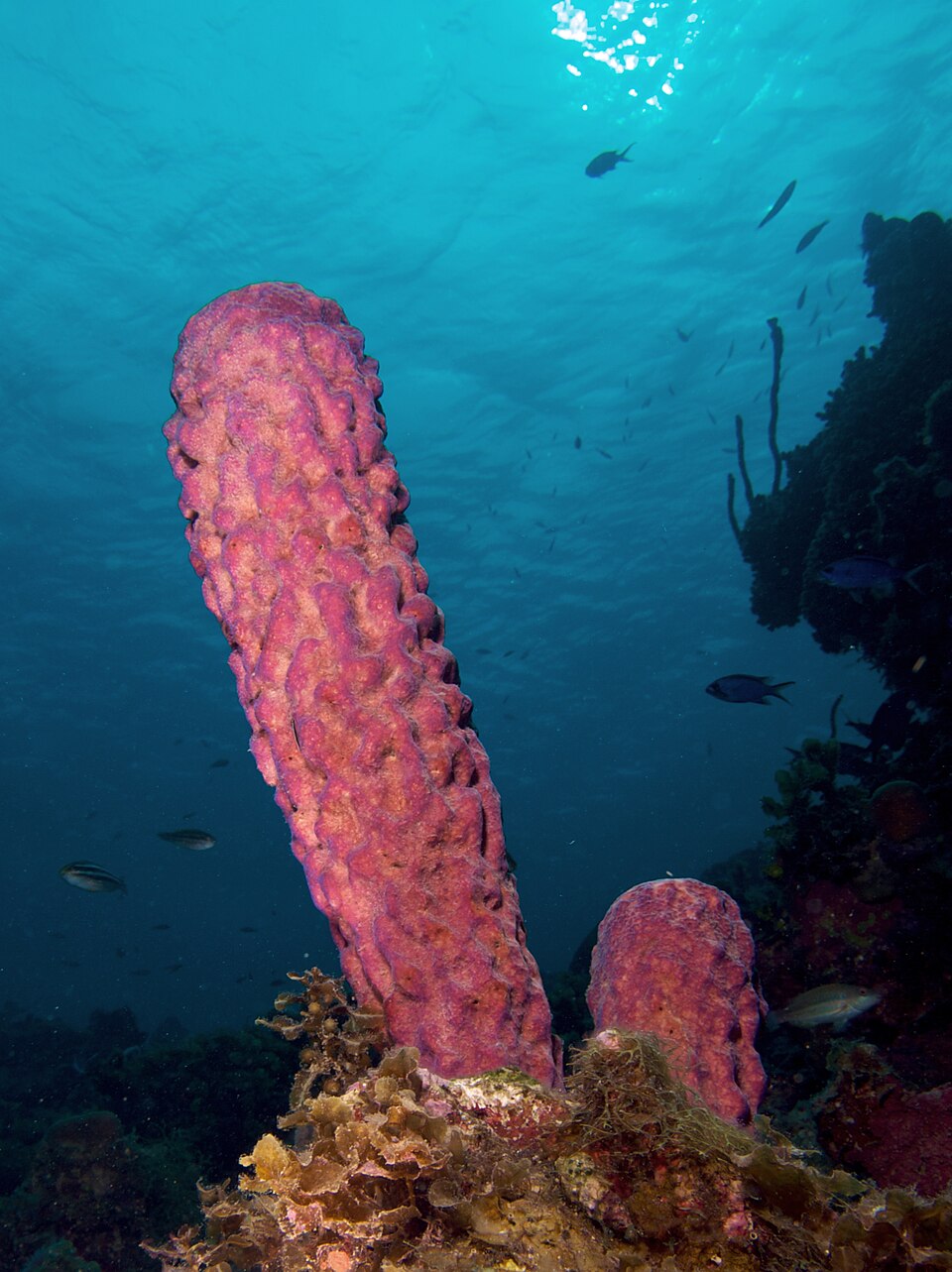
The sea sponge is a primitive aquatic animal belonging to the phylum Porifera, lacking organs and a nervous system. Its body is made up of a porous skeleton crossed by a network of channels that allow water to circulate. Fixed to a substrate, it filters seawater to feed and breathe. Sponges are found in nearly every marine environment, from shallow waters to the deep sea. Since ancient times, certain species have been harvested for their fibrous skeleton, which is used as a bathing sponge.
The sponge's body is asymmetric or radial, composed of poorly specialized cells organized around a matrix called the mesohyle. It has many pores (ostioles) that allow water to enter and one or more oscula for water to exit. Its skeleton may be made of spongin, calcareous or siliceous spicules, depending on the species. It has no head, no internal organs, and no nervous or circulatory system.
Characteristics
Indicative values: they vary by subspecies, sex and region.
Habitat and distribution
The sea sponge lives attached to rocky, coral, or sandy bottoms, from coastal zones to the deepest ocean waters. It favors clear, well-oxygenated waters rich in suspended organic particles. Some species tolerate brackish water, but the vast majority remain strictly marine.
CURRENT RANGE
Sponges are found in all the world's oceans and seas, from tropical to polar waters. They are particularly abundant in the Mediterranean, including along the coasts of Tunisia. Their distribution depends mainly on the nature of the substrate and water quality rather than latitude.
Behaviour
The sponge is a sessile animal, permanently attached to a rocky, coral, or sandy substrate. It has no capacity for active movement in its adult state. Its only observable activity is the continuous pumping of water through its body. It can nonetheless respond to mechanical stimuli by slight contraction of its tissues.
Reproduction
Sea sponges reproduce through both sexual and asexual reproduction. Sexual reproduction occurs by releasing gametes into the water, which develop into swimming larvae that settle on a substrate. Asexual reproduction happens through budding or fragmentation, with each fragment capable of regenerating into a complete individual. This strong regenerative capacity is a notable characteristic of the group.
Peculiarities
The sponge is one of the simplest and oldest known animals, having appeared over 500 million years ago. Its regenerative capacity is such that a fragment separated from the body can reconstitute an entire individual. Some Mediterranean species, such as the bath sponge, are harvested and processed after drying for traditional household use.
Threats and conservation
Marine pollution, destruction of coastal habitats, and bottom trawling threaten certain sponge populations. Historical overexploitation of some species for commercial use, particularly in the Mediterranean, has locally reduced their populations. Ocean warming and acidification pose emerging threats to this group, which is sensitive to changes in water chemistry and physical conditions.
Numbers and trends vary across sources and regions. See the IUCN assessment for the latest reference data.
Gallery
1 documented photographs.
References
Profile updated 31 August 2026 · Reviewed by the TunisieVet editorial team.
Comments (0)
No comments yet.
CONSERVATION STATUS
Data deficient (DD)
IUCN source, latest published assessment.
Species health
Documented diseases for this species.
Find a veterinarianThis information is provided for educational purposes only and is not a substitute for a veterinary consultation. If you have any concerns about your animal's health, consult a veterinarian.
Similar animals
Other species documented in Animalpedia.

Be among the first to use our app. Sign up and get early Google Play access.
Discover