
Presentation
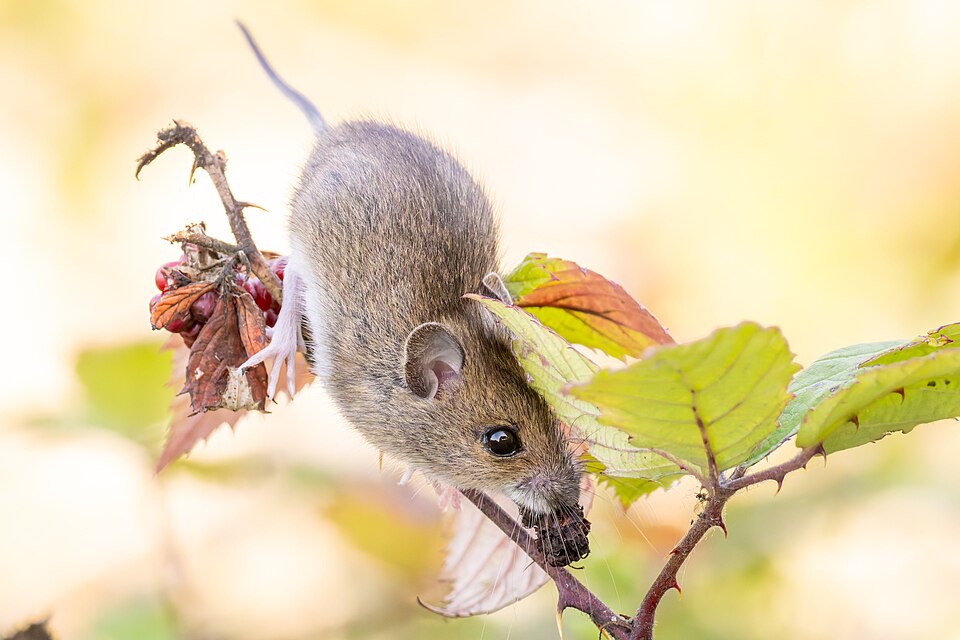
The Field mouse is a small nocturnal rodent widely distributed in Europe, North Africa and Western Asia. It can be distinguished from the house mouse by its slightly larger size, its prominent eyes and its long, thin tail. Discreet and agile, it frequents cultivated fields as well as forest edges and gardens. Its reddish-brown fur on its back contrasts with a whitish belly. It is a key species in food chains, serving as prey for many predators. It also plays a role in the dispersal of seeds and fungi.
The Field mouse has a slender body, large ears and clearly visible black eyes. Its tail measures almost as long as its body, helping it with balance when moving. Its elongated hind legs allow it to jump quickly to escape predators.
Characteristics
Indicative values: they vary by subspecies, sex and region.
Habitat and distribution
The Field mouse occupies a wide variety of environments: cultivated fields, hedges, forest edges, gardens and bushy areas. It avoids areas that are too humid or flooded but appreciates soft soils suitable for burrowing. In North Africa, it is also found in olive groves and mid-altitude agricultural areas.
CURRENT RANGE
The species occurs across much of Europe, North Africa, and parts of western Asia. In Tunisia, it is reported in agricultural and wooded areas in the north and center of the country. It remains absent from the driest desert areas.
Behaviour
Active mainly at night, the Field mouse digs complex burrows with multiple galleries and storage chambers. It is rather solitary but can tolerate the presence of other individuals near areas rich in food. An excellent climber and jumper, he can move as well on the ground as in low bushes.
Reproduction
The female can have several litters per year, especially in spring and summer, with a gestation of approximately three weeks. Each litter generally has four to seven young, born blind and hairless. Weaning occurs after three to four weeks, and sexual maturity is reached quickly, which promotes rapid population growth.
Peculiarities
The Field mouse has an excellent spatial memory capacity, allowing it to find its food caches. Its tail, longer than that of the house mouse, constitutes a practical distinguishing criterion for naturalists.
Threats and conservation
Field mouses populations are generally stable but can be affected locally by the intensive use of pesticides and the destruction of hedgerows. Natural predators such as nocturnal birds of prey and foxes naturally regulate their numbers. The species is not considered globally threatened.
Numbers and trends vary across sources and regions. See the IUCN assessment for the latest reference data.
Gallery
1 documented photographs.
References
Profile updated 22 August 2026 · Reviewed by the TunisieVet editorial team.
Comments (0)
No comments yet.
CONSERVATION STATUS
Least concern (LC)
IUCN source, latest published assessment.
Species health
Documented diseases for this species.
See the 8 diseases of this species Find a veterinarianThis information is provided for educational purposes only and is not a substitute for a veterinary consultation. If you have any concerns about your animal's health, consult a veterinarian.
Similar animals
Other species documented in Animalpedia.

TunisieVet in your pocket 📱🐾 Access your veterinary services wherever you are. [ Download the app ]
Learn more