
Presentation
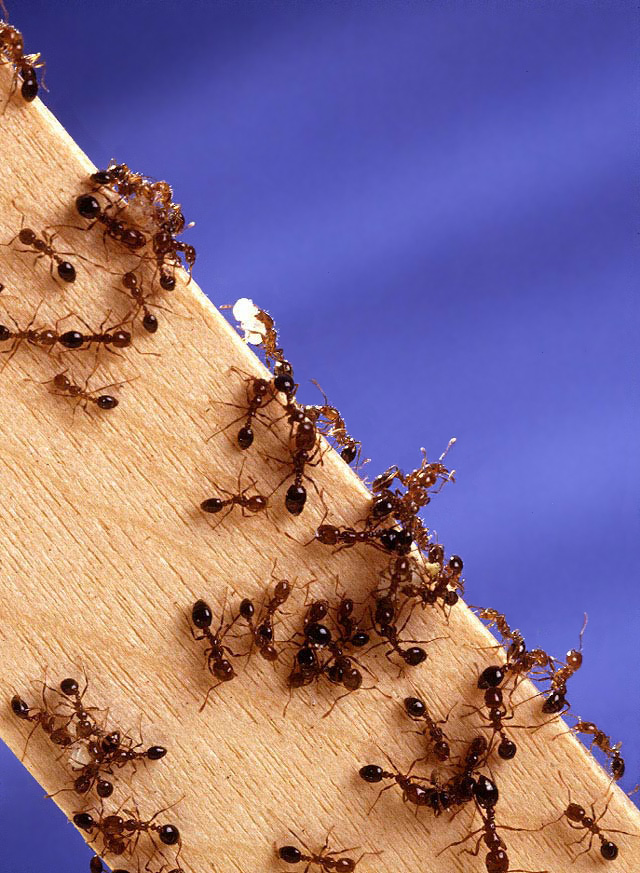
The ant is a social insect belonging to the family Formicidae, found on nearly every continent. It lives in organized colonies ranging from a few dozen to several million individuals depending on the species. Each colony relies on a strict division of labor among the queen or queens, male reproducers, and sterile female workers. Ants communicate primarily through chemical signals called pheromones. More than 12,000 described species exist worldwide, adapted to highly varied environments.
The ant body is divided into three parts: the head, thorax, and abdomen, connected by a characteristic constriction called the petiole. They have two elbowed sensory antennae and powerful mandibles used for digging, carrying, or defending themselves. Size generally ranges from 1 mm to 3 cm depending on the species. Winged castes appear during reproductive swarming periods.
Characteristics
Indicative values: they vary by subspecies, sex and region.
Habitat and distribution
Ants colonize a wide variety of environments, ranging from humid tropical forests to arid desert zones. They nest in soil, beneath stones, within dead wood, or build visible mounds on the surface. Some species have also adapted to urban environments, where they find food and shelter. Their distribution depends largely on climate and the availability of food resources.
CURRENT RANGE
Ants are present on all continents except Antarctica and a few isolated islands. They are particularly diverse in tropical and subtropical regions. In North Africa, including Tunisia, several species adapted to hot and dry climates are commonly observed.
Behaviour
Ants display complex social behavior based on cooperation and chemical communication. They organize foraging trails, construct elaborate nests, and collectively defend their territory. Some species practice fungal agriculture, raise aphids, or even enslave other colonies. Task distribution among workers often changes with age.
Reproduction
Reproduction typically occurs during nuptial flights, when males and young winged queens mate in the air. After fertilization, the queen sheds her wings and founds a new colony by laying eggs. Larvae hatched from the eggs are fed and cared for by worker ants until they complete their metamorphosis. A queen can live for several years and lay eggs continuously to sustain the colony.
Peculiarities
Some ant species can carry loads several times heavier than their own body weight. Others, such as weaver ants, build their nests by assembling leaves using silk produced by their larvae. Legionary ant colonies have no fixed nest and move by forming impressive predatory columns.
Threats and conservation
Most ant species are not threatened and maintain stable, abundant populations. Certain invasive species, such as the fire ant, create ecological problems in regions where they have been introduced. Locally, pesticide use and destruction of natural habitats can affect some specialized populations.
Numbers and trends vary across sources and regions. See the IUCN assessment for the latest reference data.
Gallery
1 documented photographs.
References
Profile updated 09 September 2026 · Reviewed by the TunisieVet editorial team.
Comments (0)
No comments yet.
CONSERVATION STATUS
Least concern (LC)
IUCN source, latest published assessment.
Species health
Documented diseases for this species.
Find a veterinarianThis information is provided for educational purposes only and is not a substitute for a veterinary consultation. If you have any concerns about your animal's health, consult a veterinarian.
To discover around: Ant
Videos, facts, stories and records linked to this species.
Similar animals
Other species documented in Animalpedia.

TunisieVet in your pocket 📱🐾 Access your veterinary services wherever you are. [ Download the app ]
Learn more