
Presentation
The Great white shark is the largest carnivorous fish on the planet, an imposing and fascinating marine predator. With its tapered gray-blue body and characteristic white belly, it embodies power and predatory efficiency. This mythical animal arouses both fear and admiration for its crucial role in marine ecosystems.
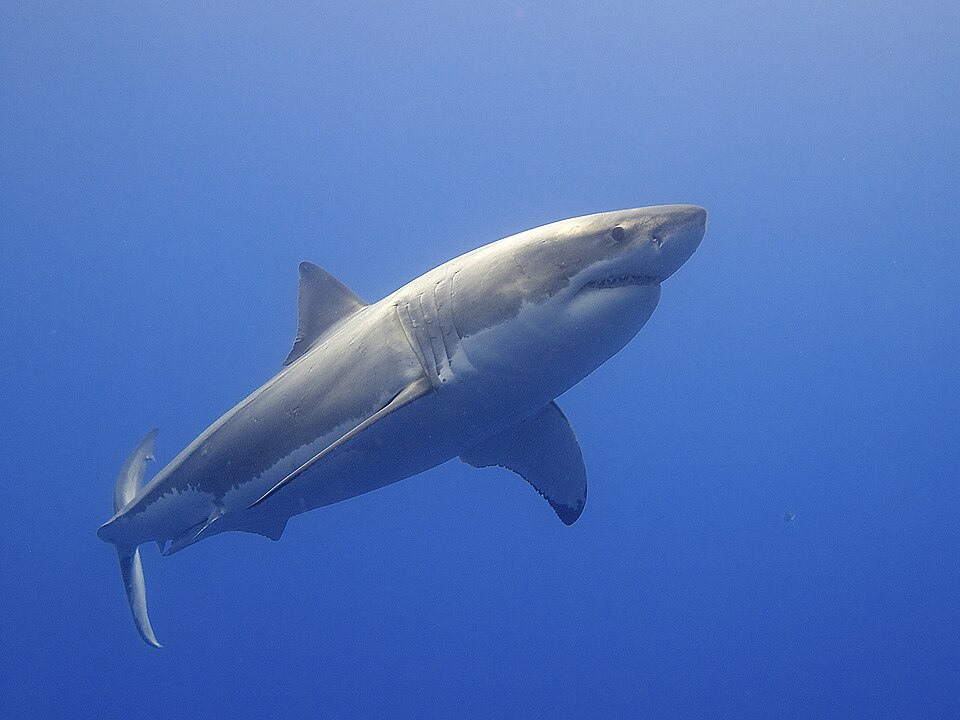
Great white shark has rough gray to blue-gray skin, with a sharply contrasting white belly. Its conical nose, black eyes and powerful jaws filled with sharp triangular teeth make it immediately recognizable. Its triangular dorsal fin is a distinctive signature visible on the water surface.
Did you know?
Can a shark really smell a drop of blood from miles away?
Characteristics
Indicative values: they vary by subspecies, sex and region.
Habitat and distribution
The Great white shark frequents coastal waters and external areas, preferring temperate and tropical waters between 12 and 24°C. It often concentrates near rocky coasts and islands where marine mammals abound. Although migratory, it remains in predictable coastal areas during breeding and feeding seasons.
CURRENT RANGE
Great white shark is distributed globally in temperate and subtropical coastal waters of all oceans. The main populations are concentrated in South Africa, Australia, California and the Mediterranean. Its transoceanic migrations make it appear regularly in different regions, but never in Tunisia due to the temperatures of its waters.
Behaviour
The Great white shark is an active and migratory swimmer, making long transoceanic journeys. Generally solitary, it can also form temporary groups around carrion. It is a strategic hunter that often attacks from the depths, moving quickly towards its prey. It is partially homeothermal, slightly regulating its body temperature for better muscular performance.
Reproduction
The Great white shark reproduces slowly, reaching sexual maturity at around 12 to 16 years of age. It practices ovoviviparity: the eggs hatch in the maternal uterus and the young remain there until their birth. A female gives birth to 2 to 14 young every two years. This slow reproduction makes the species particularly vulnerable to overfishing.
Peculiarities
The Great white shark has an extraordinary sensory system: electroreceptors (Ampulla of Lorenzini) capable of detecting tiny electric fields produced by the muscular contractions of its prey. He also has an exceptional sense of smell that can detect a drop of blood several kilometers away. These abilities make him a virtually unbeatable hunter.
Threats and conservation
The Great white shark is threatened mainly by intensive fishing, accidental or targeted, for its fins and other products. Marine pollution, the destruction of coastal habitats, the reduction of marine mammal populations and climate change also impact its chances of survival. Its slow reproduction does not allow it to recover quickly after decline.
Numbers and trends vary across sources and regions. See the IUCN assessment for the latest reference data.
Gallery
1 documented photographs.
References
UICN — Liste rouge des espèces menacées
Profile updated 29 August 2026 · Reviewed by the TunisieVet editorial team.
Comments (0)
No comments yet.
CONSERVATION STATUS
Vulnerable (VU)
IUCN source, latest published assessment.
Species health
Documented diseases for this species.
This information is provided for educational purposes only and is not a substitute for a veterinary consultation. If you have any concerns about your animal's health, consult a veterinarian.
To discover around: Great white shark
Videos, facts, stories and records linked to this species.
Similar animals
Other species documented in Animalpedia.

TunisieVet in your pocket 📱🐾 Access your veterinary services wherever you are. [ Download the app ]
Learn more