
Presentation
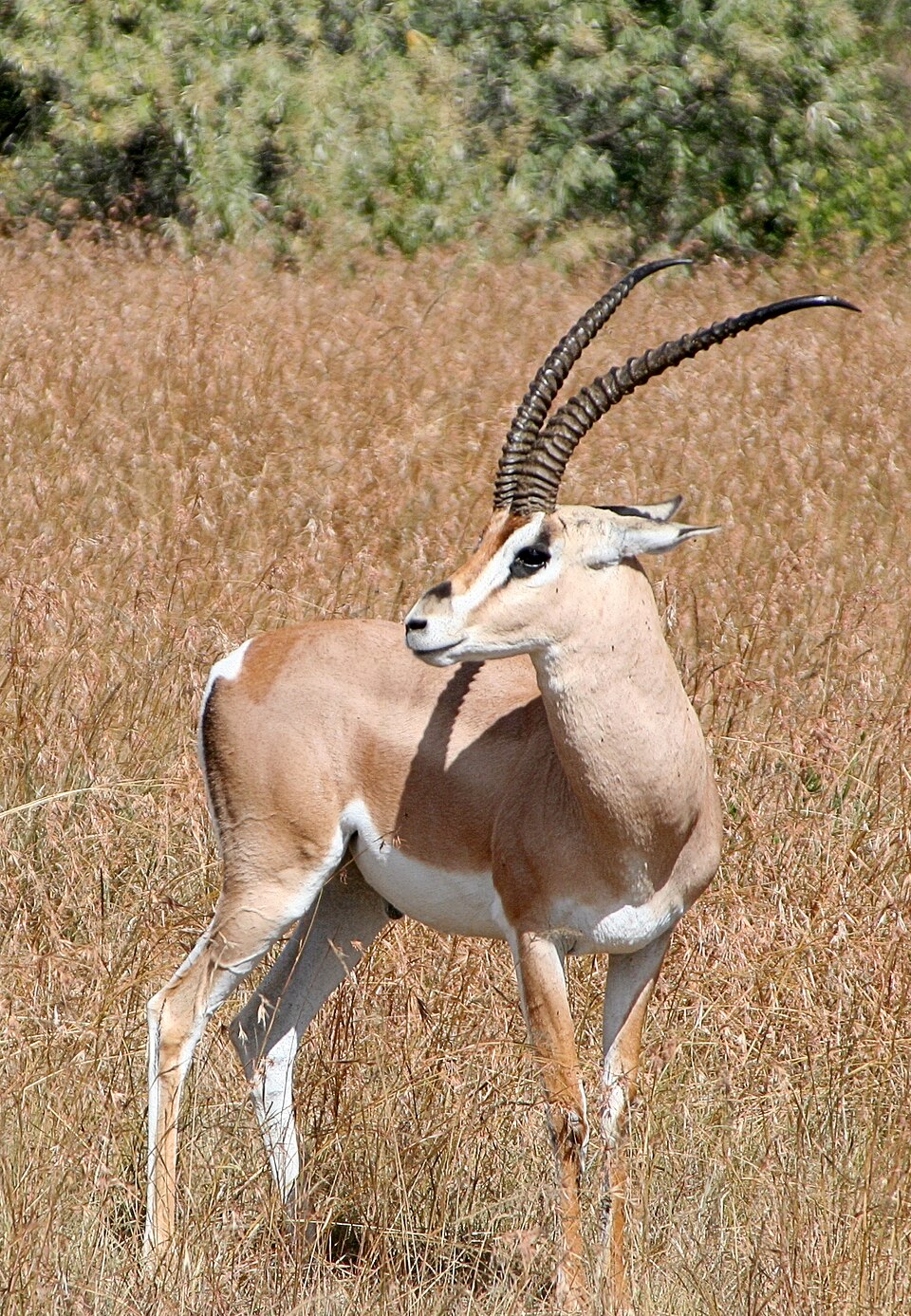
The Grant's gazelle is a medium to large antelope native to the savannahs of East Africa. It is distinguished by its light fawn coat, its white belly and a faint black band on its sides. Its ringed horns, present in both sexes, curve backwards then forwards in the shape of a lyre. It lives in structured groups and travels across vast territories in search of pastures. This species is well adapted to dry environments and can do without open water for long periods.
The Grant's gazelle has a beige to fawn coat, lighter on the belly, with a clearly visible white caudal mirror edged in black. Males have longer and more robust horns than females, which can exceed 70 cm. The body is slender, the legs long and thin, adapted to rapid running on open ground.
Characteristics
Indicative values: they vary by subspecies, sex and region.
Habitat and distribution
This gazelle frequents open savannahs, grassy plains and semi-arid areas of East Africa. It tolerates drier habitats than many other antelopes, including sparse bushy areas. On the other hand, it avoids dense forests and overly rugged terrain.
CURRENT RANGE
The species occurs in Kenya, Tanzania and limited areas of Somalia and Uganda. Its distribution is centered on the great plains of East Africa, particularly around the Serengeti and the Masai Mara. It does not occur naturally outside the African continent.
Behaviour
Grant's gazelle lives in loosely led groups of females and young, while adult males defend individual territories during the breeding season. It is active mainly during the day, with peaks of activity at sunrise and sunset. Fast and agile, it can reach high speeds to escape predators like cheetahs, lions and hyenas. Males use their horns in ritual combat to establish dominance.
Reproduction
The female gives birth to a single young after a gestation of approximately six months. The fawn remains hidden in the vegetation during the first weeks, a behavior which limits the risk of predation. Sexual maturity is reached around one to two years depending on the sex. Births can occur throughout the year, with peaks linked to resource availability.
Peculiarities
The Grant's gazelle is distinguished from similar species by the size of its white caudal mirror, which remains visible even with the tail lowered. It can survive several days without drinking thanks to its metabolic adaptation to aridity.
Threats and conservation
The main threats are habitat loss linked to agricultural expansion and livestock farming, as well as competition with domestic livestock for pasture. Localized hunting and poaching affect certain populations. Prolonged droughts can also temporarily reduce numbers.
Numbers and trends vary across sources and regions. See the IUCN assessment for the latest reference data.
Gallery
1 documented photographs.
References
Profile updated 19 August 2026 · Reviewed by the TunisieVet editorial team.
Comments (0)
No comments yet.
CONSERVATION STATUS
Least concern (LC)
IUCN source, latest published assessment.
Species health
Documented diseases for this species.
See the 8 diseases of this species Find a veterinarianThis information is provided for educational purposes only and is not a substitute for a veterinary consultation. If you have any concerns about your animal's health, consult a veterinarian.
Related species
To discover around: Grant's gazelle
Videos, facts, stories and records linked to this species.
Similar animals
Other species documented in Animalpedia.

TunisieVet in your pocket 📱🐾 Access your veterinary services wherever you are. [ Download the app ]
Learn more